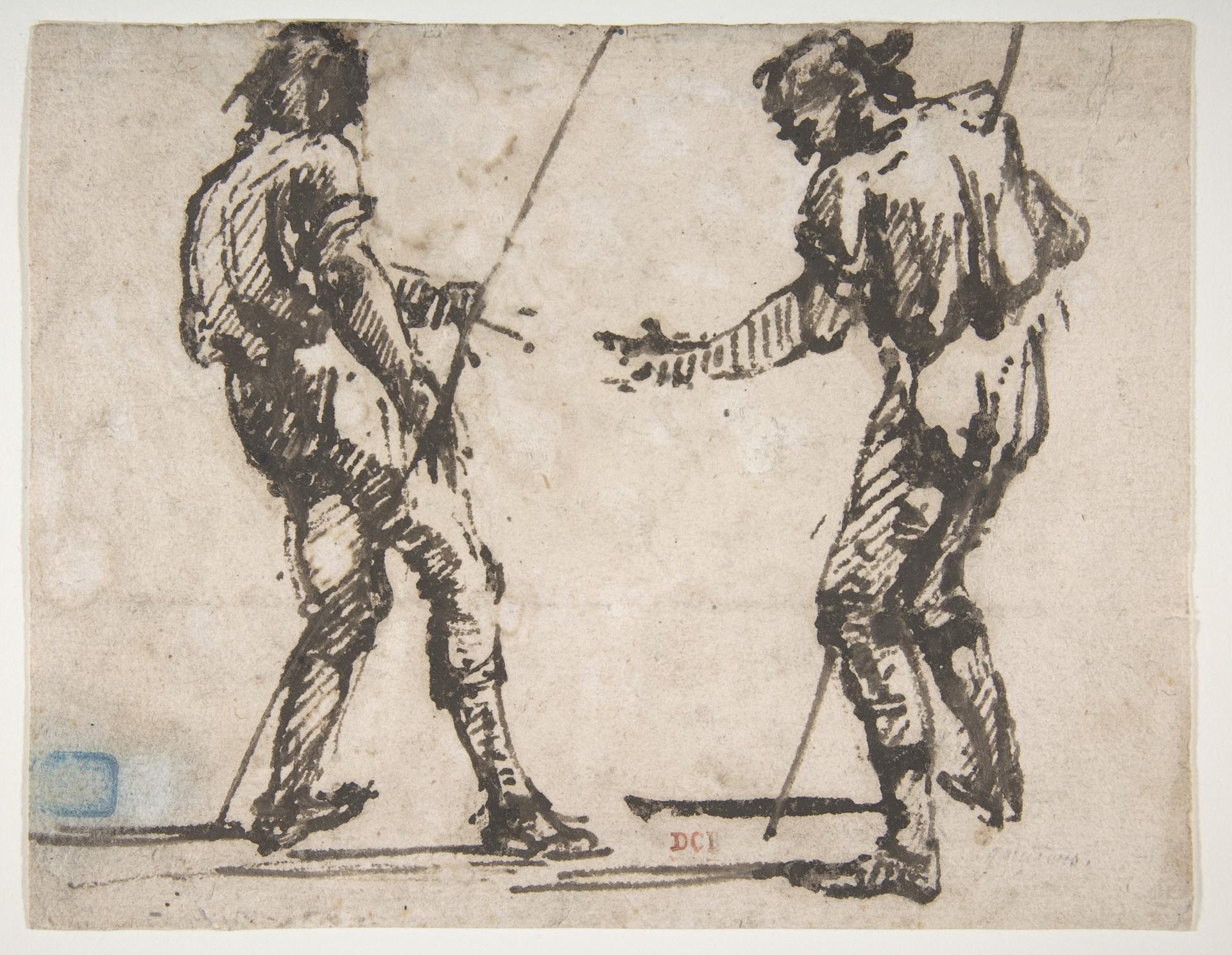
Two Men Holding Long Staffs (recto); Proof impression of part of an etching, and scribbles in the artist's hand (verso)
Original title: Two Men Holding Long Staffs (recto); Proof impression of part of an etching, and scribbles in the artist's hand (verso)
kurzbeschreibung
Two men stride toward each other, each gripping a long staff. Giovanni Battista Piranesi drew them in brown ink with a pen, sometime between 1720 and 1778. The figures are caught in a moment of tension, their stance determined and aggressive. On the verso, a trial proof of part of an etching appears, along with scribbles in the artist's own hand.
Description
Facing each other head-on, the two figures thrust their arms forward and level their long staffs at one another. Thin, confident strokes shape their bodies, bringing out muscle and movement; clothing is suggested with only a few basic lines. The arrangement is symmetrical, and the parallel staffs heighten the tension between the men. The sheet is executed in black ink on cream-colored paper, without shading or any touch of color.
Context
Piranesi's work was shaped by intensive study of ancient buildings and the human figure, and this sheet belongs to that period. The trial proof on the verso suggests the drawing served as a preparatory study for an etching. Quick pen sketches like this were often made by the artist to test movements and pictorial ideas before translating them into print. The work comes from a phase in which he focused more strongly on effective figure compositions.
Impact
The strained postures and the parallel alignment of the staffs create an immediate, almost theatrical drama. Because shading is absent and the lines remain clear, the viewer's attention goes entirely to the movement. The symmetrical layout gives the sheet a formal rigor that further emphasizes the confrontation between the two men.
Technique
Pen and brown ink are applied to paper; the thin, precise strokes reveal a sketchy, direct technique. A trial proof of an etching on the verso indicates that the sheet was used in the printing process. Wash or hatching is entirely absent, and the image relies solely on linear contours.
AI-generated description text
Source: Metropolitan Museum of Art · Public Domain (CC0 1.0)