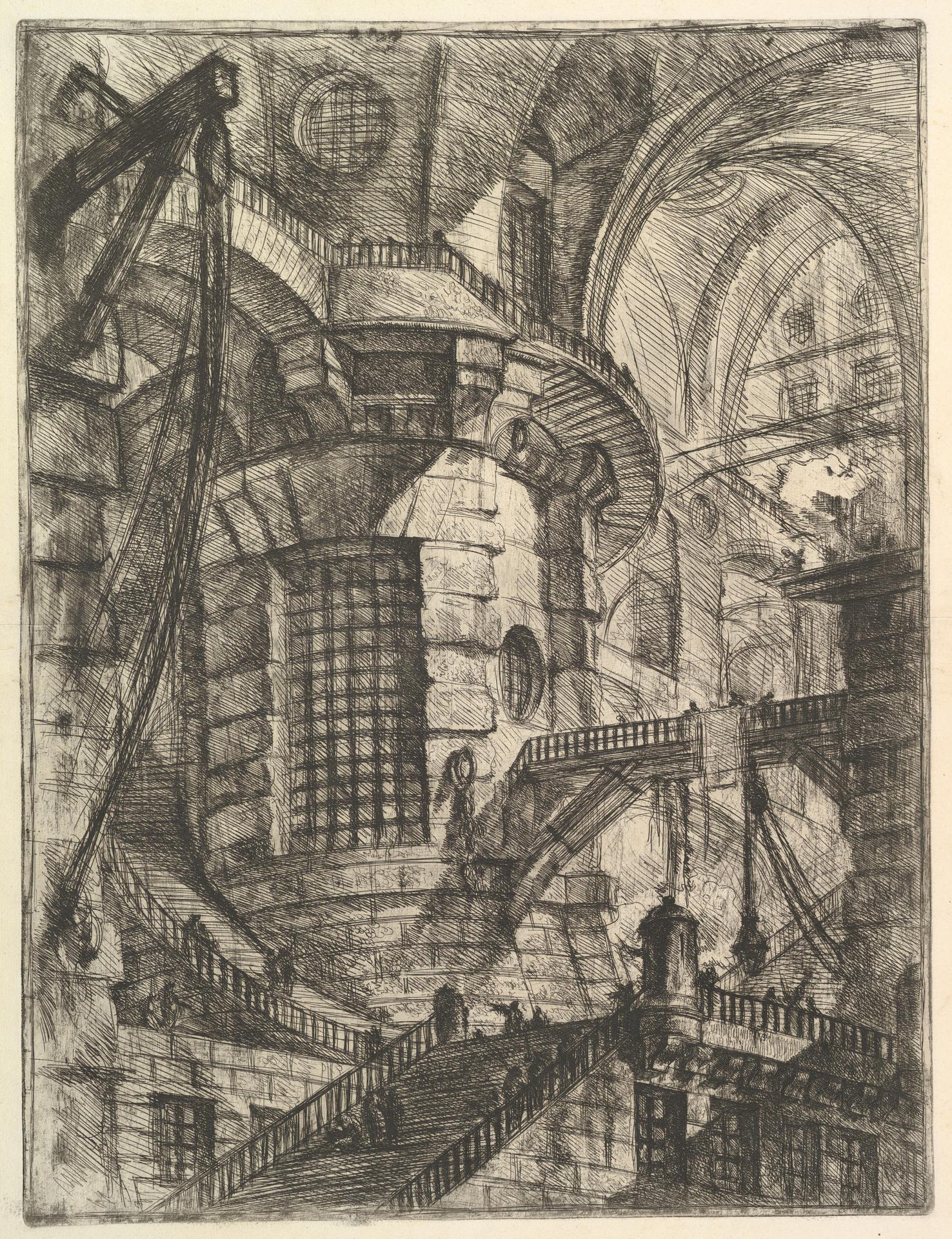
The Round Tower, from "Carceri d'invenzione" (Imaginary Prisons)
Original title: The Round Tower, from "Carceri d'invenzione" (Imaginary Prisons)
kurzbeschreibung
A multi-layered interior with a central round tower, surrounded by galleries, arches and staircases, forms the subject of 'The Round Tower' from Giovanni Battista Piranesi's series 'Carceri d'invenzione' (Imaginary Prisons). This etching with engraving, sulphur tint or open bite, and burnishing, made around 1749–50, is here in the first of four states (per Robison). What appears is an invented, monumental prison architecture.
Description
A central round tower or dome dominates the layout, with several levels and galleries wrapping around it. Columns, arches and balconies rise in stages, and small figures can be made out on some balconies. Light falls through an opening into the high vault, while further architectural elements are hinted at deeper in the image. The symmetrical arrangement stays in monochrome greys; fine hatching and shading create spatial depth.
Context
The 'Carceri' first appeared between 1749 and 1750 as a series of initially 14, later 16 etchings. Piranesi worked in Rome as an architect and printmaker, engaging there with ancient building art. The prints are seen as a reaction to the veduta painting of the time, yet they push architecture into the fantastic and visionary. Later they influenced Romanticism and Surrealism; no direct patron is recorded.
Impact
The gloomy, exaggerated architecture creates an oppressive yet fascinating atmosphere that transports the viewer into an unreal world. Precise linework and monumental perspective trigger a mix of admiration and unease typical of Piranesi's 'Carceri'. The print emerges as an architectural fantasy that suspends real spatial logic.
Technique
Etching and engraving are supplemented by sulphur tint or open bite, followed by burnishing. This produces fine lines and soft shading that render the complex architecture in detail. In the first state, later reworkings are not yet present, so the original linework and tonal values remain.
AI-generated description text
Source: Metropolitan Museum of Art · Public Domain (CC0 1.0)