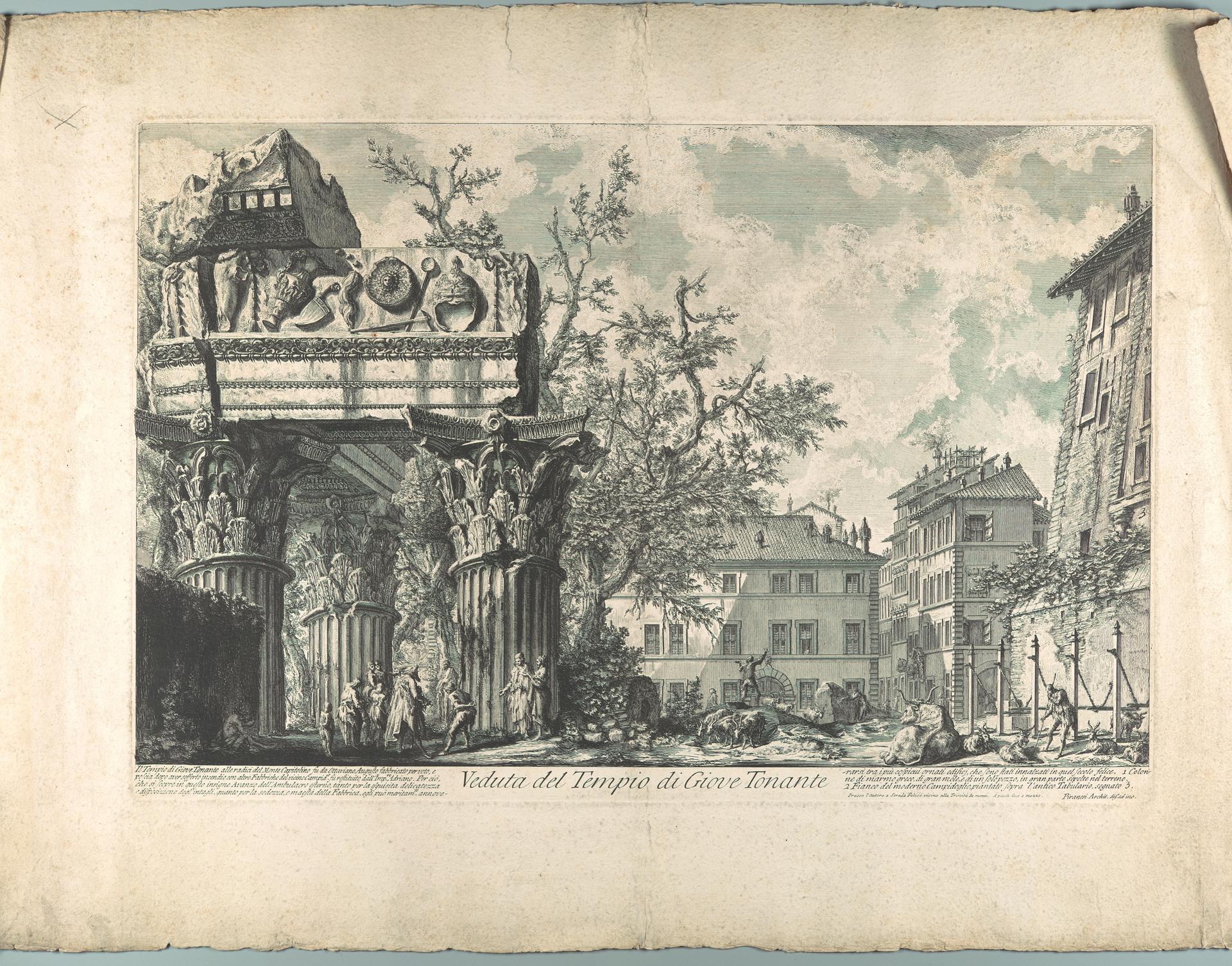
Veduta del Tempio di Giove Tonante
Original title: Veduta del Tempio di Giove Tonante
kurzbeschreibung
Between the 1740s and 1760s Giovanni Battista Piranesi made this veduta of the Tempio di Giove Tonante. The print records the ruin of an ancient Roman temple in a richly detailed etching, its Corinthian columns and a sculpted relief set within a stretch of open landscape.
Description
The temple's remains fill the foreground: Corinthian columns carrying a heavy roof, with a relief of figures worked into the structure, and trees standing close around them. Several buildings and a second temple can be made out beyond. Trees and shrubs frame the view and lend it a natural setting, while small figures linger near the columns. The arrangement is symmetrical, the temple at its centre, and the light falls evenly across the whole.
Context
Piranesi issued this view among his series of Roman antiquities, published across the 1740s to 1760s. He was known for careful archaeological recording, though he often dramatised what he saw to stress the scale of Roman building. The Temple of Jupiter Tonans went up in the first century BC, and Piranesi captured its ruined state as it stood in the eighteenth century. The etching belongs to an age when the Grand Tour and European enthusiasm for Roman antiquity were at their height.
Impact
A calm, elevated mood rises from the etching and underlines the monumentality of the ancient ruin. Symmetry and even light give it a clear, sober beauty of the kind Piranesi favoured. The print invites us to read the ruin as part of an idyllic landscape.
Technique
This is an etching on paper. The drawing is scratched through a wax ground on a copper plate, which is then bitten with acid. That process allows the fine lines and exact detail Piranesi is known for. At 38 x 59.5 cm the sheet follows the usual veduta format and leaves room for a detailed rendering of the architecture.
AI-generated description text
Source: Metropolitan Museum of Art · Public Domain (CC0 1.0)