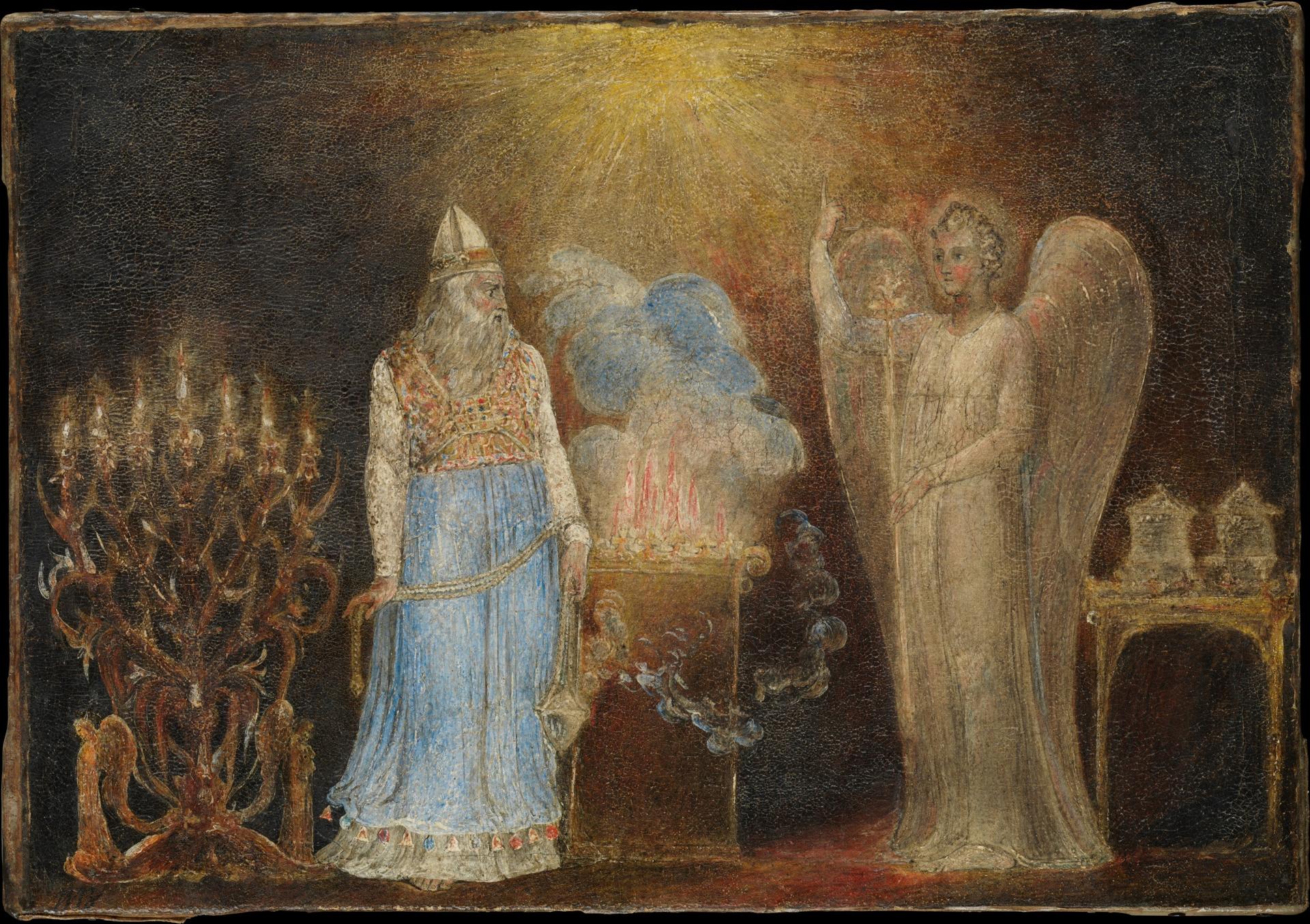
The Angel Appearing to Zacharias
Original title: The Angel Appearing to Zacharias
kurzbeschreibung
William Blake painted Der Engel erscheint Zacharias in 1799–1800, capturing the biblical encounter between the angel Gabriel and the priest Zacharias, who is told of the birth of his son John. The work is executed in pen and black ink, tempera, and glue size on canvas, measuring 26.7 × 38.1 cm.
Description
Zacharias stands in priestly vestments—a white robe, a blue cloak, a headpiece, and a gold chain—while Gabriel faces him, also in white, with wings, a book in his right hand, and his left raised in an explanatory gesture. Between them rises an altar with burning candles, surrounded by a many-branched golden lampstand. Small dark objects in the background recall statues or sculptures. Dim light falls on the figures and the altar, creating a dramatic, mysterious atmosphere.
Context
Between 1799 and 1800, Blake painted numerous biblical scenes for his patron Thomas Butts. As an artist and poet of English Romanticism, Blake combined mystical visions with religious subjects. The scene derives from the Gospel of Luke (Luke 1:8–20), where Zacharias receives the announcement of his son's birth.
Impact
The figures and the altar radiate a solemn, almost otherworldly presence, carried by the dark palette with accents of gold and white. The arrangement draws the eye to the dialogue between the mortal priest and the divine messenger, underscoring the sublimity of the moment. The sparse lighting heightens the sense of mystery and spiritual revelation.
Technique
Blake combined pen and black ink with tempera and glue size on canvas. This allowed both fine drawn details and a matte, colored surface. The small format of 26.7 × 38.1 cm reflects Blake's preference for intimate, detailed portrayals of biblical themes.
AI-generated description text
Source: Metropolitan Museum of Art · Public Domain (CC0 1.0)