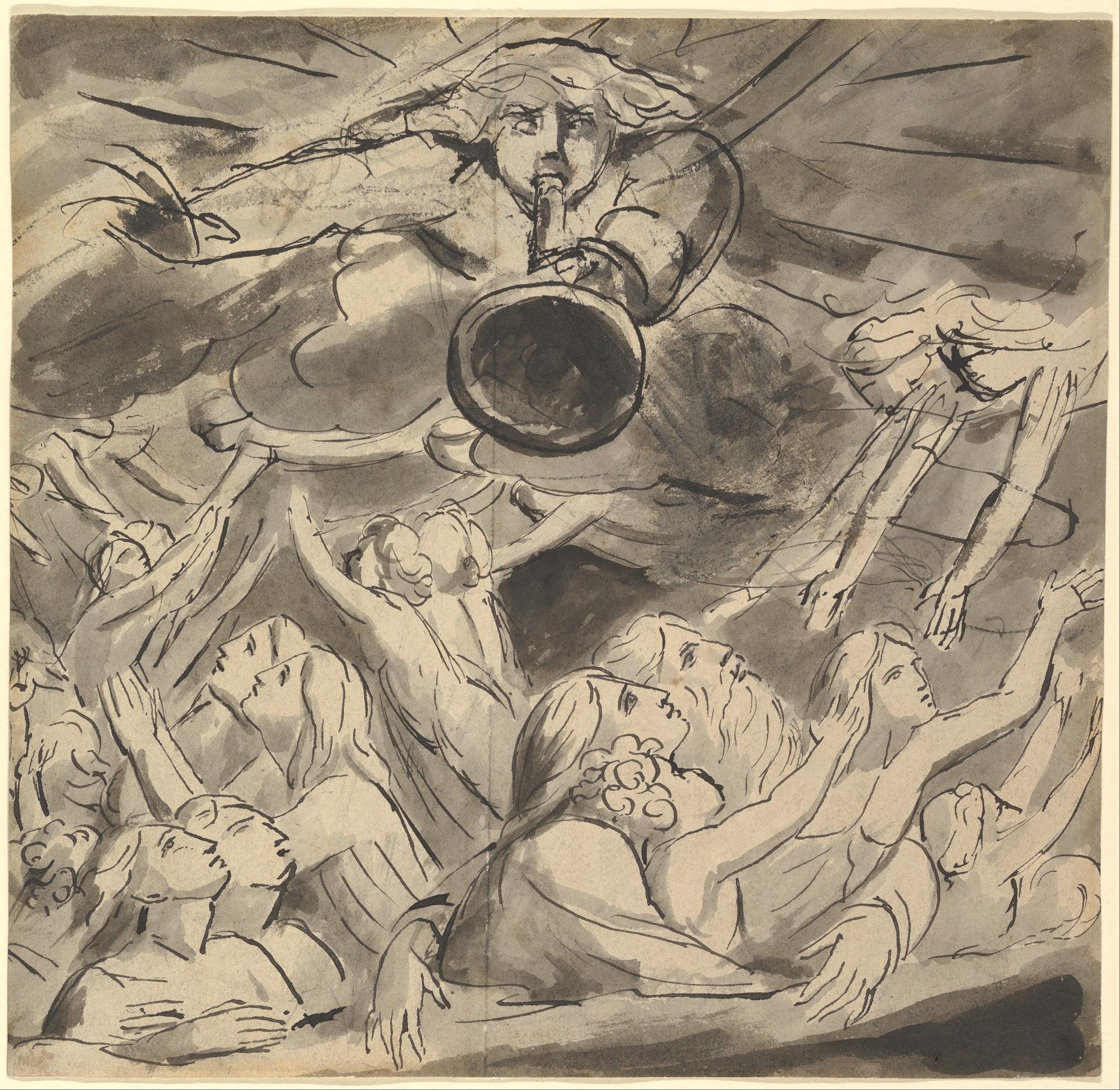
The Last Trumpet (recto); Two studies of a right eye, a profile of an open-mouthed young man, the head of an eagle, and the head of a lion (verso)
Original title: The Last Trumpet (recto); Two studies of a right eye, a profile of an open-mouthed young man, the head of an eagle, and the head of a lion (verso)
kurzbeschreibung
Unlike many apocalyptic scenes of his time, William Blake’s sheet of around 1780–85 does not crowd the picture with figures. Instead, a single trumpet-blowing figure is brought into the light. People of various ages surround it, lying on the ground or kneeling, their heads turned upward. The verso carries studies in black chalk: two right eyes, the profile of a young man with his mouth open, and the heads of an eagle and a lion.
Description
A central figure blows the trumpet; its outline stays bright and draws the eye, while those around it recline in shifting poses—some stretched out, others sitting or standing, faces lifted. The layout pulls toward the middle, and light falling from above heightens the contrast with the dark passages. Brushstrokes vary in pace, and shading is sometimes laid on strongly, sometimes held back.
Context
Around 1780–85 Blake worked mainly as an engraver and began developing his own drawings alongside. The theme of the last trumpet takes up biblical visions of the end, which recur several times in his later work. The studies on the verso probably served as preparatory work for larger designs.
Impact
The mix of harsh chiaroscuro and restless line gives the sheet something visionary. The figures’ gazes and gestures turn upward, creating a tension that mediates between the earthly setting and the heavenly event.
Technique
For the recto Blake used pen and gummy black ink, working with gray ink washes in several layers over a graphite underdrawing, and employed etching techniques. The verso is drawn in black chalk, which allows a loose, sketchy touch.
AI-generated description text
Source: Metropolitan Museum of Art · Public Domain (CC0 1.0)