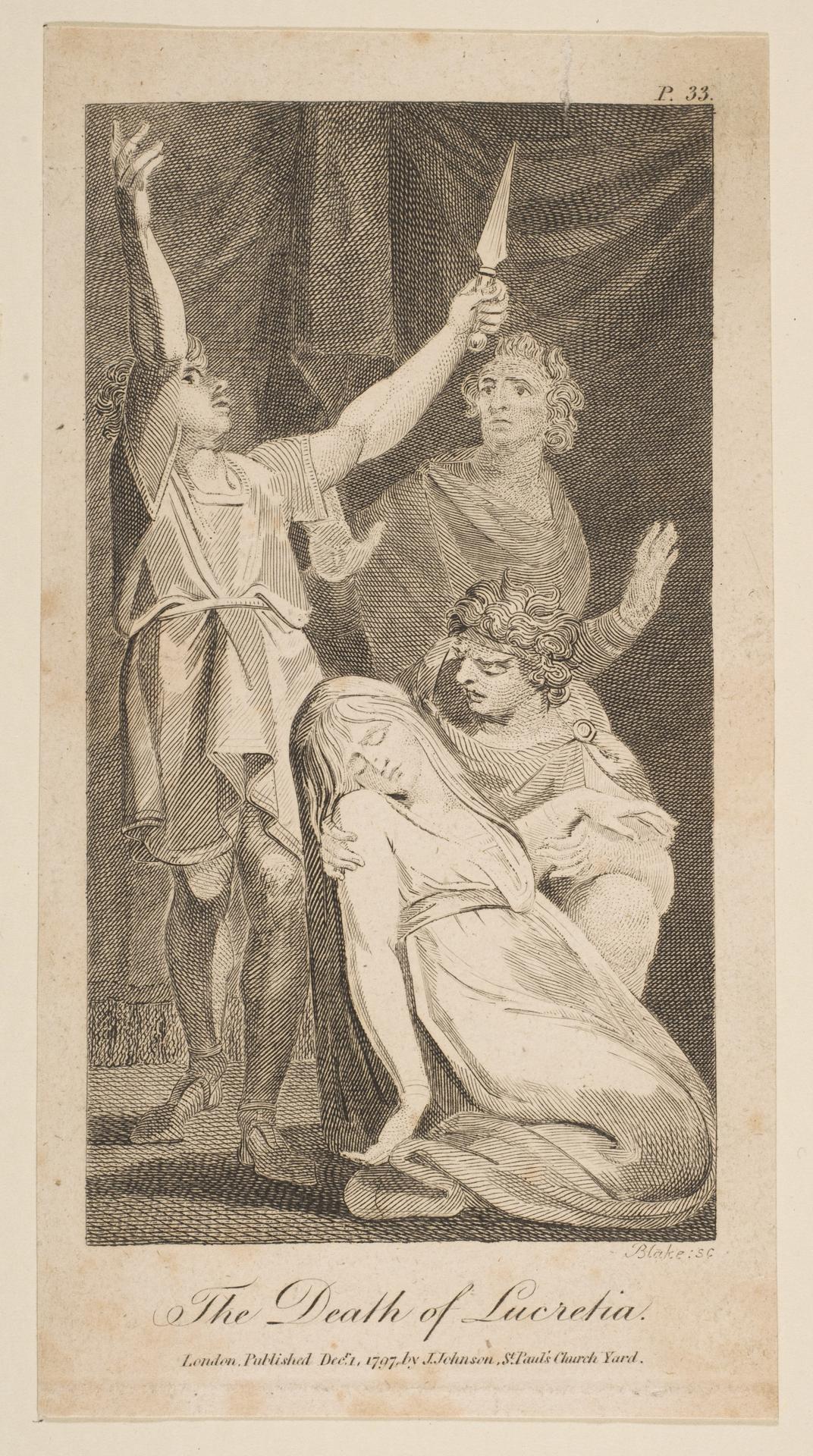
The Death of Lucretia, from Allen's 'New and Impartial Roman History'
Original title: The Death of Lucretia, from Allen's "New and Impartial Roman History"
kurzbeschreibung
Lucretia, the Roman heroine, takes her own life in William Blake's 1797 engraving. The print served as an illustration for Charles Allen's 'New and Impartial Roman History' and depicts the legendary suicide after her rape by Sextus Tarquinius.
Description
In the foreground a woman in a white gown kneels, thrusting a dagger into her breast; pain and despair mark her posture. A man beside her wears Roman dress and holds a sword, as if urging her to the suicide. From the background another Roman looks on. The layout is distinctly asymmetrical, bringing the kneeling woman to the fore. Gray tones model light and shadow in the monochrome rendering.
Context
The engraving was made in London in 1797 as a book illustration for Charles Allen's 'New and Impartial Roman History'. At the time Blake took on many commissions from publishers to earn his living. The story of Lucretia was a moral exemplum in Rome's republican tradition and was widely circulated in eighteenth-century historical and literary works.
Impact
High-contrast lighting and the protagonist's dramatic pose immediately stir the viewer's emotions. Delicate linework and the detailed finish of the figures give the scene an almost theatrical intensity.
Technique
For this engraving, lines were cut into a copper plate and then printed. The monochrome printing technique allows precise shading through varying density and direction of lines. The plate measures 14.9 x 8.3 cm, the sheet 18.1 x 9.7 cm.
AI-generated description text
Source: Metropolitan Museum of Art · Public Domain (CC0 1.0)