Clarence's Dream (Shakespeare, Richard III, Act 1, Scene 4)
Original title: Clarence's Dream (Shakespeare, Richard III, Act 1, Scene 4)
kurzbeschreibung
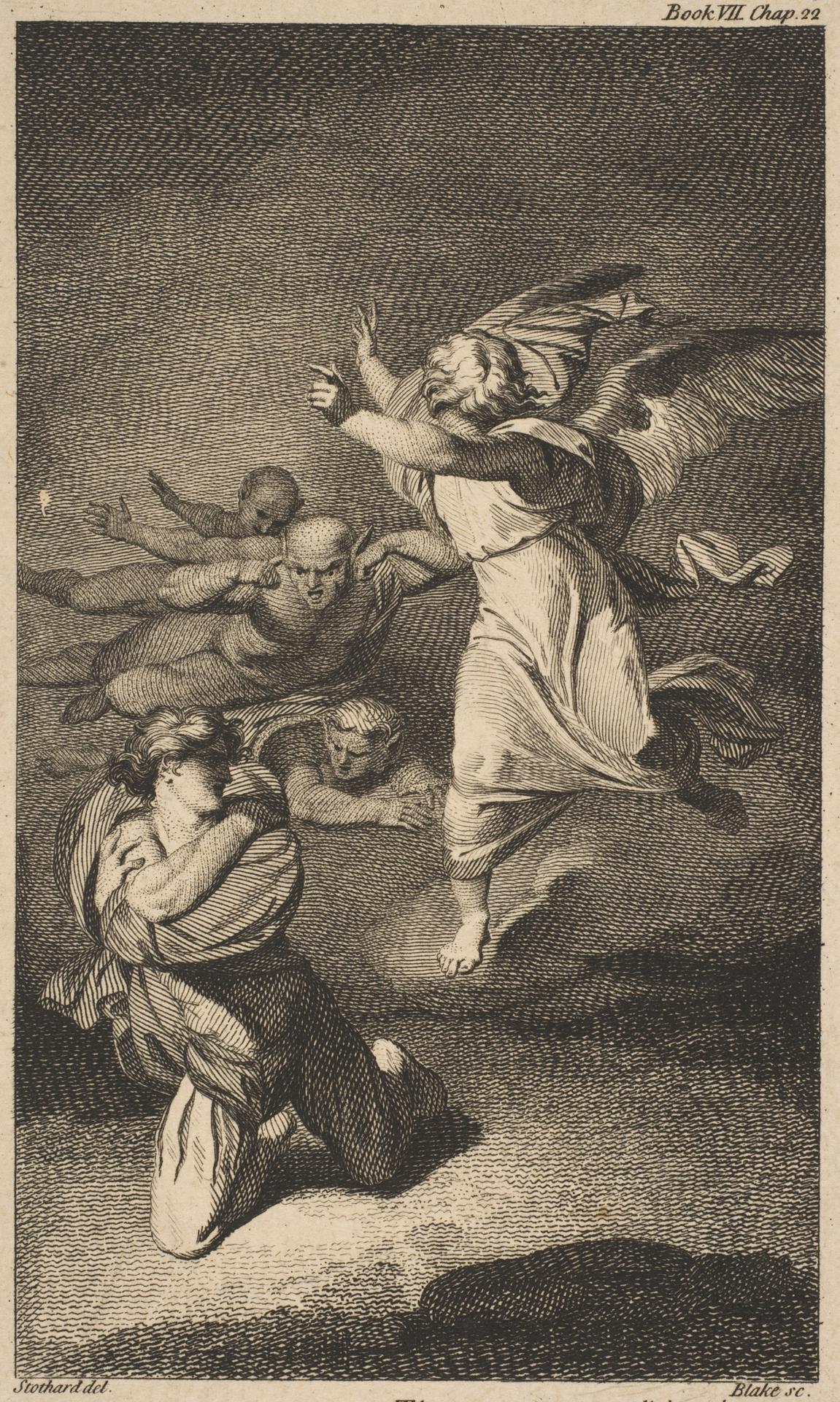
William Blake made this etching and engraving in 1774 as an illustration to a scene from Shakespeare's Richard III (Act 1, Scene 4). It shows the sleeping Clarence visited by a vision, surrounded by other figures caught up in restless movement.
Description
A man with raised arms and a grave, strained face dominates the middle of the picture, his posture dynamic and heavy with gesture. Behind and beside him appear several figures, some hovering, some on the ground, all dressed in the clothing of the period. The arrangement stretches distinctly upward and gives rise to a feeling of unrest and urgency. Light falling from above picks out the contours and shading of the figures.
Context
Blake's sheet of 1774 belongs among his illustrations of literary subjects, and Shakespeare held an important place in his work. The source, Richard III, is set in sixteenth-century England. What is pictured is Clarence's dream, which in the play foretells his approaching death. In such works Blake often joined biblical and literary motifs with symbolic elements.
Impact
The agitated poses and the tall, upright format place the viewer in a tense, almost threatening atmosphere. This black-and-white etching, with its dense lines and hatching, feels dramatic and at the same time melancholy. The eye is drawn to the central figure and then follows the rising figures back into the depth of the space.
Technique
The sheet was executed as an etching and engraving: lines are bitten into a metal plate and then printed. Varying densities and directions of stroke produce the shading that gives the image depth and texture. The plate measures 12.4 x 7.3 cm, the sheet 16.4 x 9.2 cm.
AI-generated description text
Source: Metropolitan Museum of Art · Public Domain (CC0 1.0)