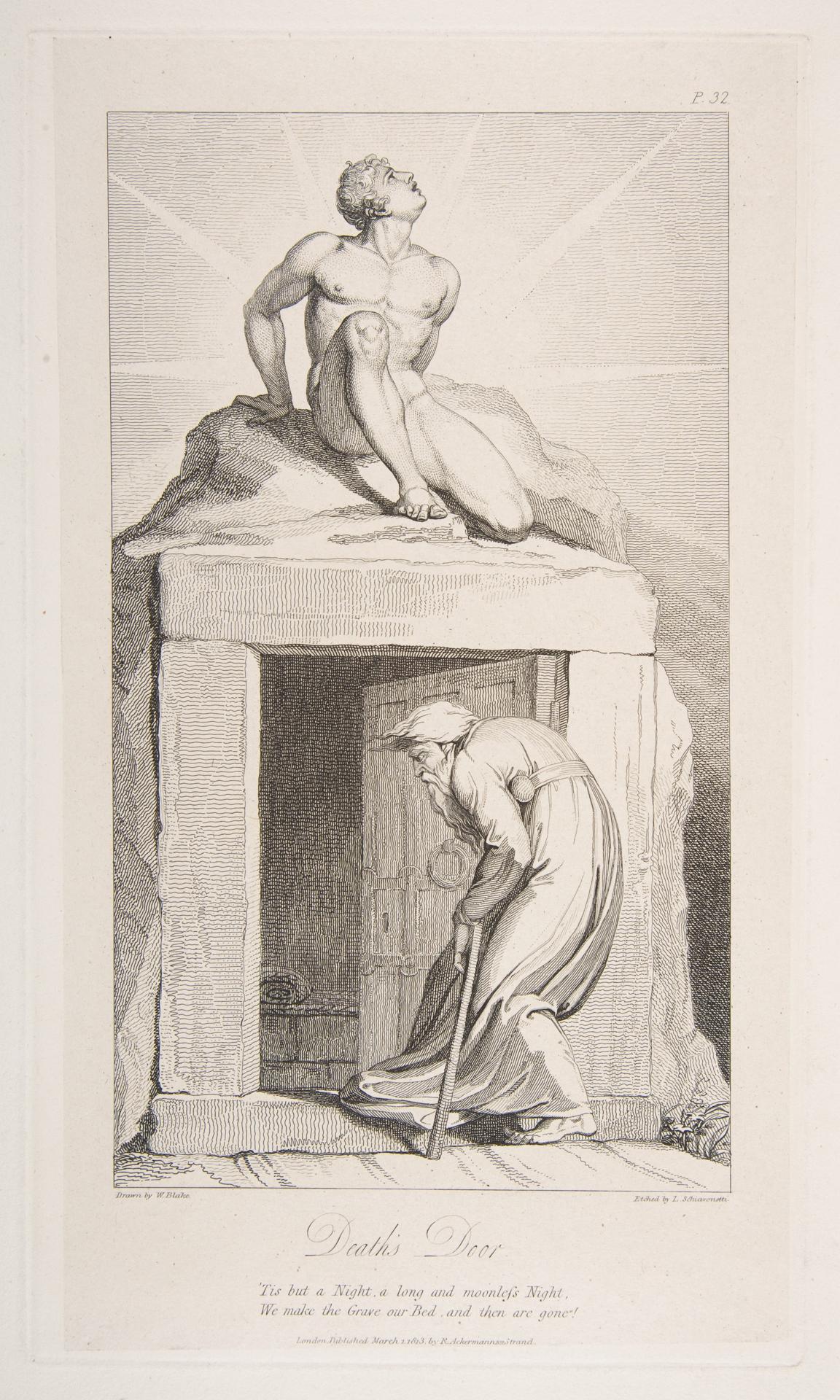
Death's Door, from "The Grave," a Poem by Robert Blair (March 1, 1813)
Original title: Death's Door, from "The Grave," a Poem by Robert Blair
kurzbeschreibung
William Blake made the engraving Death's Door in 1813 as an illustration for Robert Blair's poem The Grave. A naked man sits on a rock, his gaze lifted upward, while below a kneeling woman in a long robe looks up at him.
Description
At the top a powerful, unclothed man sits on a rock and looks up as if searching the sky; his posture seems both thoughtful and tense. Below, a grey-haired woman in a floor-length dress kneels, holding a stick, and gazes up at him as though watching or praying. A door leading into a dark room appears in the background. Light falls from above, picking out the figures and the rock's texture. The style is neoclassical, with sharp outlines and finely detailed lines.
Context
This print belongs to a series of illustrations Blake made for Robert Blair's poem The Grave, commissioned by the publisher Robert Cromek. The date 1 March 1813 refers to the publication of that edition. Blake was known for his idiosyncratic interpretations of literary sources and often worked spiritual and existential themes into his images. The door as a passage between life and death recurs in Blair's poem and in Blake's art as a symbol.
Impact
A calm but insistent mood arises, prompting the viewer to reflect on death and transcendence. The male and female figures face each other, and with the dark doorway, a tension grows between this world and the beyond that invites pause.
Technique
For engraving, the design is cut into a copper plate and then printed on paper. Fine, detailed lines and a monochrome finish are characteristic of this method; the shading comes from lines placed at different densities.
AI-generated description text
Source: Metropolitan Museum of Art · Public Domain (CC0 1.0)