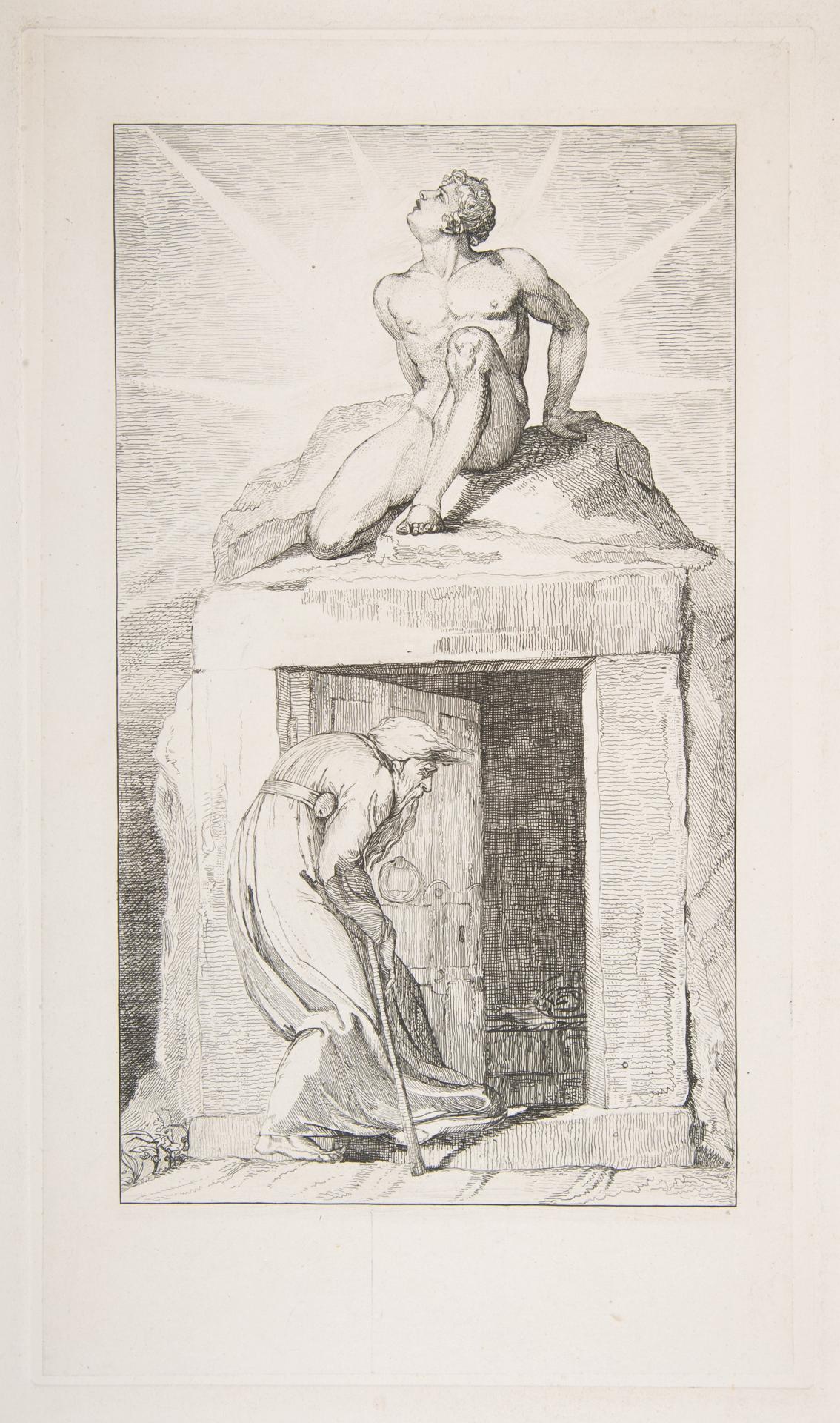
Death's Door, from "The Grave," a Poem by Robert Blair (19th century)
Original title: Death's Door, from "The Grave," a Poem by Robert Blair
kurzbeschreibung
William Blake's 19th-century etching Death's Door takes its cue from Robert Blair's poem The Grave. A clothed man bows before a door, holding out a tool as if to pass it through, while behind him a naked, muscular figure sits on a rock.
Description
In the foreground a man in a robe and hat leans toward a door, a tool in his hand as though offering it inside. To the left, a strong nude figure sits on a rock, face turned upward, bathed in bright light. The layout has a steady balance: the man occupies the middle, the seated figure off to the side. Light falls from above, picking out the muscular body. Crisp outlines and shading give the image its neoclassical cast.
Context
Blake made this print as an illustration to Robert Blair's poem The Grave (1743), a key work of graveyard and night-thought literature. He produced several plates for the text, though they were published only after his death. The subject belongs to a series in which Blake wrestles with death and resurrection—a recurring concern throughout his work.
Impact
A solemn, elevated mood rises from the sheet, carried by the balanced arrangement and the sharp contrast of light and dark. The muscular figure feels monumental, lending the scene a timeless, symbolic weight.
Technique
For this etching, acid bit the plate to produce fine lines and shadows. The black-and-white printing sharpens the graphic contours and the play of light and dark that marks Blake's prints.
AI-generated description text
Source: Metropolitan Museum of Art · Public Domain (CC0 1.0)