Bust of Pseudo-Seneca
Original title: Bust of Pseudo-Seneca
kurzbeschreibung
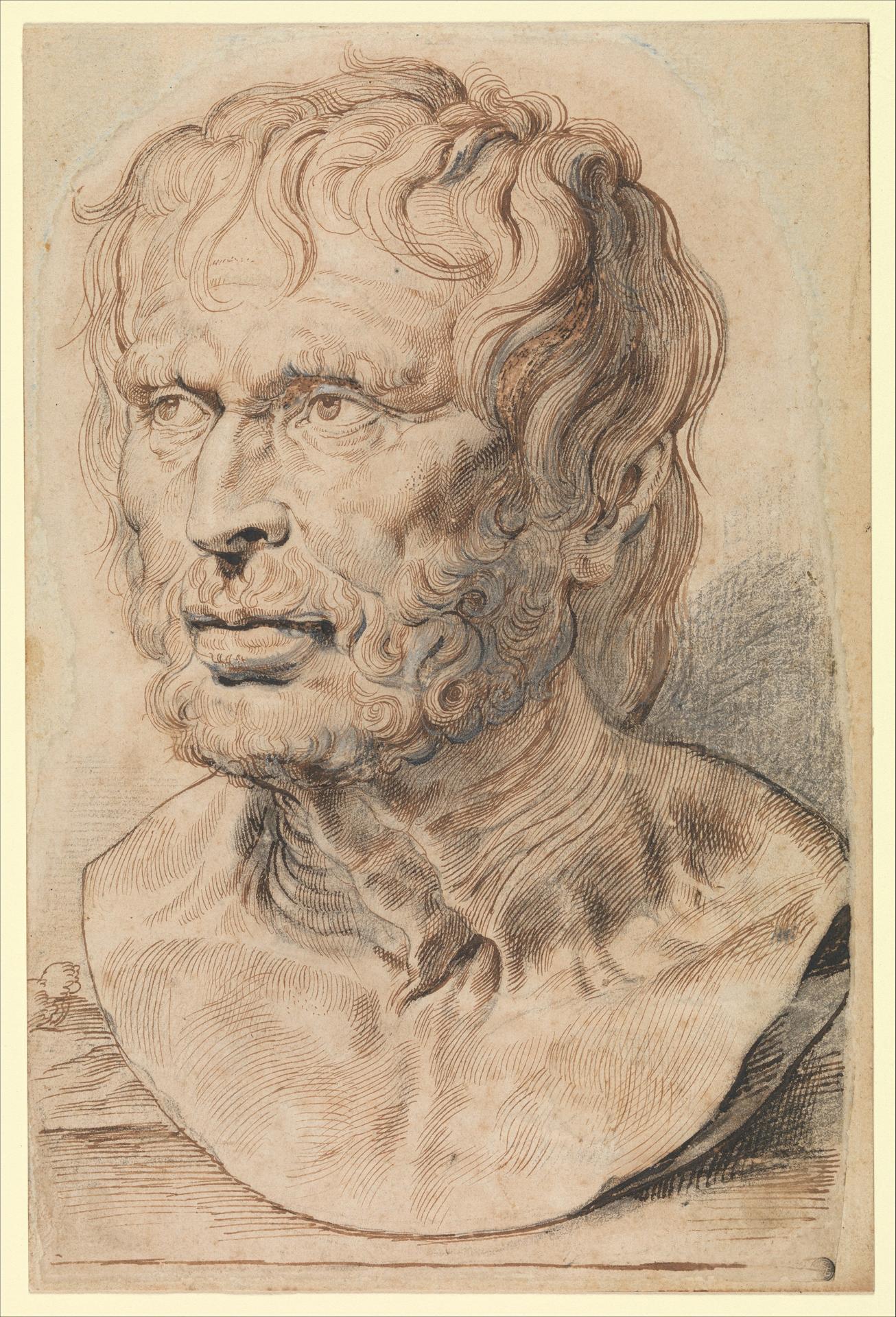
Unlike many of his contemporaries' sculptural studies, Peter Paul Rubens's drawing "Bust of Pseudo-Seneca" (1600–1626) relies on a mix of pen and brown ink over black chalk, supplemented with white heightening and gray ink. The sheet depicts a male head with curly hair and a thick beard, known under the name Pseudo-Seneca.
Description
A man's head with curly hair and a full, wavy beard and mustache fills the sheet. The facial features are precisely captured: prominent eyebrows, a slightly open mouth that creates a calm, thoughtful mood. The background remains empty, so that the head and shoulders receive all the attention. Brown and gray tones dominate the drawing, with white accents setting targeted highlights. Signs of age are visible.
Context
Rubens made this study during his stay in Italy, where he engaged with ancient sculptures. The bust of Pseudo-Seneca was then thought to be a portrait of the Roman philosopher Seneca; only later was it recognized as a fictional representation. Such drawings served Rubens as templates for paintings and as exercises in rendering expression and surface texture.
Impact
The precise linework and nuanced hatching make the sheet lively and rich in detail. The sitter's calm expression gives it a thoughtful, almost intimate atmosphere.
Technique
Rubens combined pen and brown ink with black chalk, adding white heightening and brush in gray ink. This allowed for fine gradations of light and shadow and the rendering of hair and skin textures.
AI-generated description text
Source: Metropolitan Museum of Art · Public Domain (CC0 1.0)