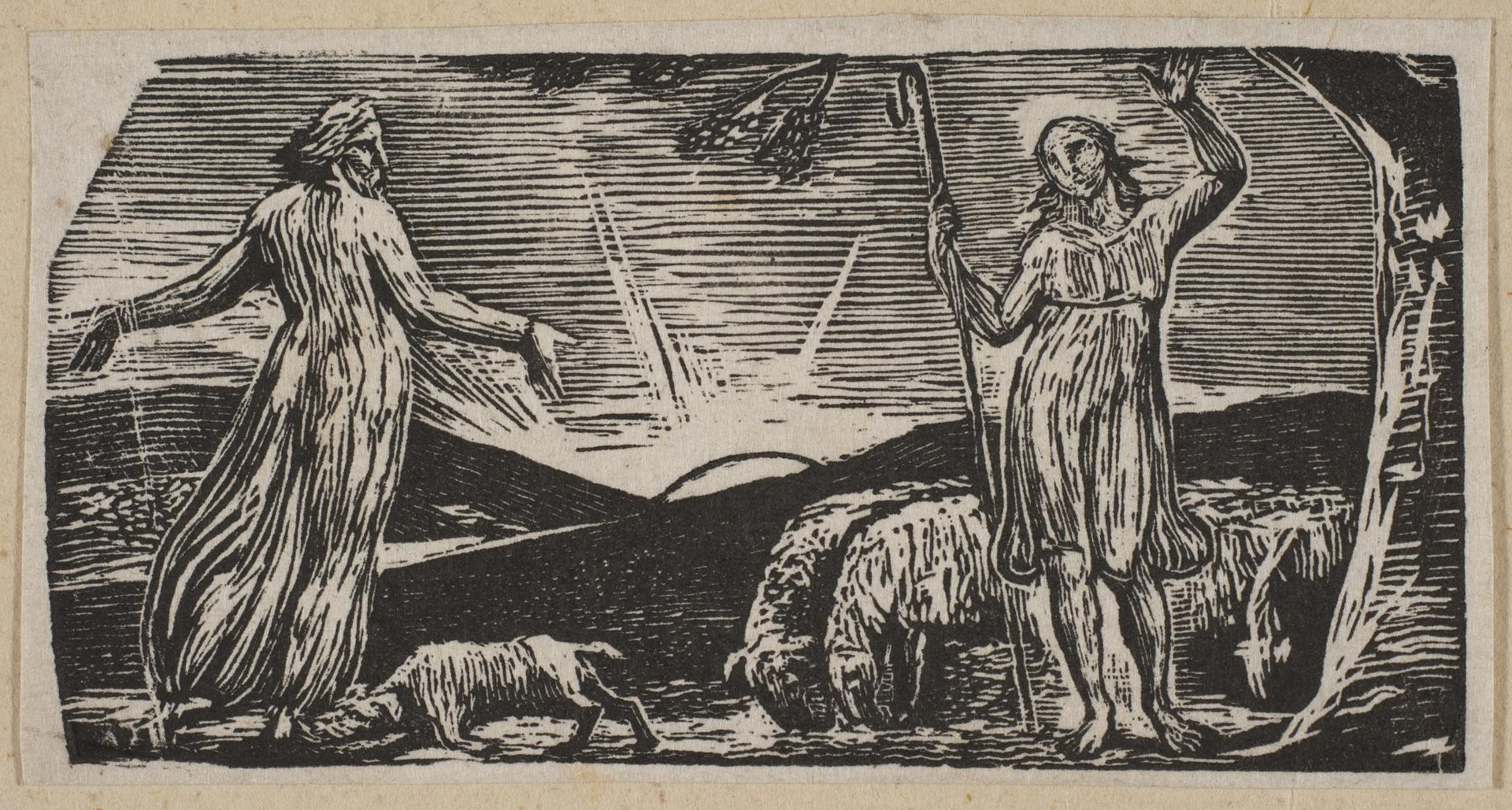
Thenot Remonstrates With Colinet, from Thornton's "Pastorals of Virgil" (1821, Met-Objekt 3882)
Original title: Thenot Remonstrates With Colinet, from Thornton's "Pastorals of Virgil"
kurzbeschreibung
Made in 1821, William Blake's wood engraving takes a scene from Virgil's Eclogues: the shepherd Thenot reproves young Colinet. The print belongs to a set of wood engravings produced for Thornton's edition of the "Pastorals of Virgil." Sheep and a rural setting frame the two figures.
Description
Two figures step forward: one, wrapped in a long garment, bends toward the left, while the other stands upright holding a spade. The standing figure has raised a hand, as if to explain or stress a point. Around them lies a clearing with sheep; behind it, scattered marks suggest sky and landscape. Black and white govern the image, and its linear texture betrays the wood engraving.
Context
The illustrations were made for Robert John Thornton's "Pastorals of Virgil," published in 1821 as a school edition with translations and notes. Thornton commissioned the wood engravings from Blake even though he initially regarded his work with scepticism; they were printed nonetheless. Blake's approach to the pastoral scenes follows not the classical tradition but his own visionary hand.
Impact
The eye is drawn at once by the hard black-and-white contrasts, which give this small print directness and force. The spare forms and lively linework lend the encounter something timeless and archetypal, reaching well beyond a mere book illustration.
Technique
A wood engraving in its second state was printed in black on paper. The raised lines and areas of the block produce the characteristic linear texture, which here comes out especially delicate and careful. With a block measuring only 4.9 by 7.6 centimetres, the method demands a high degree of manual precision.
AI-generated description text
Source: Metropolitan Museum of Art · Public Domain (CC0 1.0)