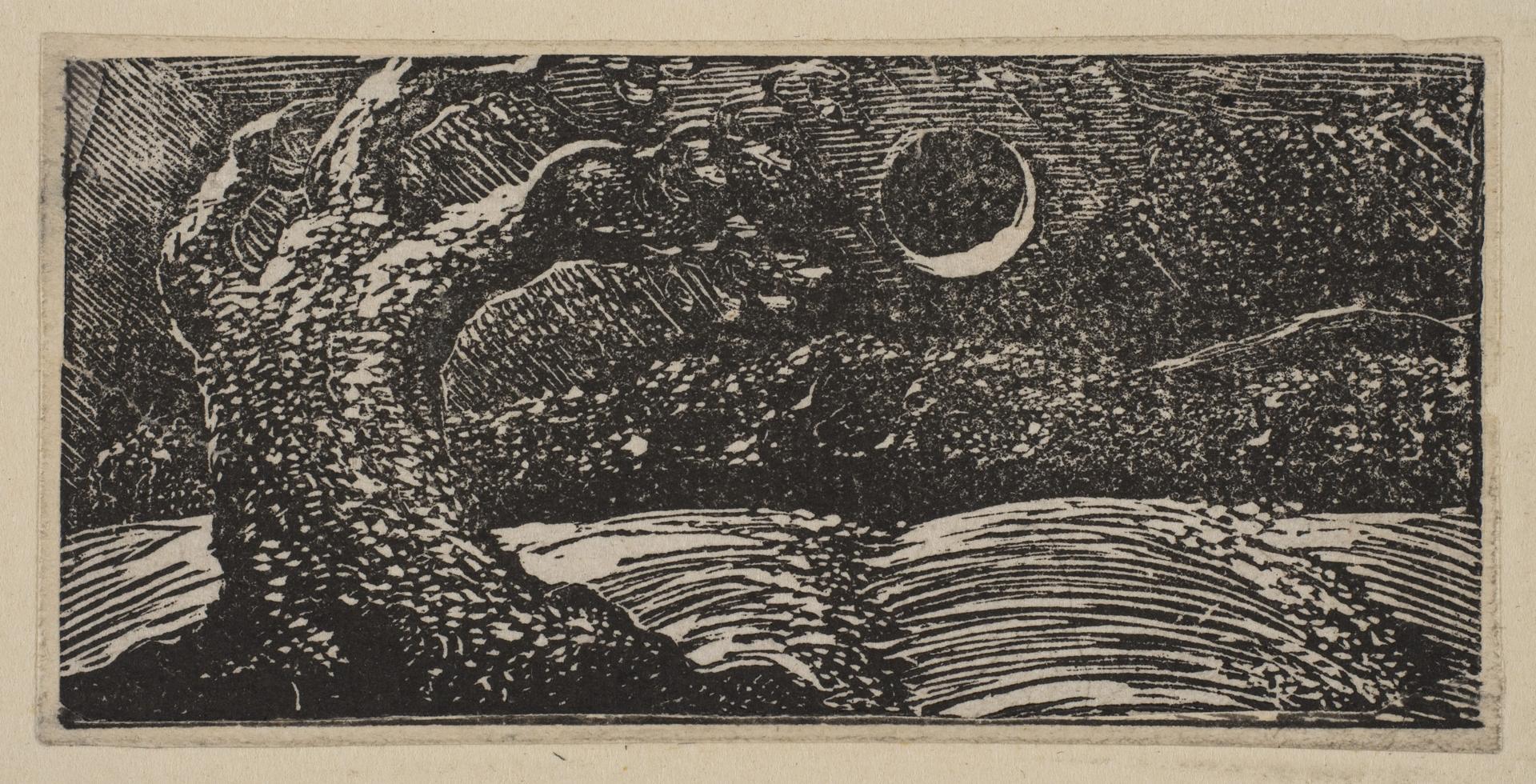
Blasted Trees and Flattened Crops, from Thornton's "Pastorals of Virgil"
Original title: Blasted Trees and Flattened Crops, from Thornton's "Pastorals of Virgil"
kurzbeschreibung
Created in 1821, William Blake's wood engraving 'Blasted Trees and Flattened Crops' was made for Virgil's 'Pastorals'. It shows a night landscape in ruins: in front, gnarled and twisted tree trunks; behind, flattened, wave-like fields under a moon in an almost black sky. This impression is the second state.
Description
The layout is broad, and the eye is first drawn to a dense group of knotted trees with rounded, irregular growth. Their branches look stunted, like deformities or signs of decay. Beyond them lie flat, wave-shaped fields that suggest ruins or devastated land. A moon casts the sky in a very dark tone. The grey tones of the monochrome print add to a gloomy, oppressive mood.
Context
Blake cut the woodblock in 1821 as an illustration for Robert John Thornton's edition of Virgil's 'Pastorals'. The vignette was intended for a collection of pastoral songs published in an elaborately illustrated edition. For this publication Blake produced a whole series of wood engravings; this sheet is one of them and interprets the classical source in a very personal way.
Impact
The night view feels eerie and melancholy. The twisted trees and the devastated land evoke decay and transience and invite reflection. The parallel lines of the wood engraving give the image something delicate, almost graphic.
Technique
In wood engraving, the design is cut into the woodblock and then printed. The densely spaced parallel lines create the textures and shadows that are crucial to the monochrome effect. The fact that this is the second state suggests wear or reworking of the block.
AI-generated description text
Source: Metropolitan Museum of Art · Public Domain (CC0 1.0)