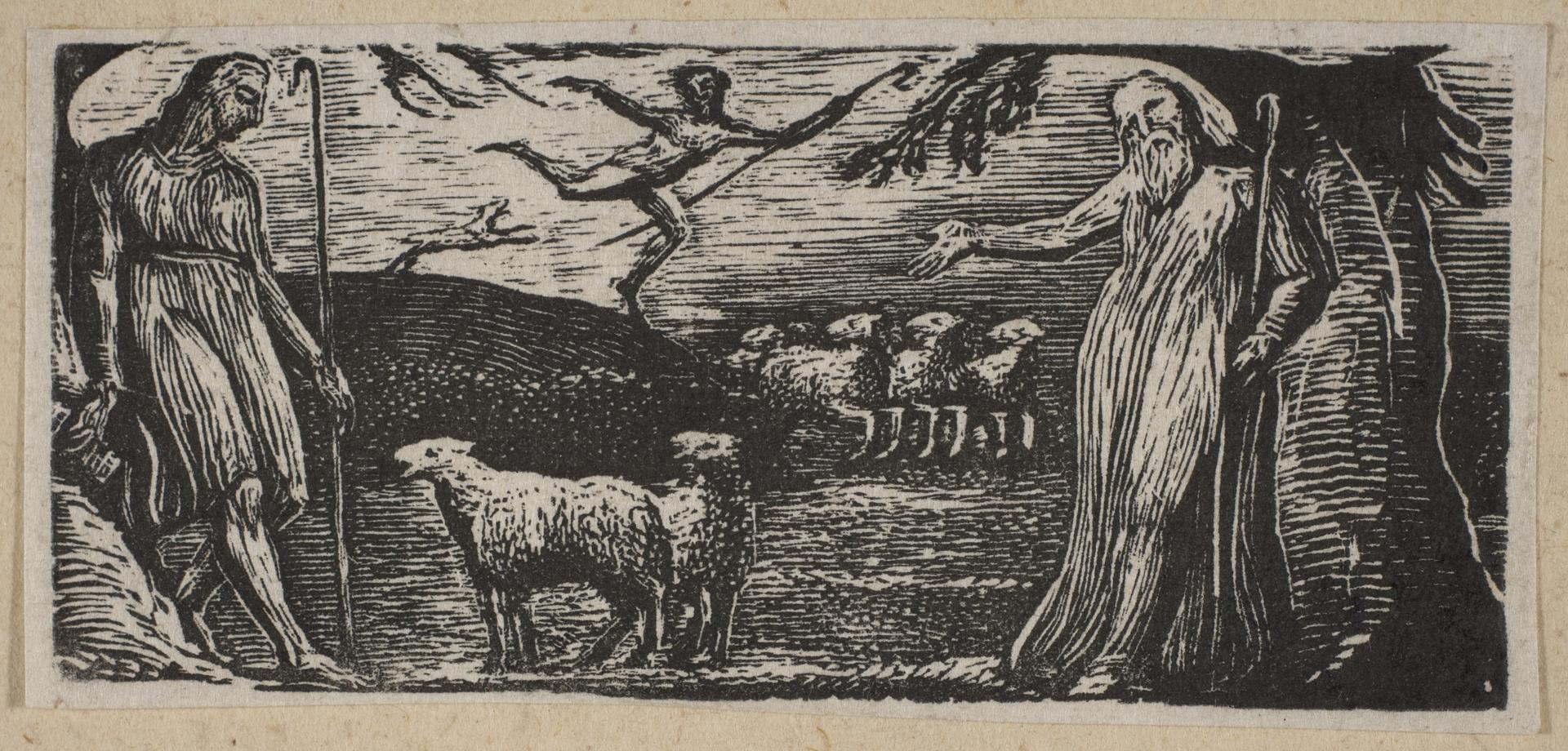
Thenot Remonstrates with Colinet, Lightfoot in the Background, from Thornton's "Pastorals of Virgil"
Original title: Thenot Remonstrates with Colinet, Lightfoot in the Background, from Thornton's "Pastorals of Virgil"
kurzbeschreibung
Two shepherds, Thenot and Colinet, stand in conversation in the foreground of this 1821 wood engraving by William Blake. It was made for an edition of Virgil's Eclogues published by William Henry Pyne Thornton. A further figure, called Lightfoot, appears behind them. The print belongs to a series of illustrations Blake produced for Thornton's Pastorals of Virgil.
Description
At the front, two figures: one holds a staff as a shepherd, the other has a long beard and a hood, looking like an older or clerical figure. Both stand on a rise, surrounded by a group of sheep. Behind them, a person floats in the air while another rides a horse. The layout is broad, the figures absorbed in dialogue. Black and white predominate, as is usual for wood engravings, with even light and no colour contrasts.
Context
For the 1821 edition of the Pastorals of Virgil, edited by William Henry Pyne Thornton, William Blake made this illustration. The series comprises 17 wood engravings that served as images for the Eclogues of the Roman poet Virgil. Blake was 63 at the time and received the commission through the publisher, who valued his work. The prints were produced in a small edition and are rare today; this impression is a second state of the wood engraving.
Impact
The restrained black-and-white rendering and delicate linework create a quiet, rural mood. The interaction of the figures and the floating figure behind give the scene a fine, almost mystical ring. Despite its small size, the arrangement feels balanced and rich in detail, inviting the viewer to look closely.
Technique
In this wood engraving, the design is cut into a woodblock and then printed. The present impression is a second state, meaning the block was revised or re-engraved after the first printing. The dimensions of only 3.7 x 7.3 cm show how Blake could place precise, expressive lines in the smallest space. The process allows fine details and a clear black-and-white contrast, typical of 19th-century book illustration.
AI-generated description text
Source: Metropolitan Museum of Art · Public Domain (CC0 1.0)