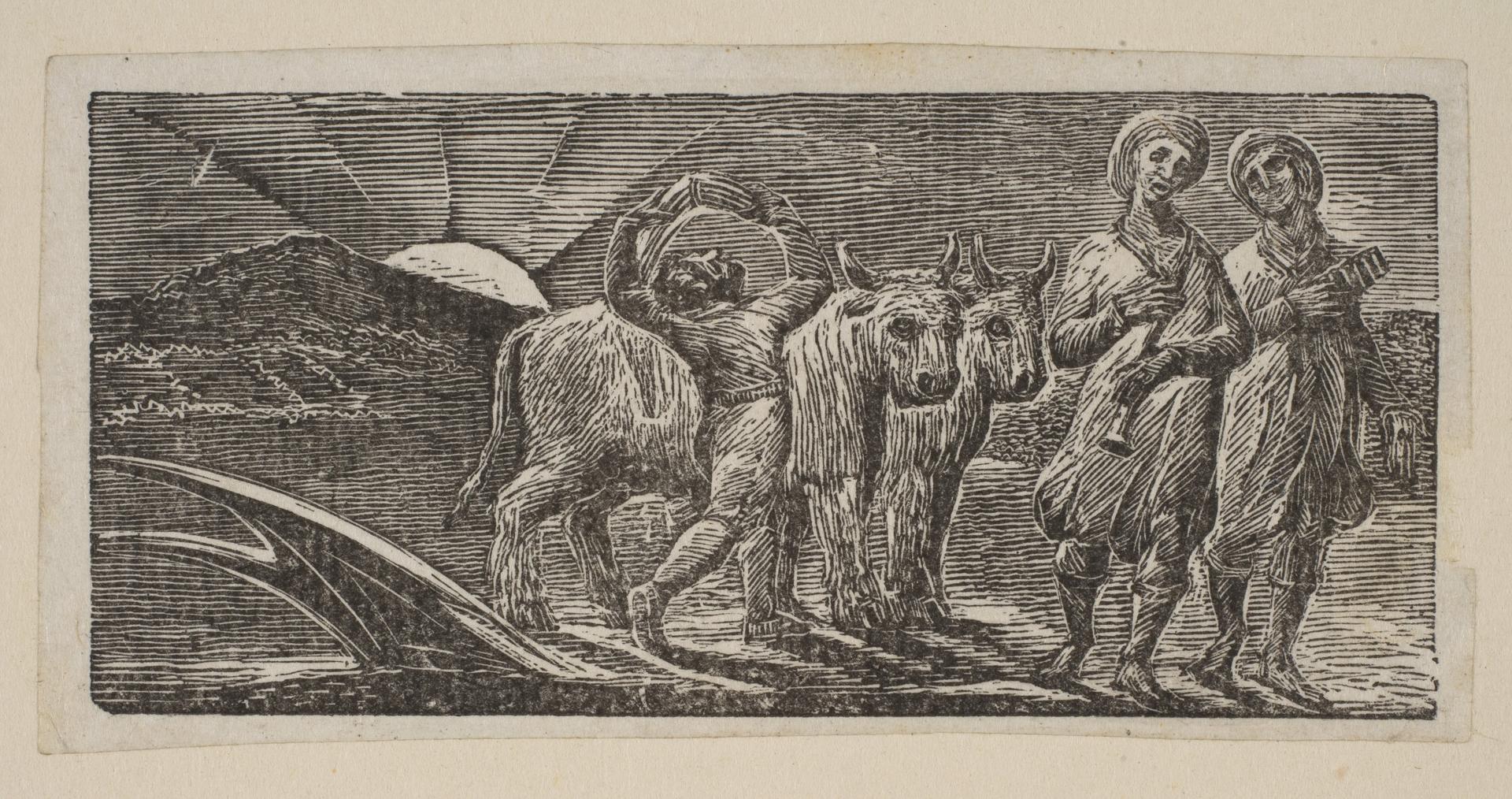
Boy Returning Joyfully, with Plough and Oxen, from Thornton's "Pastorals of Virgil" (1821, Met-Objekt 3874)
Original title: Boy Returning Joyfully, with Plough and Oxen, from Thornton's "Pastorals of Virgil"
kurzbeschreibung
William Blake's 1821 wood engraving presents a boy returning home from the fields with a plough and a team of oxen. The print belongs to a series of rural scenes that Blake made for Robert John Thornton's edition of Virgil's Pastorals. At just 3.8 x 7.8 cm, the image combines a motif from country life with the richness of detail characteristic of Romanticism.
Description
Up front, a young man in simple clothing and a hat drives the plough and pair of oxen with evident joy, his step lifted. Two further figures in traditional dress stand to the side, pointing to field work. Gentle hills rise behind them, giving the image a calm rural setting. The arrangement stretches horizontally, the main motif resting in the middle while the secondary figures line the edges. Fine lines and hatching create light and structure of the wood surface in the monochrome rendering.
Context
The wood engraving was made in 1821 for a school edition of Virgil's Pastorals edited by Robert John Thornton. It is one of a series of 17 wood engravings that helped shape Blake's late work. Originally intended as simple illustrations for teaching, they reveal Blake's idiosyncratic view of ancient pastoral poetry. In the Romantic era the wood engraving saw a new flowering, and Blake used it for a direct, expressive line.
Impact
At first glance, the calm emanating from the tiny scene is striking, drawing the eye into the arcadian landscape. The boy's cheerful posture and the clear organization of the image create an idyllic mood characteristic of Blake's pastoral depictions. Despite the small format, the print remains surprisingly present through its lucid structure and lively linework.
Technique
For the wood engraving, the drawing was cut into a woodblock and then printed. Blake used the fine lines of the wood grain to achieve shading and light effects. The precise cutting allows a high density of detail in the small format.
AI-generated description text
Source: Metropolitan Museum of Art · Public Domain (CC0 1.0)