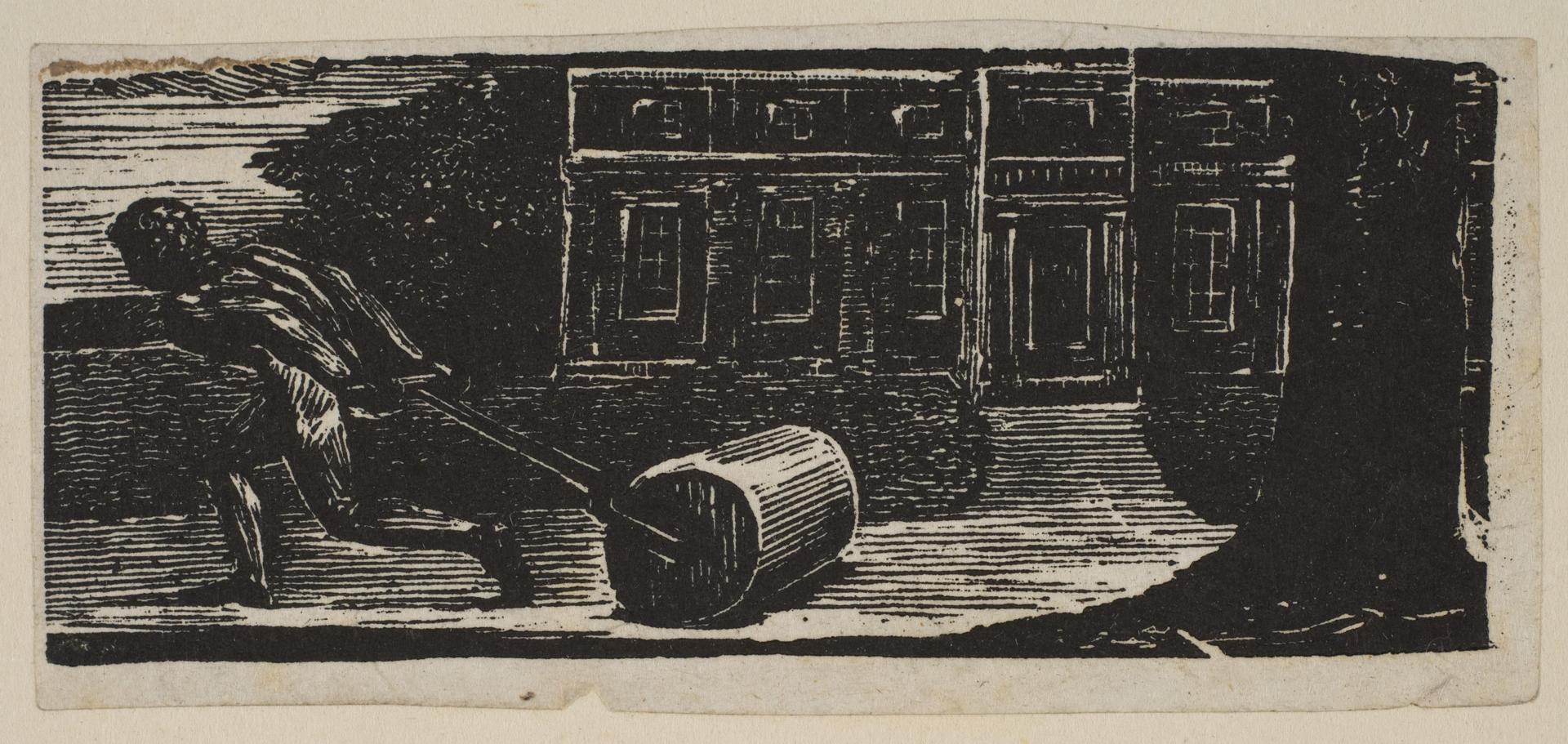
A Rolling Stone Is Ever Bare of Moss, from Thornton's "Pastorals of Virgil"
Original title: A Rolling Stone Is Ever Bare of Moss, from Thornton's "Pastorals of Virgil"
kurzbeschreibung
A man shoves a large barrel along ahead of him in this 1821 wood engraving by William Blake. The print belongs to the illustrations for Thornton's 'Pastorals of Virgil' and comes from Blake's late years, when he often illustrated books. A classical building sets the backdrop.
Description
A stocky man in a plain shirt is bent double, braced against a tipped-over barrel to keep it moving. His hunched posture makes the weight of the load plain. Behind him rises a large structure with windows and columns, recalling an ancient temple. The building sits in dark tones, while the figure and the barrel stand out as pale shapes. The engraving stays black and white; light falls from the front and traces shadows and outlines.
Context
The sheet was made for Robert John Thornton's edition of 'The Pastorals of Virgil', which gathers the poet's eclogues. Blake was working in a period when he turned more and more to book illustration, taking up classical texts in his own idiosyncratic way. At just 3.8 x 7.8 cm, this is a small detail illustration meant to be printed on a page of the book.
Impact
The man's crouched stance and the size of the barrel convey physical exertion at once. Because the foreground stays light and the building recedes into darkness, the contrast pulls the eye to the action. The result is a calm mood fixed on the task itself.
Technique
Coarse lines and flat areas cut from the wood block and printed define this engraving. The method allows only a few gradations, which explains the plain, pared-down style of the sheet. Blake used the contrasts of light and dark deliberately to create depth and tension within the small format.
AI-generated description text
Source: Metropolitan Museum of Art · Public Domain (CC0 1.0)