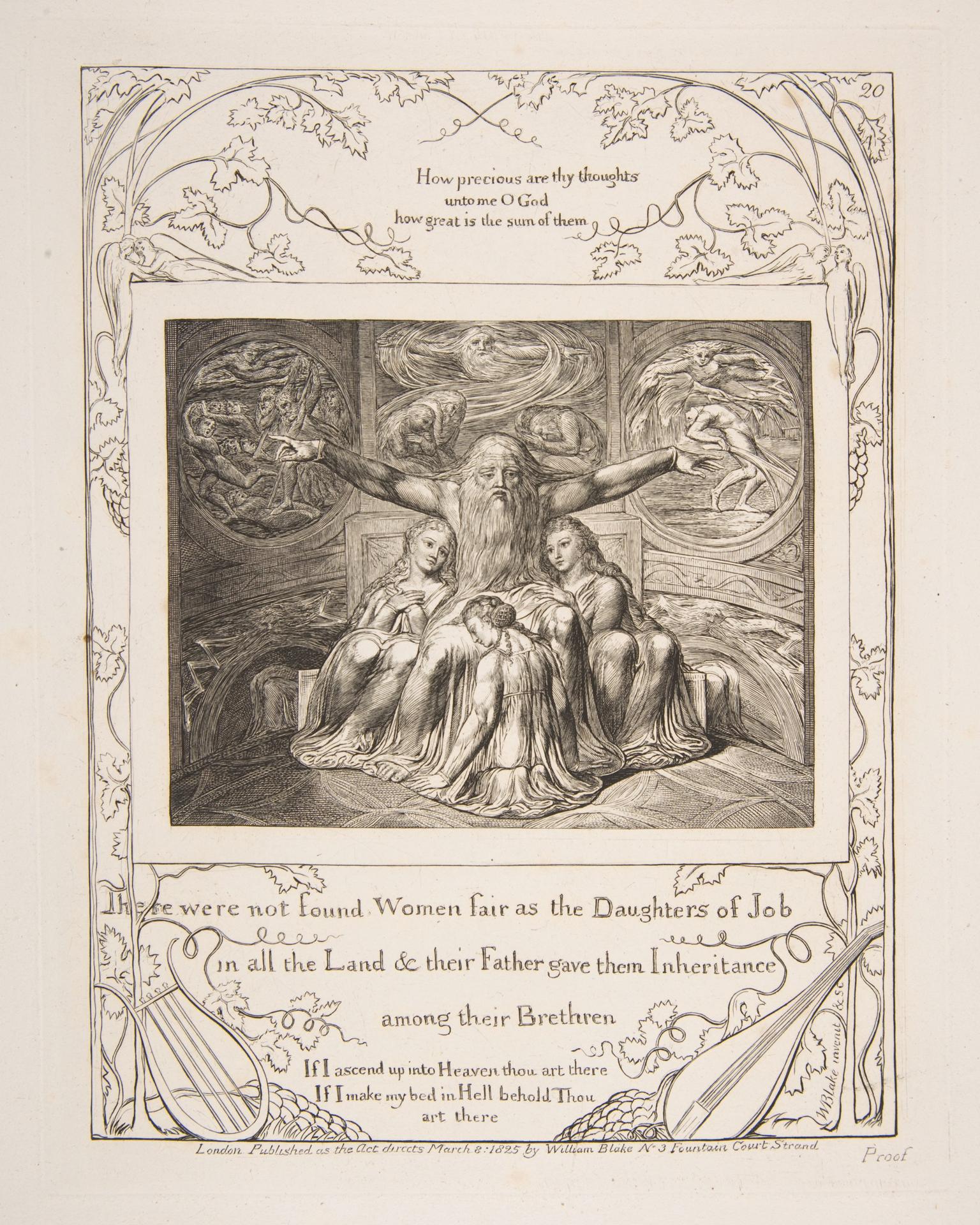
Job and his Daughters
Original title: Job and his Daughters
kurzbeschreibung
William Blake made the engraving 'Job and His Daughters' in 1825–26, showing the biblical Job surrounded by his four daughters. It belongs to his well-known series of illustrations for the Book of Job, joining religious subject matter with a visual poetry of his own.
Description
Job sits at the centre, long-bearded and white-haired, both arms opened wide in a gesture of shelter and welcome. Four female figures in traditional dress stand around him in a half-circle, stressing harmony and family closeness. Three round medallions near the top hold scenes or emblems from the Job story. Black-and-white line and hatching build light and contrast. Along the upper and lower edges, biblical words and explanations are engraved in clear lettering.
Context
The print came about as part of Blake's Job illustrations, which he produced in 1825–26 for the publisher John Linnell. Blake was then almost seventy and could look back on a large body of work in poetry, painting and printmaking. The series runs to 21 plates and ranks among the major achievements of his late years. The story of Job, who holds fast to God through severe trials, carried a particular spiritual meaning for Blake.
Impact
Clear symmetry and the calm grouping of the figures give the sheet a solemn, dignified character. Delicate line and a balanced arrangement create a meditative stillness that emphasises family concord and divine order.
Technique
Blake worked in etching: the drawing was transferred to an etched copper plate. The lines are precise and detailed; fine hatching models light and shade. The printing plate measures 21.4 x 16.8 cm, while the sheet is larger and leaves room for the engraved texts.
AI-generated description text
Source: Metropolitan Museum of Art · Public Domain (CC0 1.0)