The Draughtsman of the Lute
Original title: The Draughtsman of the Lute
kurzbeschreibung
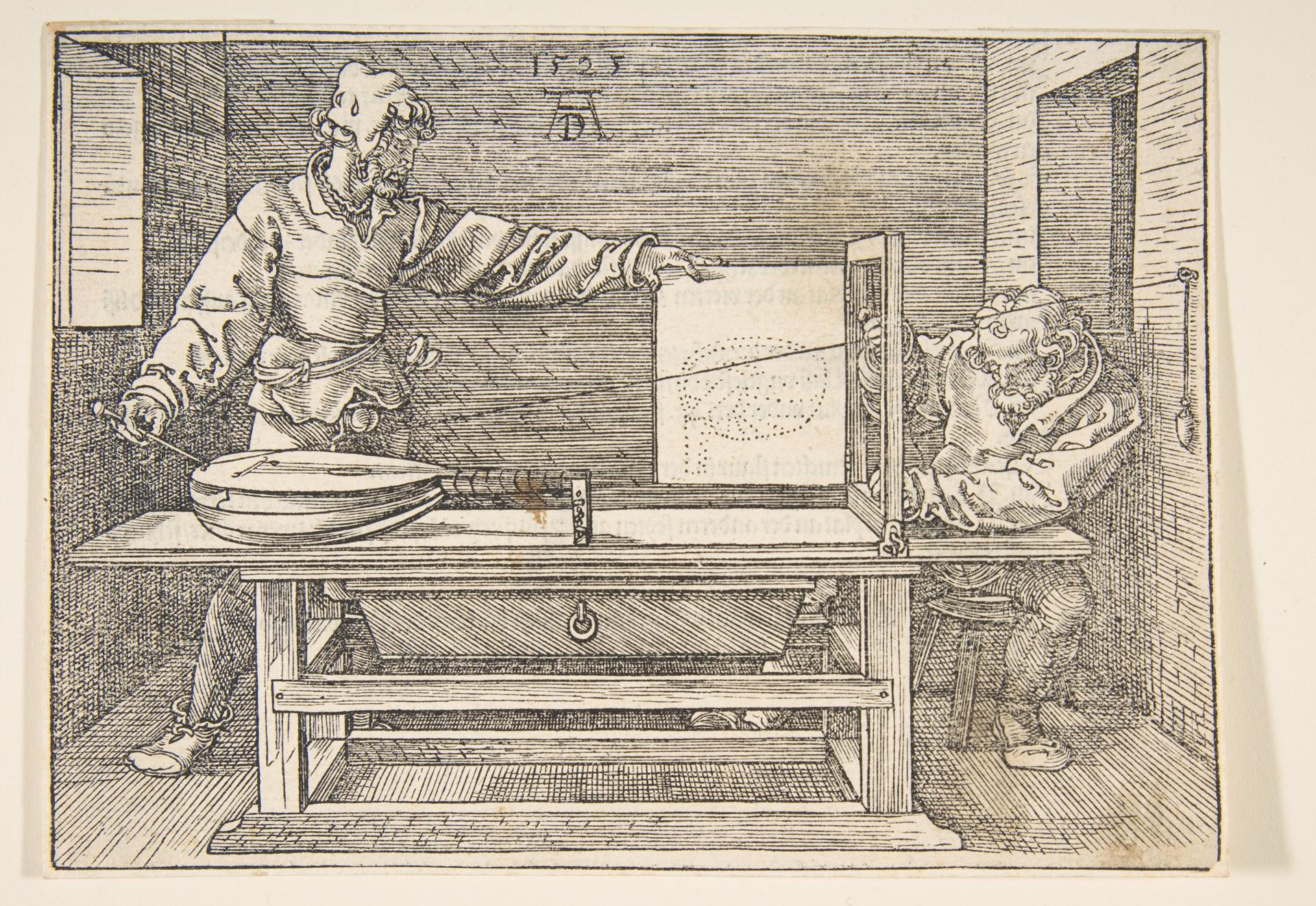
This woodcut by Albrecht Dürer, dated 1525, depicts two men in a workshop-like room, one drawing a lute with the aid of a mechanical device. It is part of Dürer's treatise on measurement and perspective.
Description
The scene shows a bearded man on the left, standing and holding a brush, while operating a device on a table where a lute board lies, with a compass or measuring tool nearby. On the right, another bearded man sits in a chair, looking toward a wall-mounted apparatus with points that likely represent a pattern or sketch. The room is sparse, featuring a door in the background and a window opening on the left. The composition is rendered in fine, precise line work typical of woodcut prints.
Context
Dürer created this woodcut as an illustration for his 1525 book 'Underweysung der Messung' (A Course in the Art of Measurement), which aimed to teach artists the principles of geometry and perspective. The image demonstrates a practical method for transferring a three-dimensional object onto a two-dimensional surface using a string and a point of sight. This work reflects the Renaissance interest in the scientific basis of art.
Impact
The print conveys a sense of intellectual inquiry and methodical practice, with the two figures engaged in a focused, almost scientific activity. The clean, linear style gives the scene a clarity that emphasizes the instructional purpose of the image.
Technique
This is a woodcut, a relief printing technique where the image is carved into a wooden block, inked, and pressed onto paper. Dürer's woodcuts are renowned for their fine, detailed line work, achieved through skilled carving that allows for a wide range of tonal effects.
AI-generated description text
Source: Metropolitan Museum of Art · Public domain (CC0)