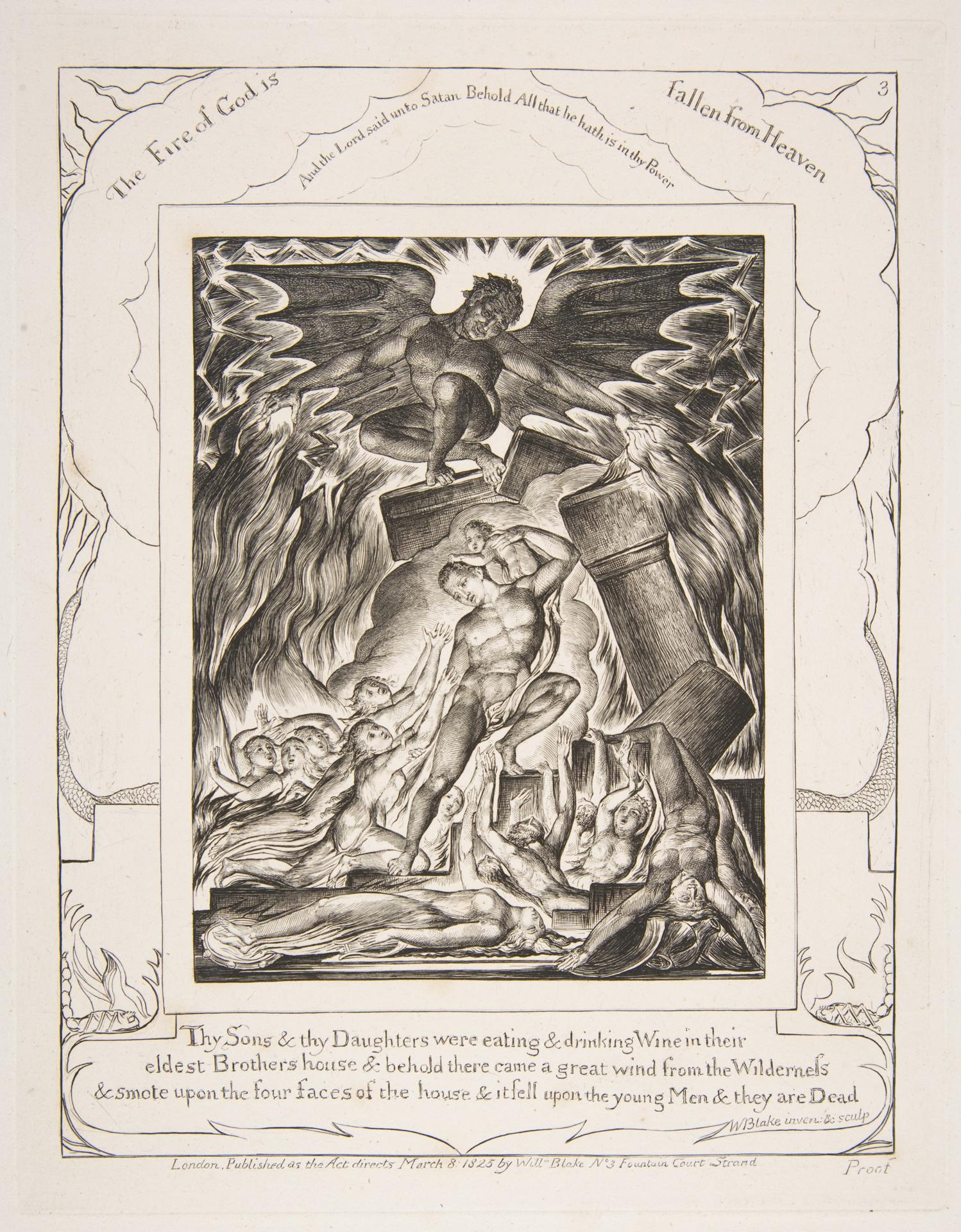
The Destruction of Job's Sons
Original title: The Destruction of Job's Sons
kurzbeschreibung
William Blake's engraving The Destruction of Job's Sons, made in 1825–26, captures the biblical moment when an angel kills Job's sons. It belongs to Blake's series of illustrations for the Book of Job and was produced as a copperplate engraving.
Description
An angel with wide-spread wings and a ghostly face hovers above a group lying on the ground, some of whom appear dead. A father holds a child in his arms and looks up at the angel. Other figures lie on the ground further back, surrounded by flames and smoke. Texts explaining the biblical context frame the event. The image remains in grayscale and uses strong contrasts.
Context
Between 1825 and 1826, Blake created this engraving as part of his 21-plate series on the Book of Job. The artist John Linnell commissioned the series from Blake. The images were reproduced as copper engravings and published in 1826. Blake's interpretation follows the biblical narrative in which God tests Job's faith.
Impact
Dark flames and smoke darken the mood and give the scene a threatening quality. The ghostly angel and the lifeless bodies evoke horror and tragedy. Bright areas stand out sharply against dark ones and draw the eye to the action in the middle, heightening the drama.
Technique
For this engraving, the drawing was etched into a copper plate. Blake combined etching and engraving to achieve fine lines and shading. The prints were made in black ink on paper; the grayscale tones result from the density of the lines and the depth of the etching.
AI-generated description text
Source: Metropolitan Museum of Art · Public Domain (CC0 1.0)