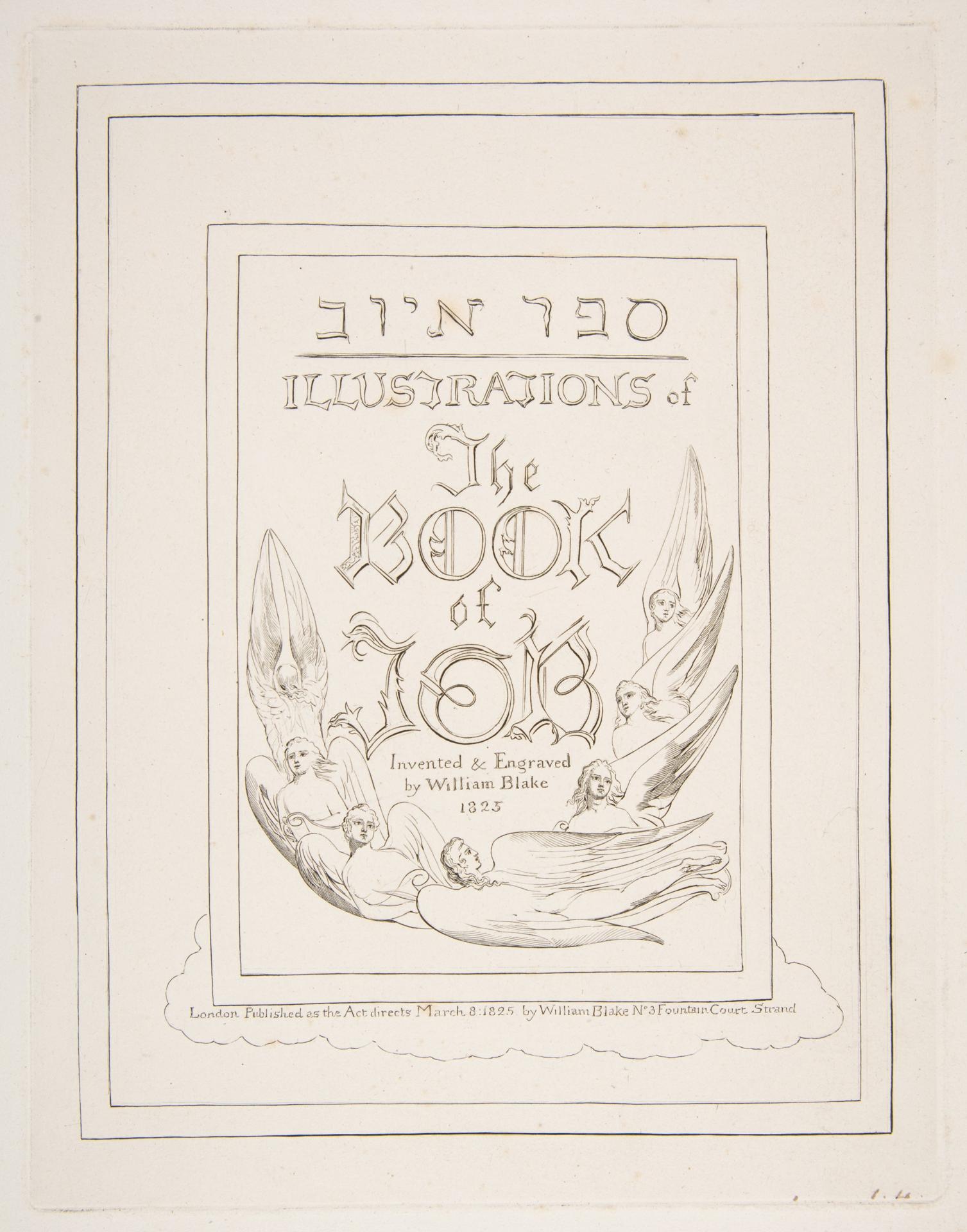
Title Page: Illustrations of the Book of Job
Original title: Title Page: Illustrations of the Book of Job
kurzbeschreibung
Unlike the other plates in the Job series, this etching by William Blake (1825–26) does not present a scene but the title itself. The lettered sheet opens the sequence 'Illustrations of the Book of Job': the work's title appears in stylized lettering, flanked by angels, with the Hebrew title and publication details added.
Description
Centered on the sheet is the inscription 'ILLUSTRATIONS of The BOOK of JOB' in an elaborate type, directly below it the line 'Invented & Engraved by William Blake 1825'. Around this center cluster numerous angels with human faces and wings in varying poses. Above the title one reads the Hebrew name 'ספר אִיּוֹב' (Sefer Iyov), and at the bottom edge the publication line: 'London. Published as the Act directs March 8 1825 by William Blake No 3 Fountain Court Strand'. The whole remains black and white and is enclosed by a border.
Context
Between 1825 and 1826 Blake worked on the Job series, which comprises 22 etchings. The title page names 8 March 1825 as the date of publication in London, where the artist then lived at Fountain Court Strand. The Book of Job was one of the biblical subjects Blake returned to repeatedly. The plates were made at a time when he received little public attention but was valued by a small circle of admirers.
Impact
What sets this page apart from narrative depictions is its symmetrical layout: the angels arrange themselves around the title, which thereby acquires a solemn, elevated rank. The precise typography and delicate lines enter into a quiet, almost meditative union that points ahead to the biblical content.
Technique
For this plate Blake used etching: the drawing was etched into a copper plate and printed in black on paper. The filigree lines demanded high precision. The plate measures 21 x 16.2 cm, while the sheet format at 41 x 27.6 cm is considerably larger.
AI-generated description text
Source: Metropolitan Museum of Art · Public Domain (CC0 1.0)