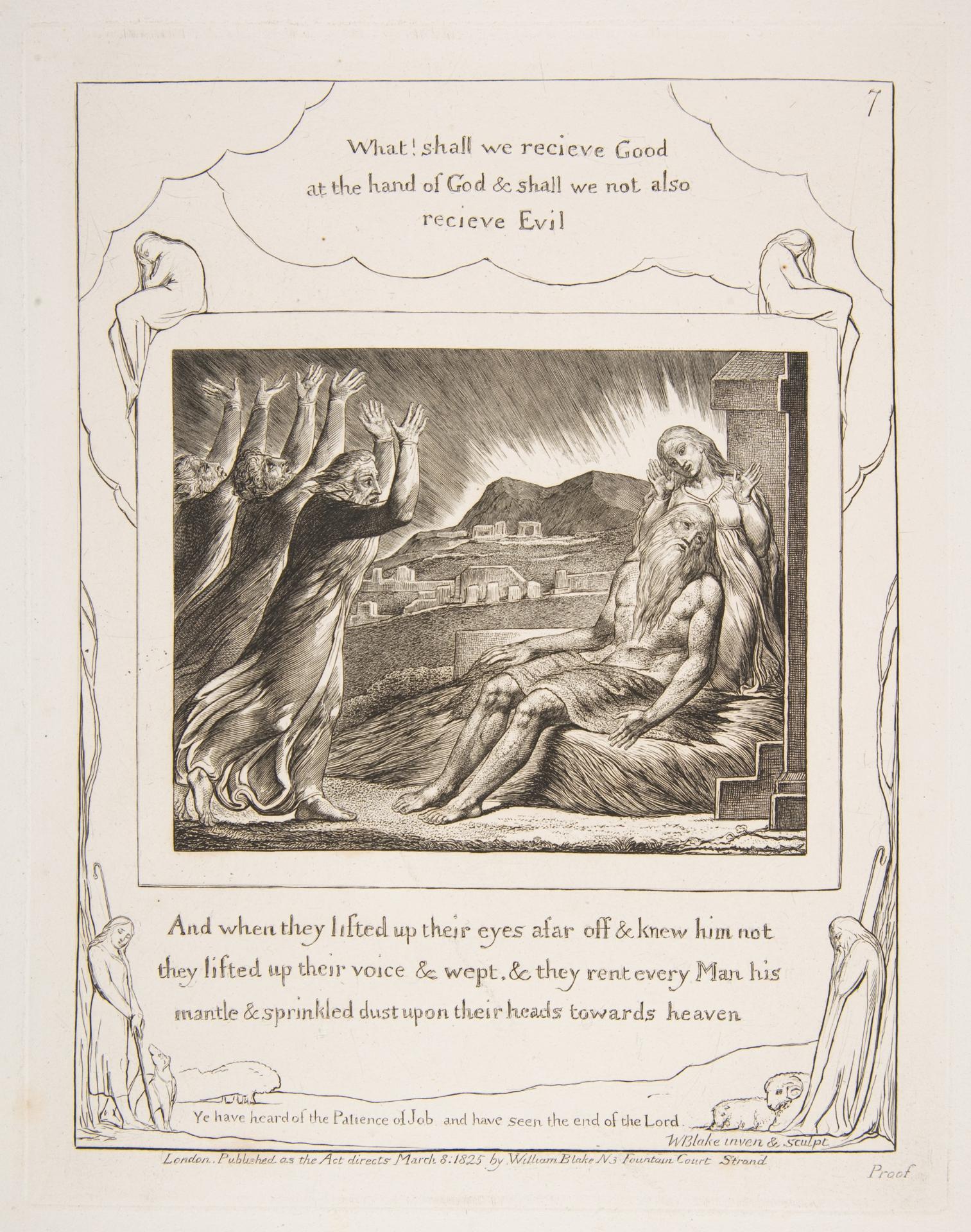
Job's Comforters
Original title: Job's Comforters
kurzbeschreibung
William Blake made the engraving 'Job's Comforters' in 1825–26. It belongs to his Job series and presents the biblical encounter between Job and his friends. The print is in black and white.
Description
Job sits on a stone in plain garments; his face looks thoughtful and weary. Four figures to his left raise their arms in prayer or lament, their faces hidden. On the right, a female figure prays with raised arms. Mountains and buildings close off the back. A text panel at the top quotes the question: 'What! shall we receive Good at the hand of God & shall we not also receive Evil'. At the bottom edge of the sheet is 'Proof', indicating a trial copy.
Context
Between 1825 and 1826 the engraving was created as part of Blake's 21 illustrations to the Book of Job, made shortly before his death. Blake was both poet and artist, and in his works he often linked religious with mystical motifs. His friend John Linnell commissioned the series; in 1826 it was published as a collection.
Impact
The tight arrangement of the figures and their expressive gestures give the sheet a dramatic, emotional tension. The delicate lines and shading of the black-and-white engraving create a sombre, reflective mood that stresses the tragic nature of the scene.
Technique
The drawing was etched into a copper plate and then printed—a process that allows fine lines and precise details, as are characteristic of Blake's style. The plate measures 21.7 x 17.5 cm, the sheet 41.9 x 27.9 cm; this results in a generous margin for the print.
AI-generated description text
Source: Metropolitan Museum of Art · Public Domain (CC0 1.0)