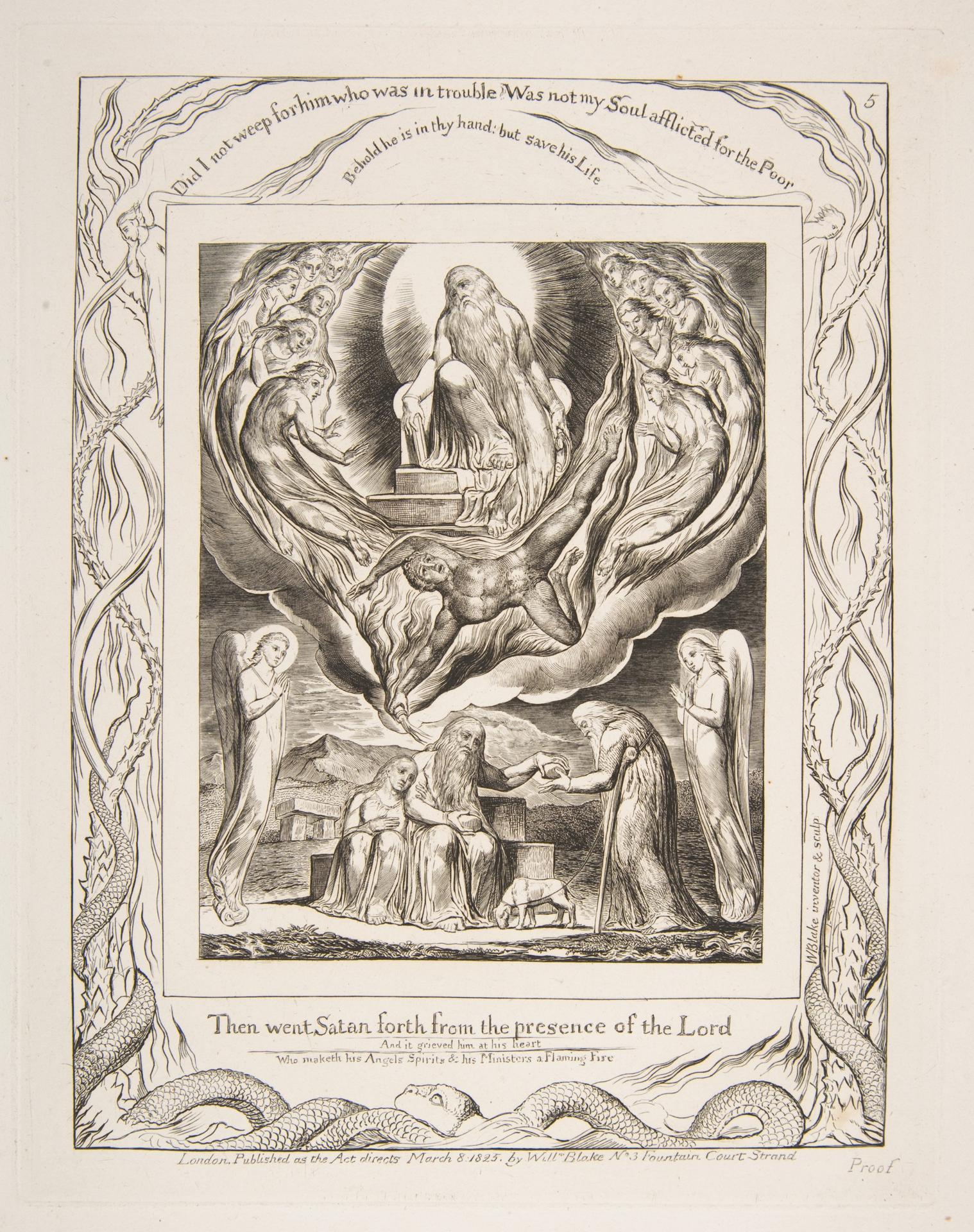
Satan Going Forth from the Presence of the Lord
Original title: Satan Going Forth fron the Presence of the Lord
kurzbeschreibung
A bearded old man sits enthroned on a pedestal, wrapped in a cloud where figures stir. William Blake's engraving Satan Going Forth from the Presence of the Lord (1825–26) renders the biblical story in black and white. At the feet of the exalted figure sit two angels; one holds a serpent that winds along the bottom edge.
Description
On a raised pedestal sits a bearded figure, framed by a cloud through which a host of moving figures passes. Below, two beings—readable as angels or spirits—are resting; one holds a snake that coils around the lower border. Vines and dragons form the ornate frame, and along the bottom runs the text “Then went Satan forth from the presence of the Lord.” Light falls from above, picking out cloud and figures; the layout is symmetrically anchored on the pedestal.
Context
This engraving was made as an illustration to the Book of Job, part of a series of 21 prints Blake published between 1825 and 1826. It is based on Job 1:12: Satan receives permission from God to test Job. Blake worked as both poet and visual artist, often weaving mystical and symbolic motifs into his work. The Job engravings count among his late masterpieces.
Impact
Harsh contrasts of light and dark and the symmetrical arrangement give the print a dramatic, almost solemn mood. The figure of God and the beings around him feel sublime and timeless, while the serpent adds a threatening note. The richly worked border draws the eye to the action in the middle and stresses the weight of the biblical narrative.
Technique
The print was made as an engraving, an intaglio process in which the drawing is etched into a copper plate. Blake combined etching and burin work to achieve fine lines alongside strong shadows. The impressions were pulled in black on paper, which gives the work its monochrome effect.
AI-generated description text
Source: Metropolitan Museum of Art · Public Domain (CC0 1.0)