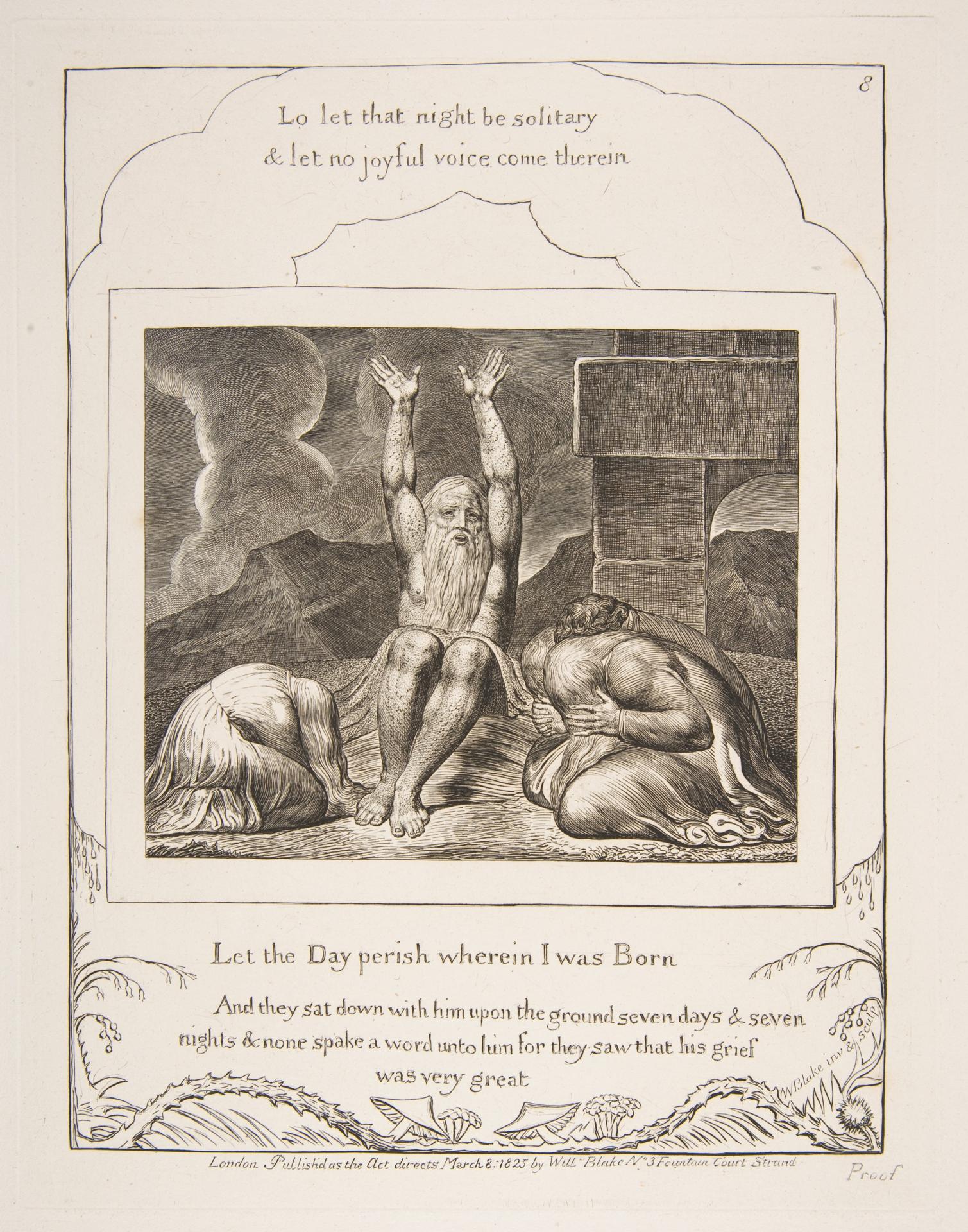
Job's Despair
Original title: Job's Despair
kurzbeschreibung
William Blake made the engraving Job's Despair in 1825–26. It shows the biblical sufferer Job alongside three companions in a mountainous storm landscape. The print belongs to Blake's widely known series of illustrations for the Book of Job.
Description
Job sits on the ground with both arms raised, his face marked by deep grief. To his left a figure kneels with a bent back; to his right another has settled, their posture also betraying sorrow. Behind the figures mountains pile up under a clouded, stormy sky that carries the gloomy mood. Two text panels with biblical quotations, one at the top and one at the bottom, frame and interpret the scene. Sharp contrasts of light and dark and crisply outlined figures heighten the emotional tension of the print.
Context
The etching belongs to a series of 21 illustrations for the Book of Job that Blake completed between 1825 and 1826. The cycle was prompted by the artist John Linnell, who commissioned it; it ranks among the most significant testimonies of Blake's late work. In these plates Blake fuses his own mystical theology with a thorough familiarity with the biblical text. The etchings first appeared in print in 1826, in an edition of 315 copies.
Impact
From the first glance one feels the oppression: Job's outstretched arms and the heavy sky make despair almost physical. At the same time the strict layout with its clear lines gives the scene something monumental, almost timeless. The inscribed biblical words tie the motif firmly to the biblical narrative and invite calm, reflective looking.
Technique
The plate was executed as an etching on copper, combining etching and engraving. The plate measures 21.7 × 16.7 cm, while the sheet at 41.3 × 27.6 cm is considerably larger. With fine lines and densely set hatching Blake achieved his effects of light and shadow; printing was usually in black on white paper.
AI-generated description text
Source: Metropolitan Museum of Art · Public Domain (CC0 1.0)