The Vision of Eliphaz
Original title: The Vision of Eliphaz
kurzbeschreibung
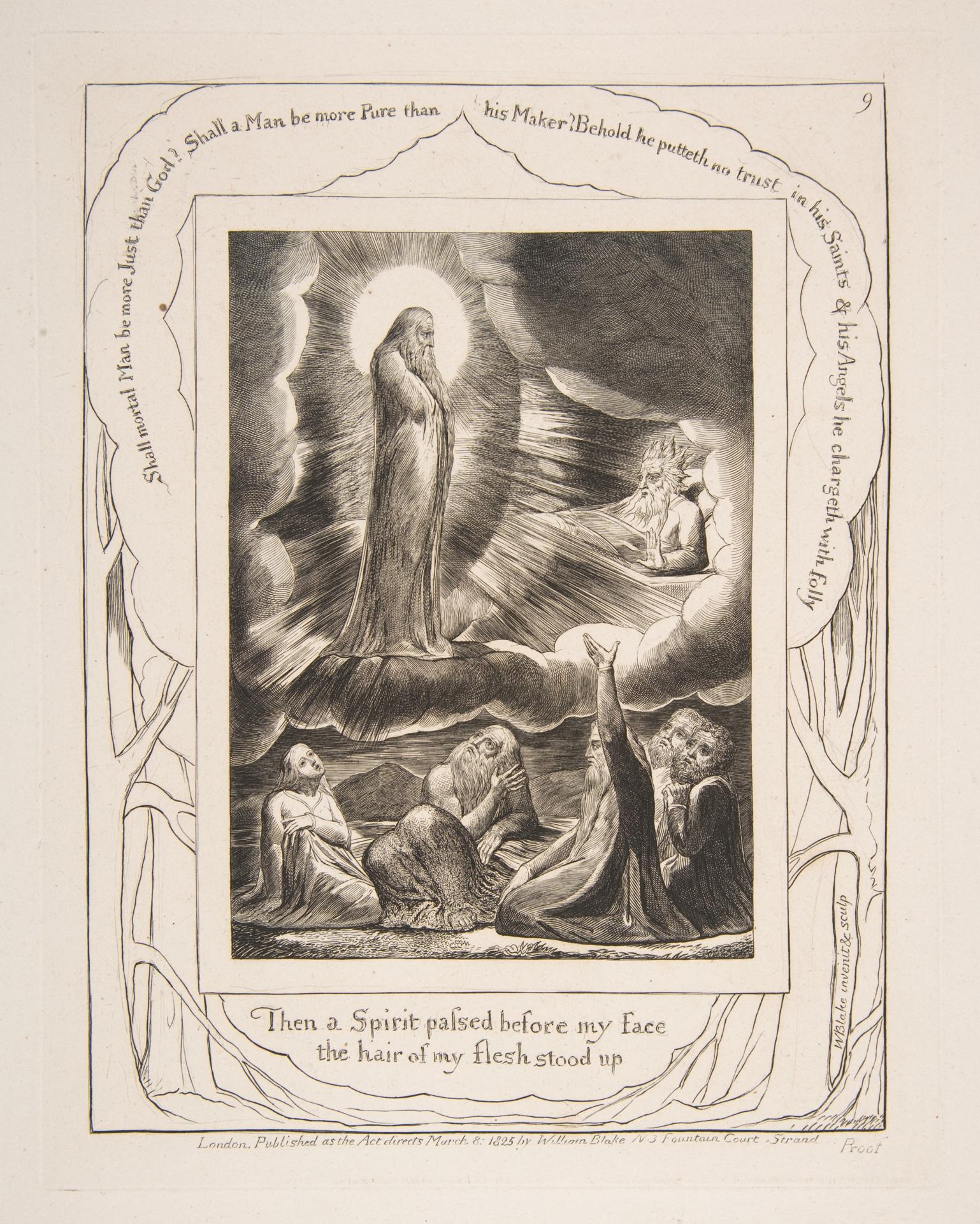
William Blake's engraving Die Vision des Eliphaz, made in 1825–26, presents a spiritual apparition from the Book of Job. A figure clad in long robes and surrounded by light stands at the center, while three figures crouch before it in reverence. The print belongs to Blake's celebrated series of illustrations for the Book of Job.
Description
A brightly illuminated figure in heavily folded garments emerges from the dark ground and dominates the design. At its feet three figures kneel, their postures betraying shock and awe; one of them reaches upward. Deeper in the space, within a cave-like setting, another figure, also touched by light, can be made out. The symmetrical arrangement and the radial contrasts of light and dark give the sheet a dramatic, spiritual mood. Biblical passages in Blake's own handwriting frame the image.
Context
As part of a series of 22 illustrations for the Book of Job, Blake created this print between 1825 and 1826 for the publisher John Linnell. The subject of Job occupied him for many years; the series is regarded as his last major engraving project. Eliphaz is one of Job's three friends and recounts a night vision in the Book of Job. The series appeared in full only after Blake's death in 1827 and ranks among the highlights of nineteenth-century British printmaking.
Impact
A strong spiritual pull emanates from the stark contrast between the luminous center and the deep black surround. The monumental stillness of the central figure meets the agitated gestures of the kneeling ones, creating tension. Blake's linework gives the scene a visionary clarity that draws the viewer directly into the biblical moment.
Technique
The sheet is executed as a copper engraving: lines were cut into the metal plate with a burin. Fine, parallel hatchings produce the graded gray tones and the dramatic chiaroscuro. The text portions around the image Blake transferred directly onto the plate in his own developed calligraphic script.
AI-generated description text
Source: Metropolitan Museum of Art · Public Domain (CC0 1.0)