Hiding of Moses
Original title: Hiding of Moses, from "Remember Me!, or a Pocket Companion"
kurzbeschreibung
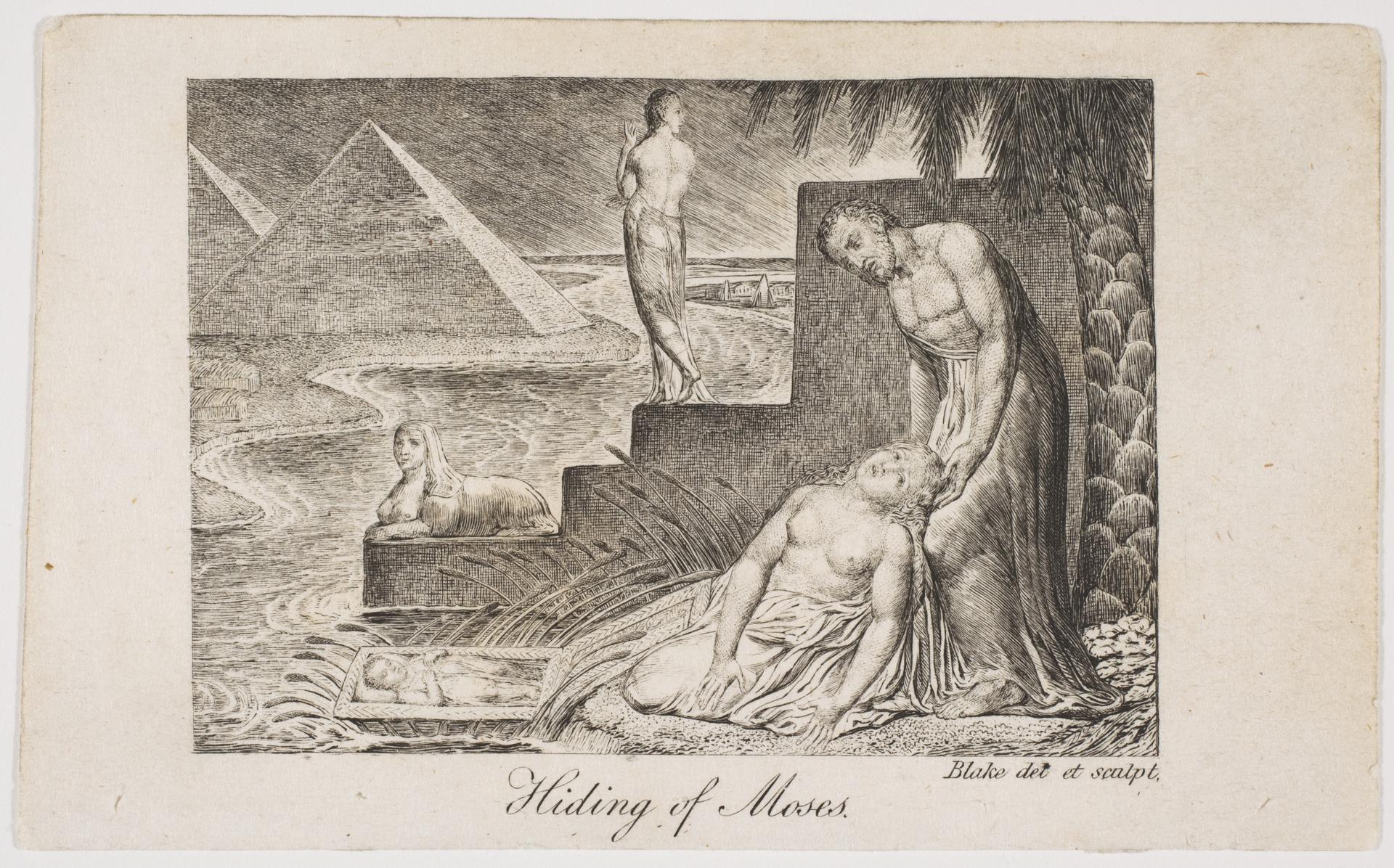
William Blake made this engraving in 1825 for the series "Remember Me!, or a Pocket Companion". The small plate most likely depicts Moses fleeing Egypt, and it is executed as an etching.
Description
A woman lies on the ground in the foreground, exhausted or wounded, while a man stands beside her and reaches down to help. Behind them a sphinx rests on a pedestal, and above it a pyramid rises and dominates the pictorial space. The figures' garments have a classical feel, and the arrangement is symmetrical. Diffused light gives the image a sombre mood, and the palette stays monochrome in various shades of grey.
Context
Blake produced the plate in 1825 as part of "Remember Me!, or a Pocket Companion", a collection of small-format prints. It belongs to a series of biblical subjects that occupied him in his later years. The series was aimed at a broad public and joined religious content with Blake's own manner.
Impact
The murky light and the monumental setting of sphinx and pyramid make the image feel oppressive and enigmatic. Because of its small format the scene comes across as intimate, almost private, without losing any of its drama.
Technique
The etching relies on strong contours and detailed textures. Its monochrome range of greys follows from the acid process, in which the plate is treated with acid.
AI-generated description text
Source: Metropolitan Museum of Art · Public Domain (CC0 1.0)