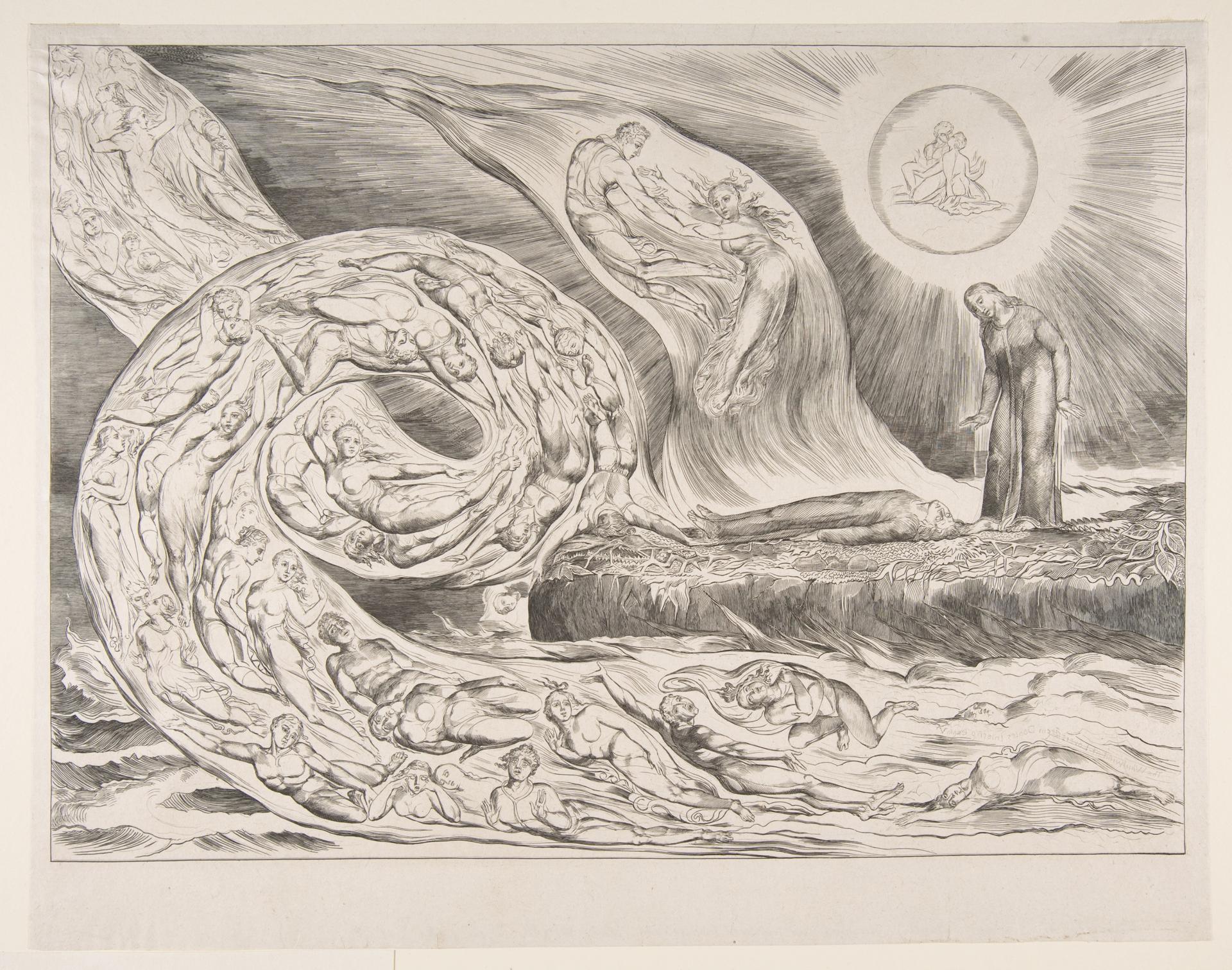
The Circle of the Lustful: Paolo and Francesca
Original title: The Circle of the Lustful: Paolo and Francesca
kurzbeschreibung
Unlike many contemporary Dante illustrations, William Blake’s engraving The Circle of the Lustful: Paolo and Francesca (c. 1825–27) does not rely on a clearly readable narrative situation but on an allegorical compression. A large spiral of figures winds through the centre of the image, embodying the damned of the second circle of Hell.
Description
A large spiral structure dominates the sheet, interspersed with numerous figures in shifting poses—some reclining, others seated or standing upright. These bodies seem to float in a whirl that creates an uneasy, even chaotic atmosphere. Two figures within a ray-surrounded circle engage with each other in the upper area. At the left edge, a single figure gazes at the spiral. The layout is asymmetrical, with figures dispersed in various directions—an expression of the restlessness that runs through the scene.
Context
Created as an illustration to Dante’s Divine Comedy, the engraving dates from Blake’s final years. It belongs to a series of over one hundred watercolours and engravings that remained unfinished during his lifetime. Paolo and Francesca, who atone for their forbidden love in the second circle of Hell, take up a core motif of literary adaptation.
Impact
An intense, almost swirling movement pervades the print, making the chaos and torment of the damned immediately palpable. Through delicate lines and strong chiaroscuro, the scene acquires a sombre yet elegiac mood that holds the viewer’s attention.
Technique
For this engraving, the drawing was etched into a metal plate and then printed on paper. Blake worked with fine, precise lines and graduated hatching to give the figures and the spiral structure a sculptural presence. The monochrome black-and-white execution creates a strong sense of spatial depth through gradations of light and shadow.
AI-generated description text
Source: Metropolitan Museum of Art · Public Domain (CC0 1.0)