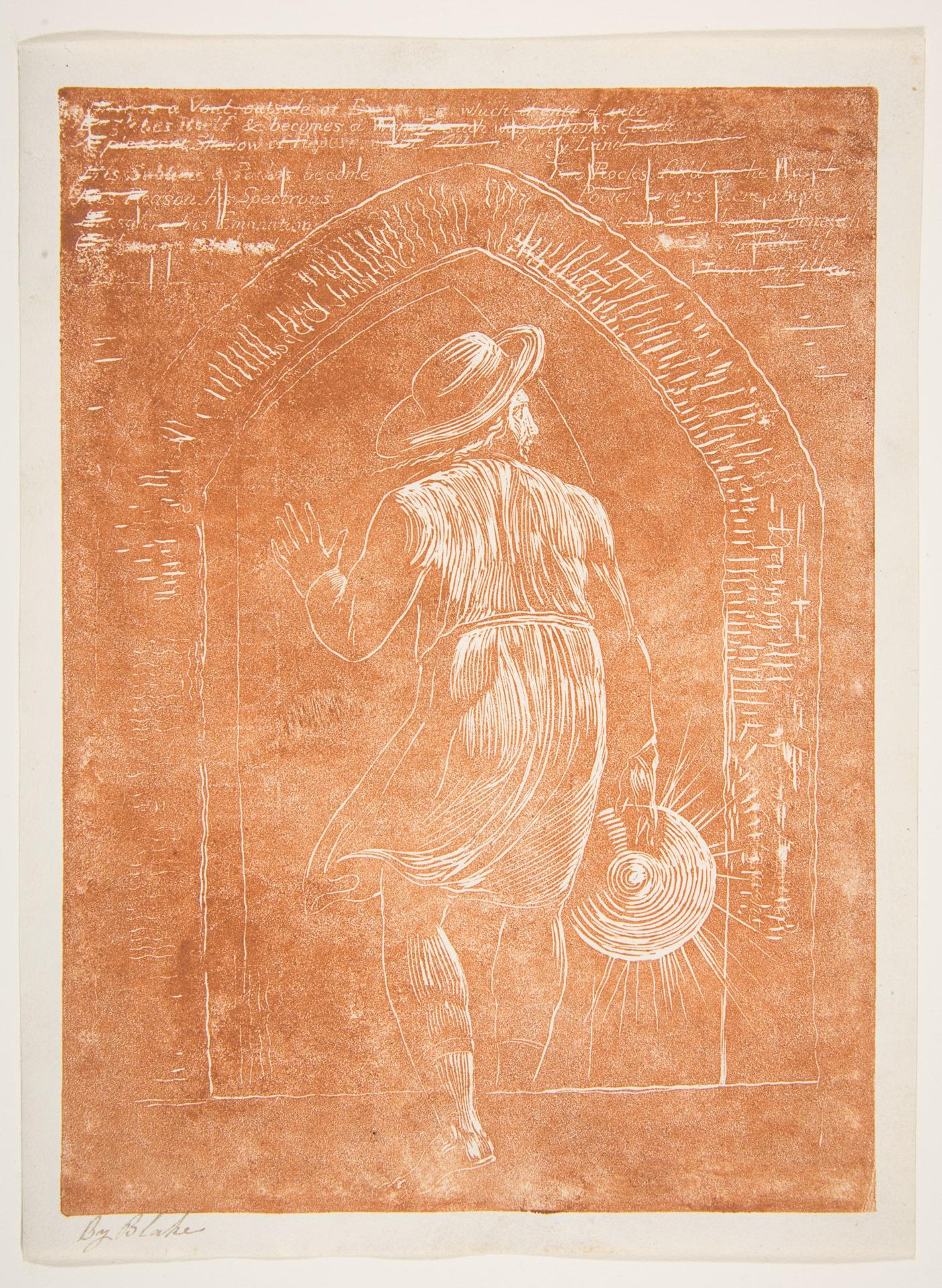
Frontispiece to Jerusalem, the Emanation of the Great Albion
Original title: Frontispiece to Jerusalem, the Emanation of the Great Albion
kurzbeschreibung
William Blake made this frontispiece for his prophetic book Jerusalem. A single figure, seen from behind, stands within a white-line etching printed in orange. The date is uncertain, placed around 1804 to 1820. The motif joins a human figure with a semicircular arch and lines of text, as is typical of Blake's illuminated prints.
Description
A figure viewed from behind, wearing a wide-brimmed hat and a long-sleeved jacket, occupies the middle of the sheet. In the right hand is an object that recalls a spinning wheel. Before the figure rises a large semicircular arch, covered with lines and strokes. More lines and strokes in the background may belong to a larger pattern. Above the arch stand several lines of text that are not fully legible. The white linework stands out sharply and without shading against the even orange.
Context
This frontispiece belongs to William Blake's epic poem Jerusalem, which he produced between 1804 and 1820. It is one of the so-called prophetic books, which Blake published himself as illuminated prints. For these prints he developed his own technique, which he called relief etching; here it appears in the variant of white-line etching. The figure is often interpreted as the poet himself or as a pilgrim passing through the gate of Jerusalem.
Impact
The figure seen from behind at the center and the monumental arch give the sheet an air of mystery that is also inviting. The strong contrast between white and orange gives it a clear, graphic presence. The illegible lines of text create an enigmatic aura that invites lingering.
Technique
For this sheet Blake used white-line etching: the lines were worked out of a dark ground and printed in orange. In this process the lines are engraved into the plate so that they appear light when printed. Printing was done on paper with a uniform orange-red tone, without gradients or shading.
AI-generated description text
Source: Metropolitan Museum of Art · Public Domain (CC0 1.0)