Songs of Experience: The School Boy
Original title: Songs of Experience: The School Boy
kurzbeschreibung
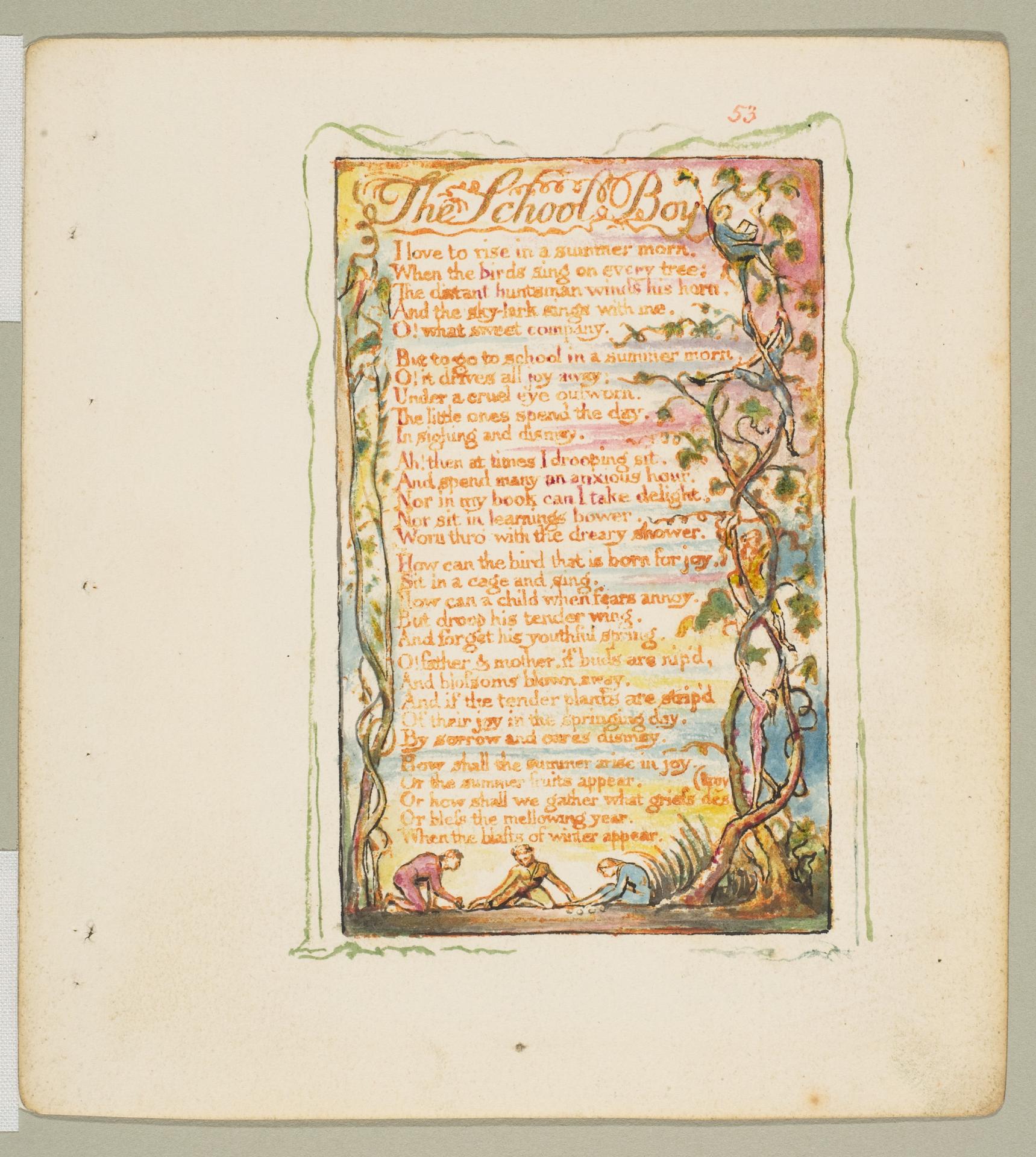
William Blake's 'The School Boy' from Songs of Experience, written in 1789, was printed around 1825. This relief etching in orange-brown ink is hand-colored with watercolor and shell gold. It presents the poem's text framed by ornamental vines, with three children gathered under a tree below.
Description
The title 'The School Boy' sits within a rectangular border entwined with green foliage. Beneath it, three children have assembled on the ground under a large tree: two are seated, one kneels. A pink-white sky and blue water, cut by a tree trunk, define the colored background. The hues are vivid; the old paper shows slight discoloration, and a band of numerals runs along the edge.
Context
Blake created Songs of Experience as a counterpart to Songs of Innocence (1789); they were first published in 1794. The poem 'The School Boy' criticizes the constraints of institutional education, which suppress a child's natural joy and creativity. Blake, trained as an engraver, developed relief printing, in which text and image are etched together on a single plate. This version was printed and hand-colored around 1825, as was typical for his later editions.
Impact
Luminous pastel colors and the ornamental frame give the sheet a dreamy, almost idyllic atmosphere. At the same time, the children under the tree convey a melancholic mood that visually underscores the poem's critical undertone. The interplay of text and image invites viewers to explore the relationship between poetic message and pictorial scene.
Technique
In the relief printing method Blake used, the non-printing areas of the copper plate are etched away, leaving lines and surfaces in relief. Printing was done in orange-brown ink; afterward, Blake colored the impressions by hand with watercolors and shell gold (finely ground gold in a binder). This allowed him to individualize each sheet and directly control the color effect of his visions.
AI-generated description text
Source: Metropolitan Museum of Art · Public Domain (CC0 1.0)