Songs of Experience: To Tirzah
Original title: Songs of Experience: To Tirzah
kurzbeschreibung
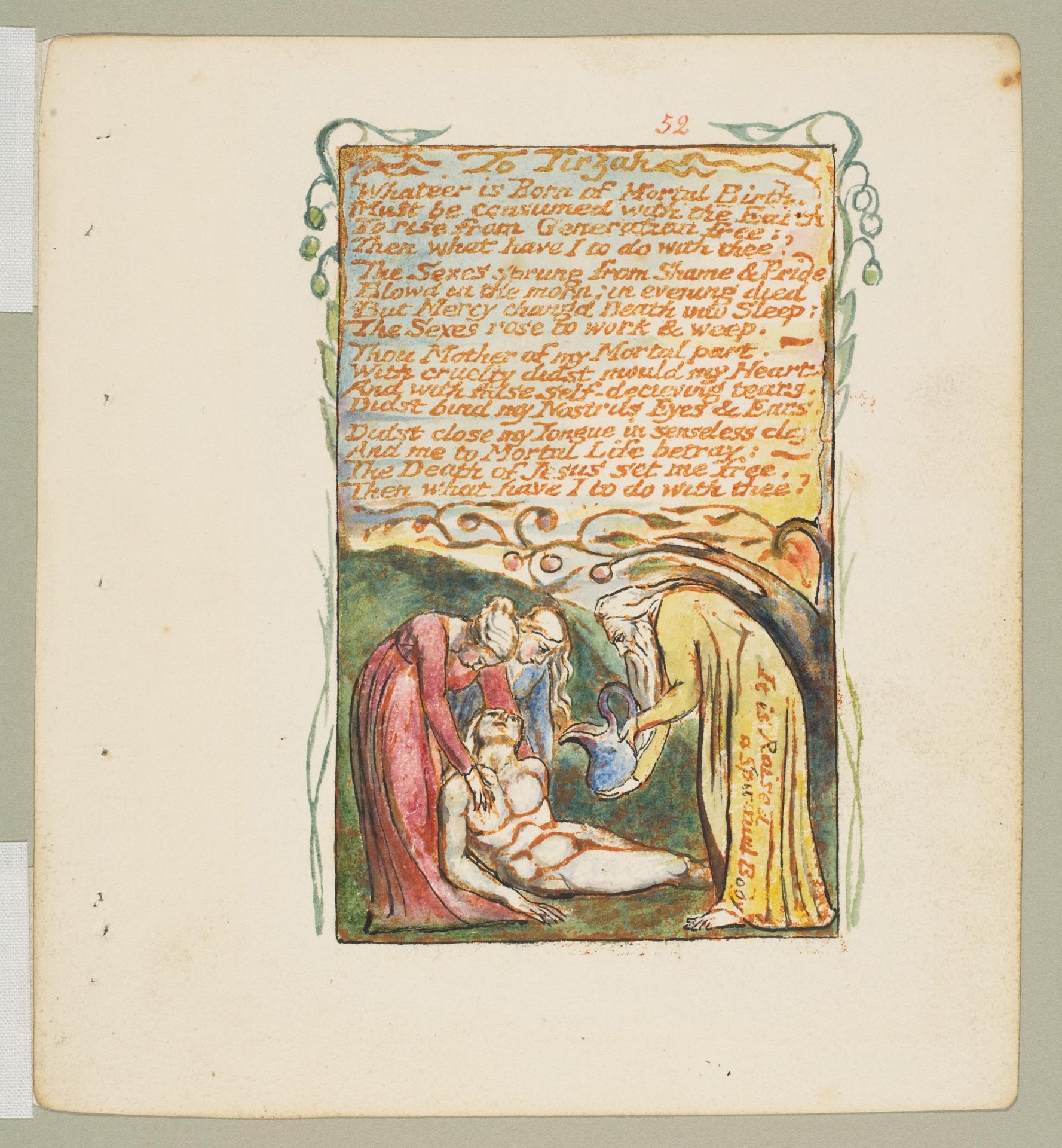
Unlike the other plates in Songs of Experience, this design gives a female figure at the center, flanked by two companions. The text belongs to William Blake's 1794 cycle, while the present impression was printed around 1825. The image was made as a relief etching in orange-brown, then hand-colored with watercolor and shell gold. Above a green landscape with trees and bushes stands the poem, and the three figures are arranged below it.
Description
A naked woman crouches on the ground, her head bowed in a mournful pose. To either side stand two figures in red and yellow garments, each holding a severed head. Behind them a green landscape opens with trees and shrubs. A block of text with the poem of the birth and death of sin is set over the scene. Leaves and blossoms form an ornamental frame around the whole sheet. Orange, brown, and gold dominate the palette; light falls evenly, without strong contrasts of shadow.
Context
The sheet belongs to Blake's Songs of Innocence and Experience, an illuminated printing series he issued from 1789 in his own technique. This pull was made around 1825, decades after the first conception, and shows Blake's later coloring. Tirzah comes from the Bible; in Blake's mythology she embodies the material, earthly world and the limitation of the spirit. The text concerns redemption from mortal nature through the divine spirit—a core motif in Blake's late work.
Impact
The calm, almost statuary arrangement of the figures and the warm tones of orange, brown, and gold give the sheet a solemn yet melancholy character. The interplay of poem and symbolic imagery creates a meditative, reflective mood. The ornamental frame makes the whole appear like a precious, handcrafted art object.
Technique
In relief etching, the non-printing areas are etched away so that only the raised lines take ink. Printing was done in orange-brown; then coloring followed by hand with watercolors and shell gold. This combination of printing and manual illumination shapes Blake's idiosyncratic book art and allowed him to make each impression individual.
AI-generated description text
Source: Metropolitan Museum of Art · Public Domain (CC0 1.0)