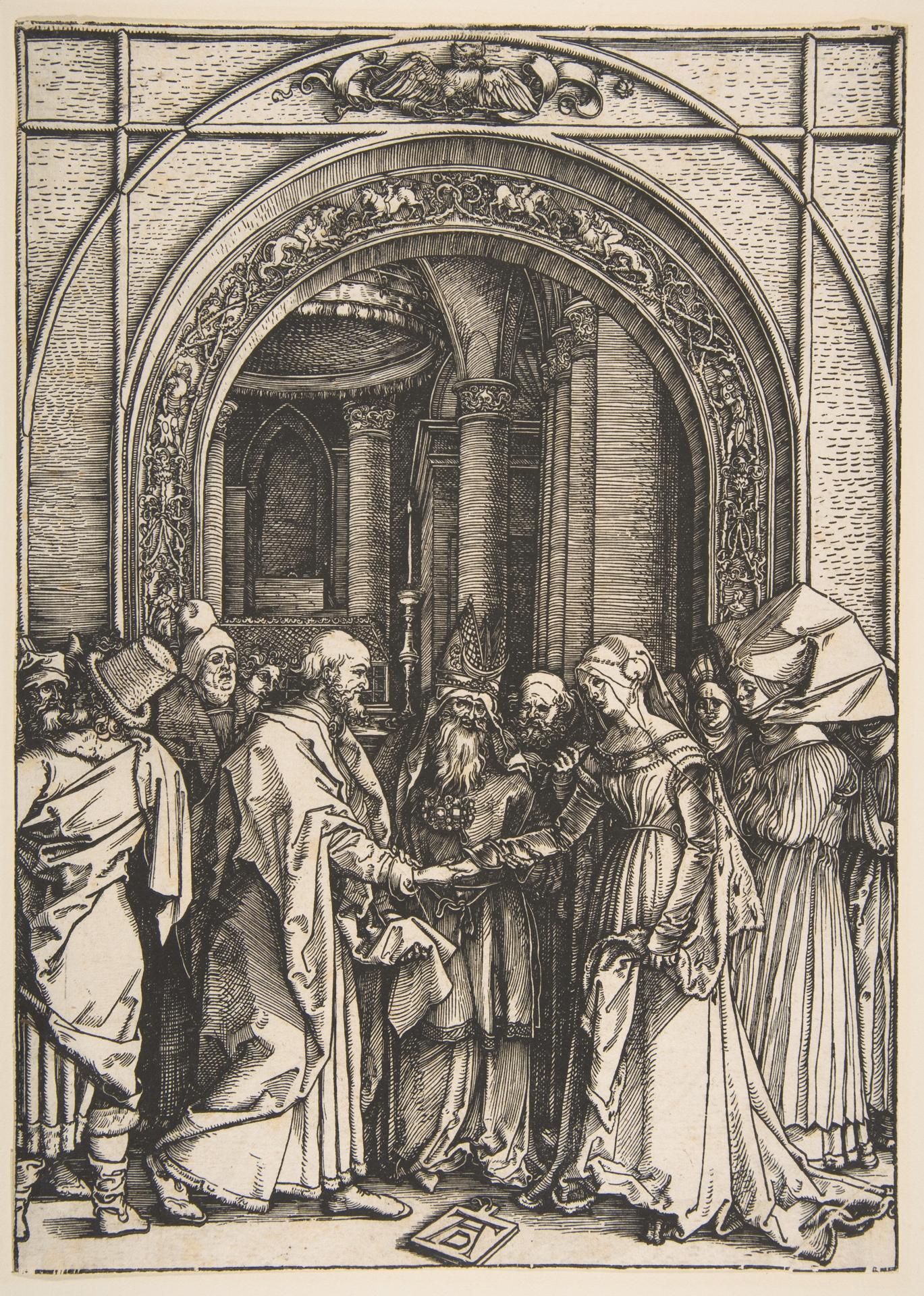
The Betrothal of the Virgin, from "The Life of the Virgin"
Original title: The Betrothal of the Virgin, from "The Life of the Virgin"
kurzbeschreibung
Unlike many contemporary betrothal pictures, this woodcut by Albrecht Dürer, made around 1504, puts the ceremony itself at the heart: Mary and Joseph join hands before a church, surrounded by a crowd of witnesses. The sheet belongs to the series 'The Life of the Virgin'.
Description
An ornate arch with decorative motifs and an eagle frames the couple: Joseph, bearded and in a white robe, takes Mary's hand and looks at her, while she, in a long dress, returns his gaze. Behind them appear columns, an altar, and a window. The layout is strictly symmetrical; men and women press in from the sides and foreground to watch the event.
Context
The woodcut series 'The Life of the Virgin' was produced in Nuremberg between 1502 and 1505. It was part of a large undertaking that brought the Marian legend to a broad audience in pictures. The betrothal scene relies on the apocryphal tradition that a divine sign chose Joseph as Mary's husband.
Impact
The clear linework and symmetrical arrangement give the sheet a calm, solemn presence. The richly detailed faces and garments draw the eye to the central gesture of hand-joining, which encapsulates the union of Joseph and Mary.
Technique
Dürer's fine, precise lines carve out the shadows and individual details of the scene, from the ornate archway with its eagle to the faces of Joseph and Mary. The monochrome execution and even distribution of light give the sheet its characteristic clarity, drawing attention to the symmetrical composition and the richly decorated clothing of the assembled figures.
AI-generated description text
Source: Metropolitan Museum of Art · Public Domain (CC0 1.0)