A Poison Tree
Original title: Songs of Experience: A Poison Tree
kurzbeschreibung
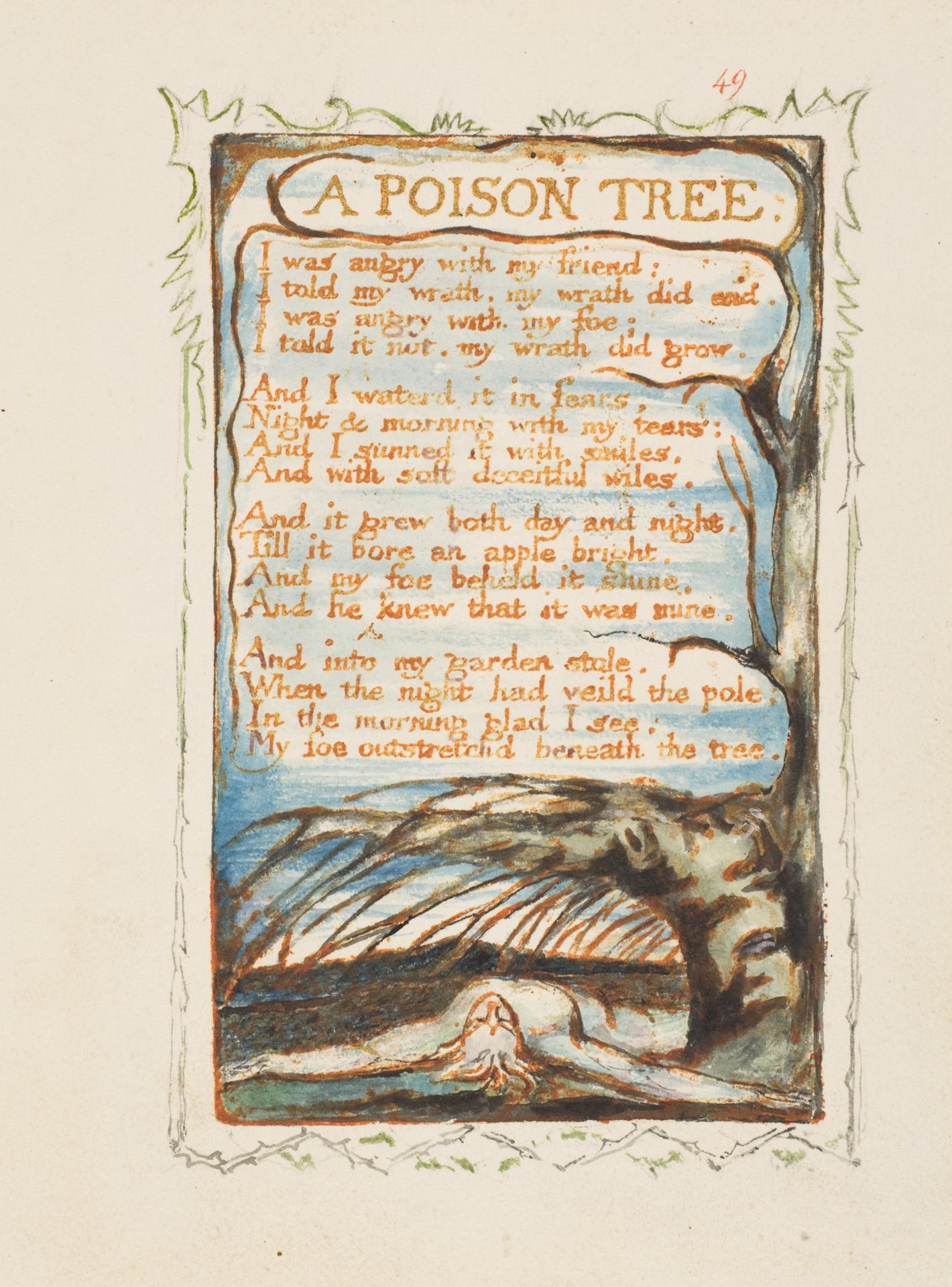
With 'A Poison Tree' from the Songs of Experience, William Blake secures a key position within his graphic oeuvre. This impression, printed around 1825, shows a tree with a human figure lying beneath it on the ground. It is executed as a relief etching in orange-brown ink, then hand-colored with watercolor and shell gold.
Description
A canopy of branches arches upward and dissolves into a blue sky. At the foot of the tree lies a pale human figure, twisting upward in a posture contorted with pain. A border frames the motif, with the title 'A POISON TREE' at the top and the poem below in orange lettering. Blue, brown, green and orange dominate the palette; light falls from above, sharpening the contours.
Context
Blake published the Songs of Experience in 1794 as a counterpart to the Songs of Innocence, which had appeared five years earlier. The text of 'A Poison Tree' revolves around suppressed anger and its destructive effects. This impression belongs to a later edition of around 1825, which Blake printed and colored himself.
Impact
Delicate watercolor tones meet bold contours, creating an atmosphere that is at once fragile and menacing. The figure lying on the ground beneath the tree distills the image into a haunting language of decay and retribution that lingers long after.
Technique
For printing, Blake used his own relief etching process: the printing areas remain raised while the spaces between are etched away. Printing was done in orange-brown, followed by hand-coloring with watercolors and shell gold, so that each impression bears its own individual traits.
AI-generated description text
Source: Metropolitan Museum of Art · Public Domain (CC0 1.0)