Songs of Experience: Infant Sorrow
Original title: Songs of Experience: Infant Sorrow
kurzbeschreibung
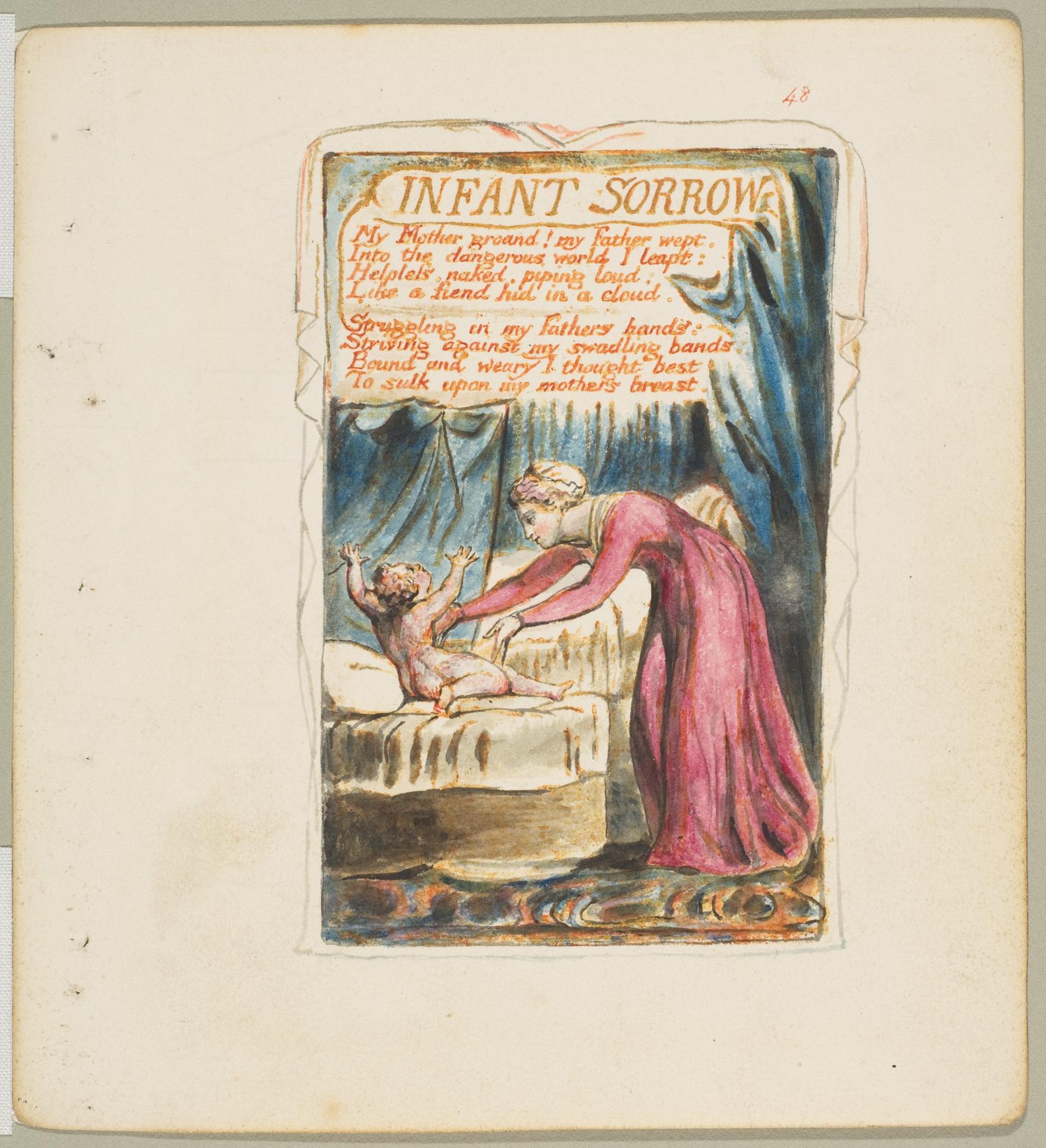
William Blake's relief etching Infant Sorrow, from the Songs of Experience of 1794 and printed around 1825, shows a woman in a red robe comforting a naked child on a bed, with a poem set beside them in orange lettering. The print was hand-coloured with watercolour and shell gold.
Description
A naked child sits up on a bed and stretches both arms upward, while a woman in a red robe touches the small body and seems to soothe it. Upper right carries the heading INFANT SORROW, with the poem below in orange script. Dark curtains close off the background and give the scene a hushed, private feel. Warm reds, oranges and golds dominate the palette, lifted by the hand-colouring and shell gold. The arrangement is centred, drawing the eye to the exchange between woman and child.
Context
Blake first published the Songs of Experience in 1794 as a counterpart to the Songs of Innocence of 1789, and the two were later issued together in one volume. The poem Infant Sorrow reads birth as a traumatic event and reflects Blake's critical view of the social and religious constraints of his time. This impression, printed around 1825, comes from a later run that Blake produced himself in his London workshop. Barely known during his lifetime, his work was only fully recognised in the twentieth century.
Impact
Delicate hand-colouring against firm linear work gives the image an emotional immediacy that stresses the infant's vulnerability. The warm colours and intimate setting sit in quiet tension with the melancholy of the poem, which leaves the viewer thoughtful. Text and image merge into a single aesthetic experience, as is characteristic of Blake's illuminated prints.
Technique
Made by relief etching, in which the non-printing areas are bitten away and the raised lines take up the ink, the sheet was printed in orange-brown ink. Watercolour and shell gold were then applied by hand. This allowed Blake to combine text and image in a single printing pass and to finish each impression individually.
AI-generated description text
Source: Metropolitan Museum of Art · Public Domain (CC0 1.0)