Songs of Experience: London
Original title: Songs of Experience: London
kurzbeschreibung
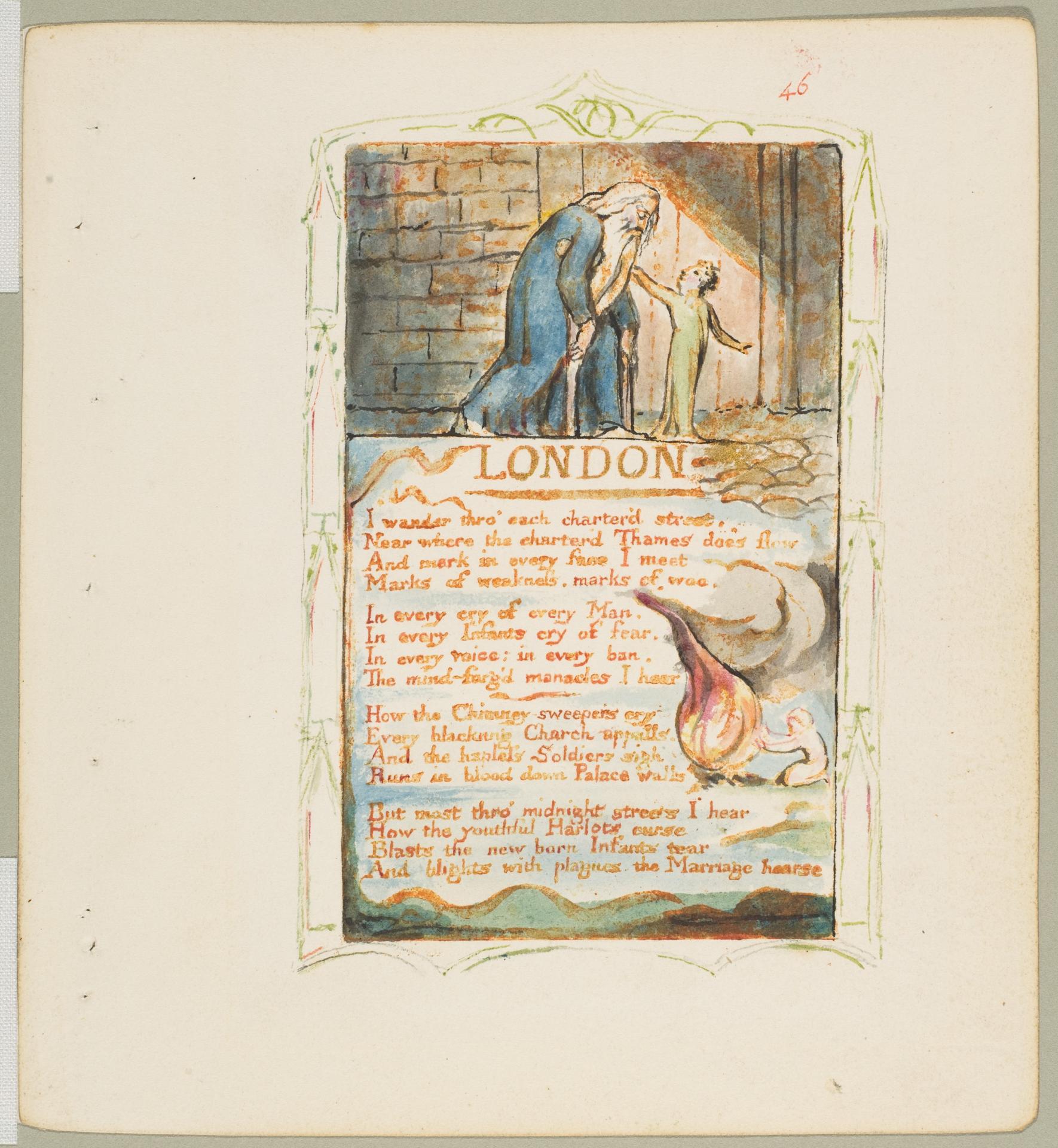
Written around 1794 for William Blake's Songs of Experience, the poem 'London' appears here in an impression pulled only about 1825. Executed as a relief etching in orange-brown ink and finished by hand with watercolor and shell gold, the sheet sets a crowded figural scene beside a text that takes up the social ills of contemporary London.
Description
At the top, two figures meet: a wooden statue of a woman in a blue robe takes the hand of a child dressed in pale garments. Stone masonry forms the backdrop and frames the pair. Beneath them sits a block of lettering, the title 'LONDON' in large type above the poem printed in orange. Lower right, flames and smoke rise in an abstract rendering of fire. Orange, brown and gold dominate the palette, giving the page a lively, dramatic charge.
Context
Blake conceived the Songs of Experience as a counterpart to his Songs of Innocence of 1789; he issued both parts together in 1794. The cycle registers the social and political grievances of late eighteenth-century London — poverty, child labor, the fallout of the Industrial Revolution. This particular print was made around 1825, late in Blake's career, and displays the relief-etching process he developed himself. Hand-coloring with watercolor and shell gold belonged to his working method, which he often carried out together with his wife Catherine.
Impact
Strong warm color and expressive line create an emotional density that makes the figures' suffering almost tangible. The clear layout, with the text block at its center and symbolic elements such as the fire at the edges, gives the sheet a dramatic yet poetic presence. The precision of the relief etching and the luminous coloring draw the viewer into Blake's somber but visually rich world.
Technique
The image was printed from a relief-etched plate, in which the non-printing areas are bitten away so that lines and flat passages stand proud. Printing was done in orange-brown ink on paper. The surfaces were then colored by hand with watercolor and shell gold, which lends the sheet its particular sheen and its individual character. This method allowed Blake to unite text and image in a single printing pass and to vary the appearance of each impression.
AI-generated description text
Source: Metropolitan Museum of Art · Public Domain (CC0 1.0)