Songs of Experience: My Pretty Rose Tree, Ah! Sun-Flower, The Lilly
Original title: Songs of Experience: My Pretty Rose Tree, Ah! Sun-Flower, The Lilly
kurzbeschreibung
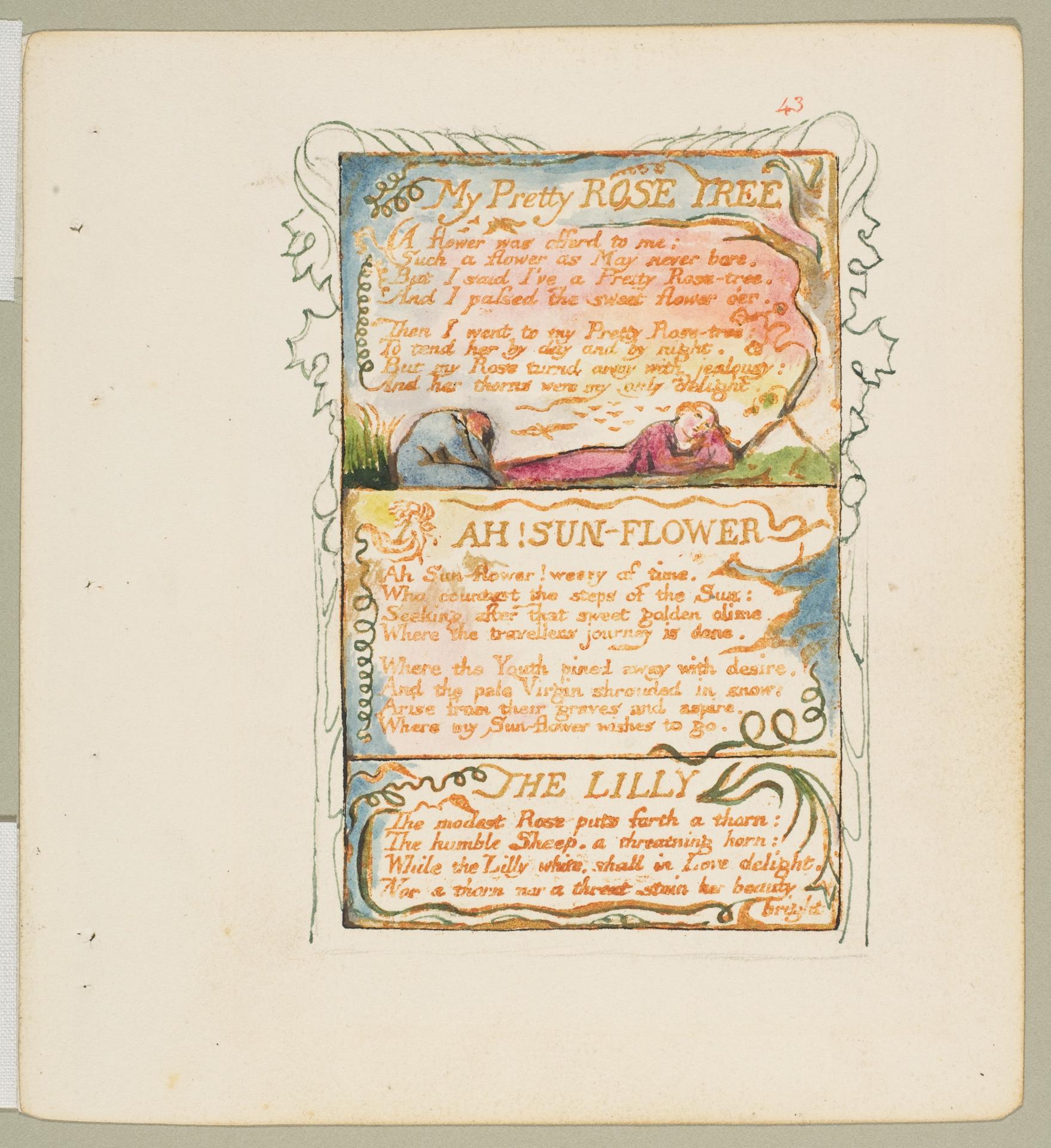
Three poems from William Blake's Songs of Experience (1794, printed around 1825) are gathered on this sheet in an ornamental layout. The relief etching in orange-brown ink takes its colour from hand-applied watercolour and shell gold.
Description
Each of the three poems sits in its own frame of foliage and tendrils. In the upper field two embracing figures lie on the ground, one in a red blouse and blue trousers, the other in red trousers and a blue top. A stylised sun and clouds surround the middle poem, Ah! Sun-Flower, with no figures at all. In the lower field, for The Lilly, flowers and plants grow inside a scrolling border. Orange, brown and pink set the warm palette, and the light falls evenly across the sheet.
Context
The Songs of Experience were made as a counterpart to the Songs of Innocence of 1789; in them Blake turned to the darker sides of human existence. This sheet belongs to a late printing of about 1825, pulled by Blake shortly before his death. Love, desire and purity are lit from different directions in the three poems, reflecting his critical eye on social norms.
Impact
Word and image are bound so closely that a quiet, almost devotional mood settles over the page and invites you to linger. The warm tones laid on by hand give the sheet something precious, nearly luminous, and make it plain how Blake understood poetry and visual art as one.
Technique
Blake worked in the relief etching method he developed himself: the drawing went onto the plate in an acid-resistant varnish, and the background was then etched away. Printing was done in orange-brown ink; colouring with watercolour and shell gold followed, done by hand, which makes every copy unique.
AI-generated description text
Source: Metropolitan Museum of Art · Public Domain (CC0 1.0)