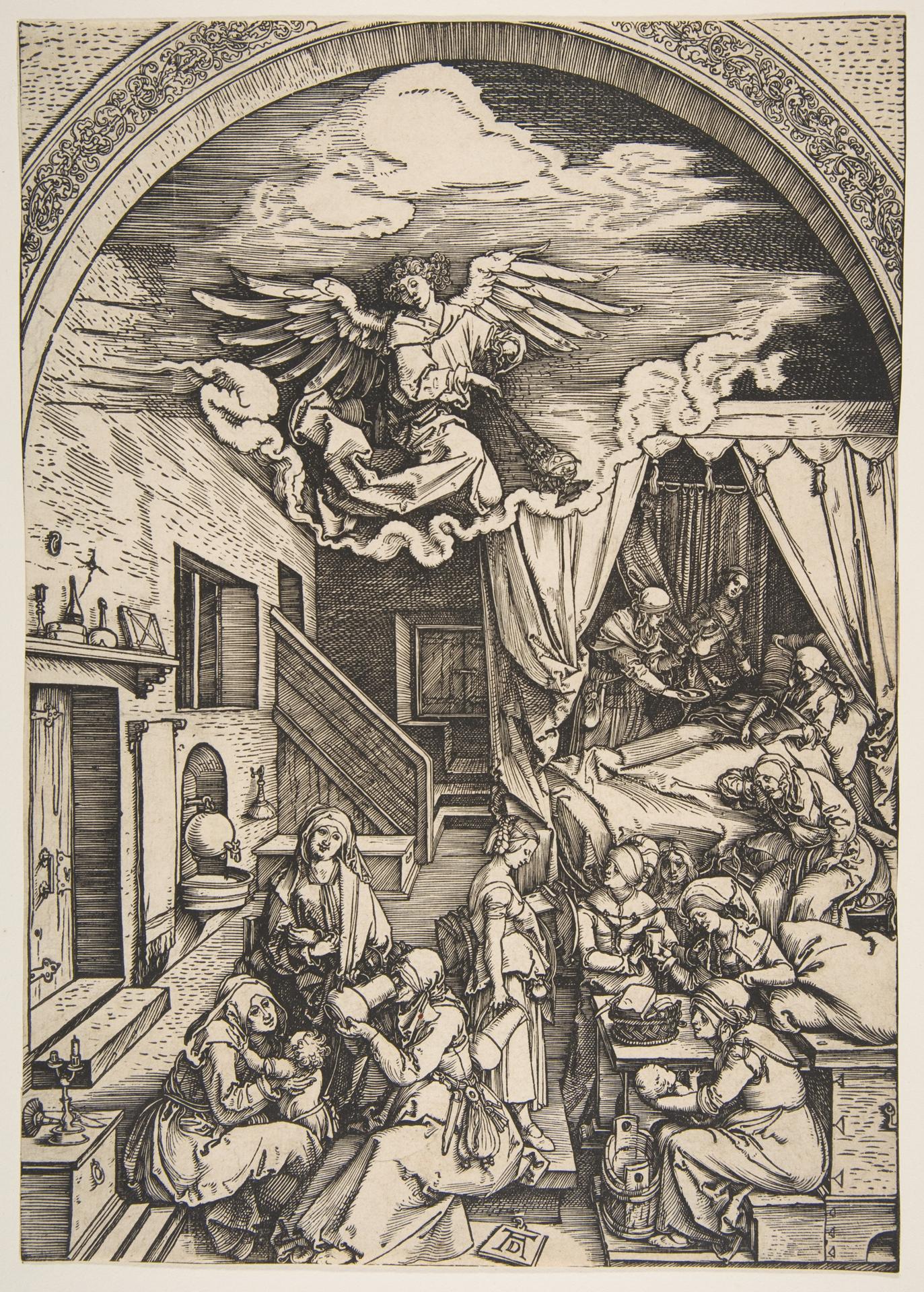
The Birth of the Virgin, from "The Life of the Virgin"
Original title: The Birth of the Virgin, from "The Life of the Virgin"
kurzbeschreibung
The Birth of the Virgin is a woodcut by Albrecht Dürer, created around 1503 as part of his series on the Life of the Virgin. It depicts the birth of the Virgin Mary, surrounded by attendants and an angelic announcement. The work is a monochromatic print, characteristic of Dürer's detailed graphic style.
Description
The composition centers on Mary, who lies on a bed, attended by a group of women providing support and care. Above, an angel with spread wings appears amid clouds, symbolizing the divine announcement of the birth. The room includes a staircase, a clock, and various objects in the background, adding domestic detail. The figures are dressed in traditional garments, and the scene is symmetrically arranged around the central figure. The print is monochrome, with even lighting typical of woodcut technique.
Context
Dürer created this woodcut around 1503 as part of his Life of the Virgin series, which illustrated key events from the life of the Virgin Mary. The series was highly popular and contributed to Dürer's reputation as a master printmaker. The scene reflects late medieval and Renaissance devotional practices, emphasizing Mary's role in Christian salvation. Dürer's work was influenced by both Northern European traditions and Italian Renaissance art, which he encountered during his travels.
Impact
The woodcut conveys a sense of intimate, sacred domesticity, balancing human tenderness with divine presence. Dürer's precise lines and detailed background invite close inspection, drawing the viewer into the narrative. The symmetrical composition and calm atmosphere evoke a contemplative mood, typical of devotional prints of the period.
Technique
This is a woodcut, a relief printing technique where the image is carved into a wooden block, inked, and transferred to paper. Dürer's mastery of the medium is evident in the fine lines and intricate details, achieved through careful carving. The monochromatic palette is inherent to the technique, relying on line and texture to create depth and form.
AI-generated description text
Source: Metropolitan Museum of Art · Public domain (CC0)