Songs of Experience: The Fly
Original title: Songs of Experience: The Fly
kurzbeschreibung
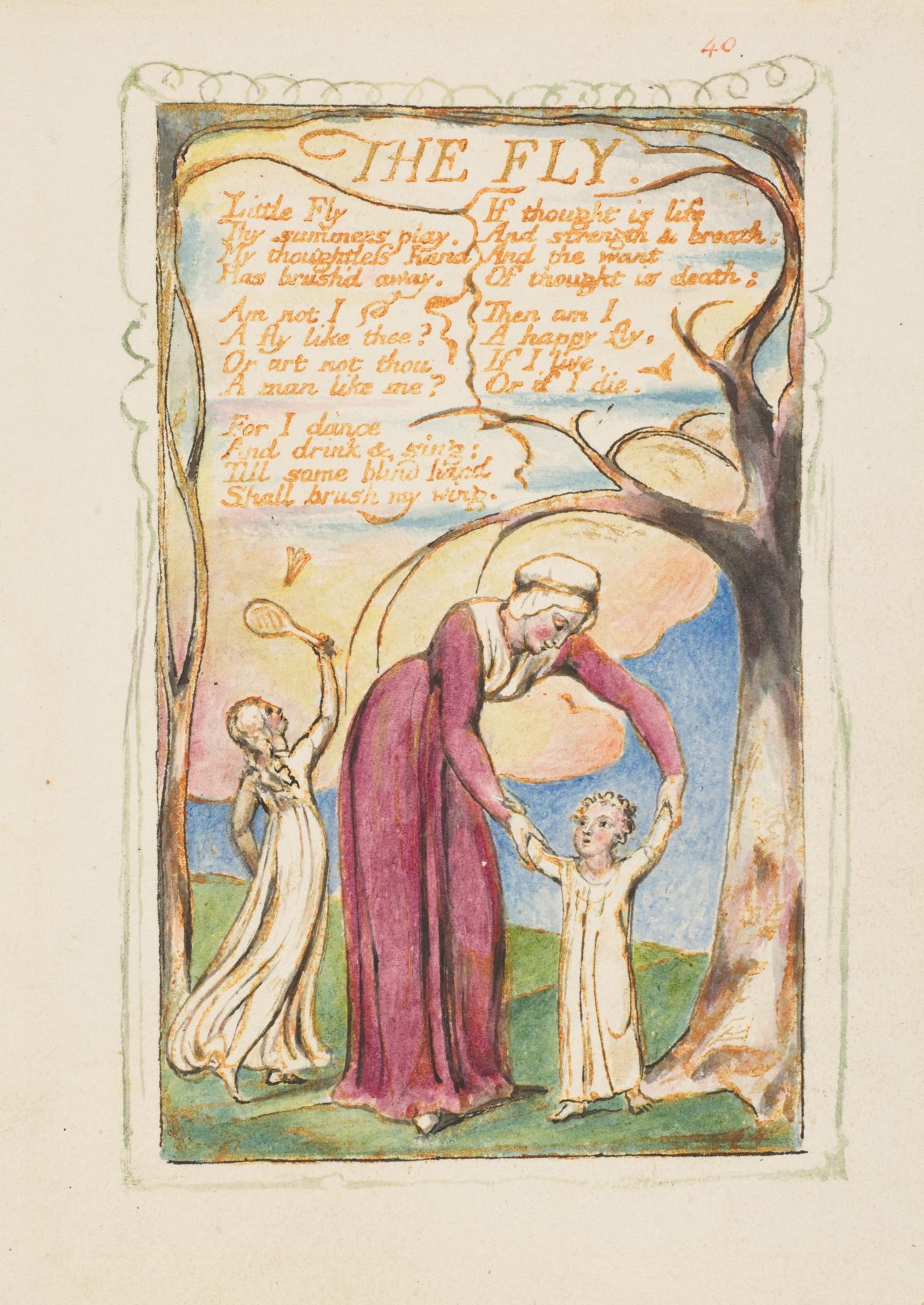
A woman with two children in a rural setting, framed by two trees, belongs to William Blake's cycle 'Songs of Experience.' The etching was made in 1794, and the present print was produced around 1825. The image and the accompanying poem together form a philosophical reflection on life and death.
Description
In a purple gown, a woman leads two children dressed in white by the hand. The children hold fly-swatters while she guides them gently. Two trees enclose the scene in the background. Above the image, the words 'THE FLY' appear in large letters, with the poem set alongside. Warm tones of orange, brown, and purple dominate the palette; light falls evenly from above onto the figures.
Context
This plate comes from Blake's illustrated volume 'Songs of Experience,' first published in 1794. In his illuminated prints, Blake linked poetry and image to convey moral and spiritual content. The printing around 1825 falls in a period when Blake was gradually gaining recognition for his work, yet he continued to live in modest circumstances. The 'Songs of Experience' form the counterpart to the 'Songs of Innocence' and bring the darker sides of human existence into view.
Impact
Delicate hand-coloring and strong outline lines create an almost meditative mood. The playing children and the calm woman spread an atmosphere of security, which the poem about the fly, however, tinges with melancholy. The warm colors and soft light make the image appear at once familiar and remote.
Technique
In relief etching, the non-printing areas are etched away so that the lines remain as raised ridges that take up the ink. Printing was done in orange-brown ink; hand-coloring with watercolors and shell gold followed. In this way Blake could design each sheet individually and vary the colors according to mood.
AI-generated description text
Source: Metropolitan Museum of Art · Public Domain (CC0 1.0)