Songs of Experience: Nurses Song
Original title: Songs of Experience: Nurses Song
kurzbeschreibung
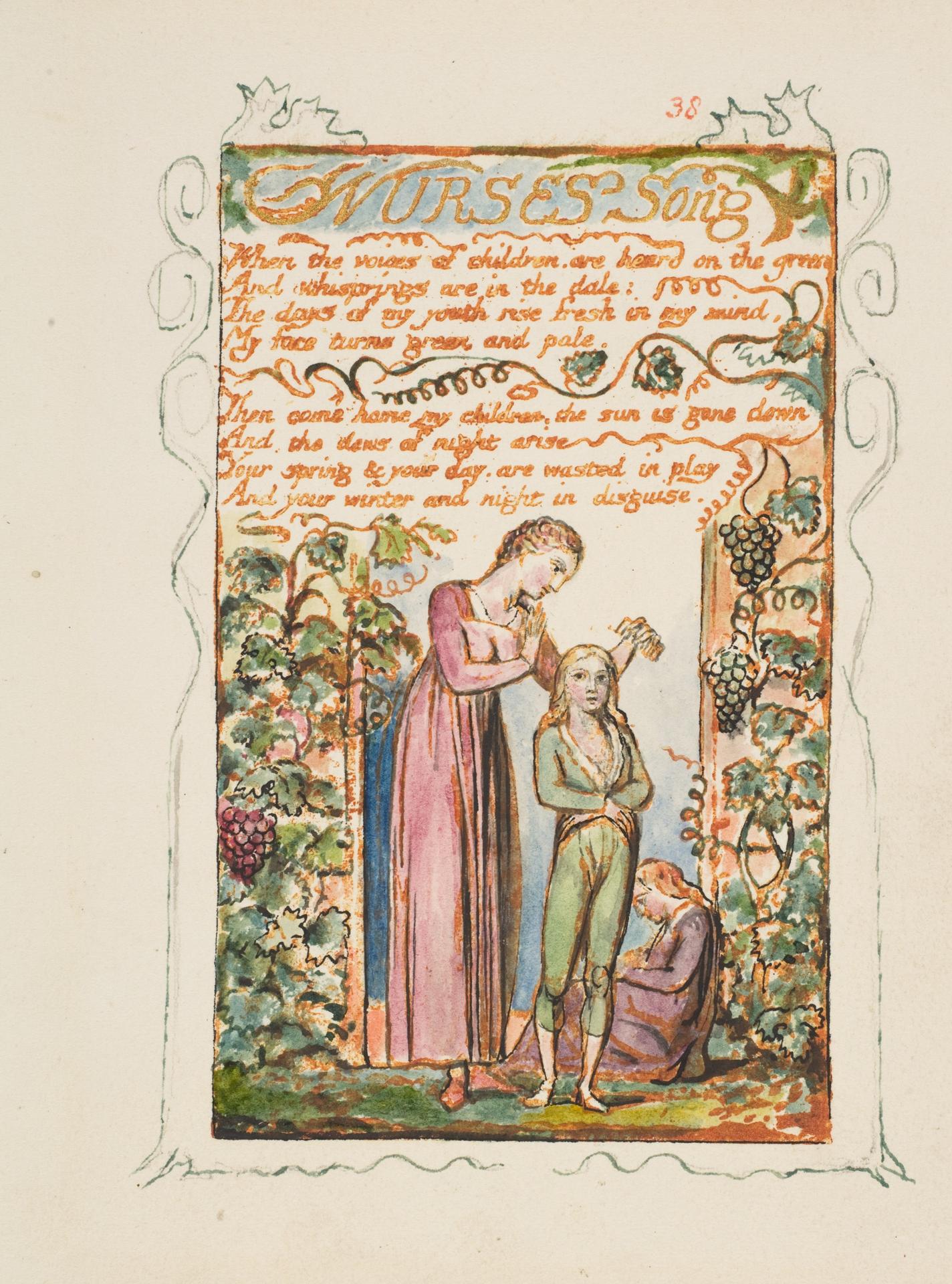
Made in 1794 and printed around 1825, this sheet by William Blake belongs to his illustrated poetry collection 'Songs of Experience'. The relief etching in orange-brown ink was hand-coloured with watercolour and shell gold. It shows a nurse gently stroking a young woman's hair, with vine tendrils surrounding the two figures.
Description
Two women form the focal point: an adult in a long pink-red gown lays her hand softly in the hair of the younger one, who wears a green top and short trousers. The younger stands upright and turns toward the older. Grapevines and leaves frame the scene behind them. Below, a third figure kneels, bent forward. The hand-colouring brings lively colour; light falls evenly, without strong shadows.
Context
The sheet comes from Blake's cycle 'Songs of Innocence and of Experience', which he printed and coloured himself as an illuminated book. The year 1794 marks the creation of the Experience songs, conceived as a counterpart to the Innocence songs. The fact that the printing took place around 1825 shows how Blake reproduced his works himself in small editions over decades. The poems deal with the loss of childhood innocence and the constraints of the adult world.
Impact
The gentle touch and warm colours give the scene something intimate and at the same time melancholic. Ornamental framing and figurative depiction combine into a dreamlike atmosphere characteristic of Blake's book art. The luminous watercolour tones and the gold lend the sheet a precious, almost meditative radiance.
Technique
Blake used the relief etching process he developed: the drawing was etched into a copper plate so that the lines remained raised. Printing was done in orange-brown ink; then hand-colouring followed with watercolours and shell gold. This process allowed a close connection between text and image, since both were printed in a single operation.
AI-generated description text
Source: Metropolitan Museum of Art · Public Domain (CC0 1.0)