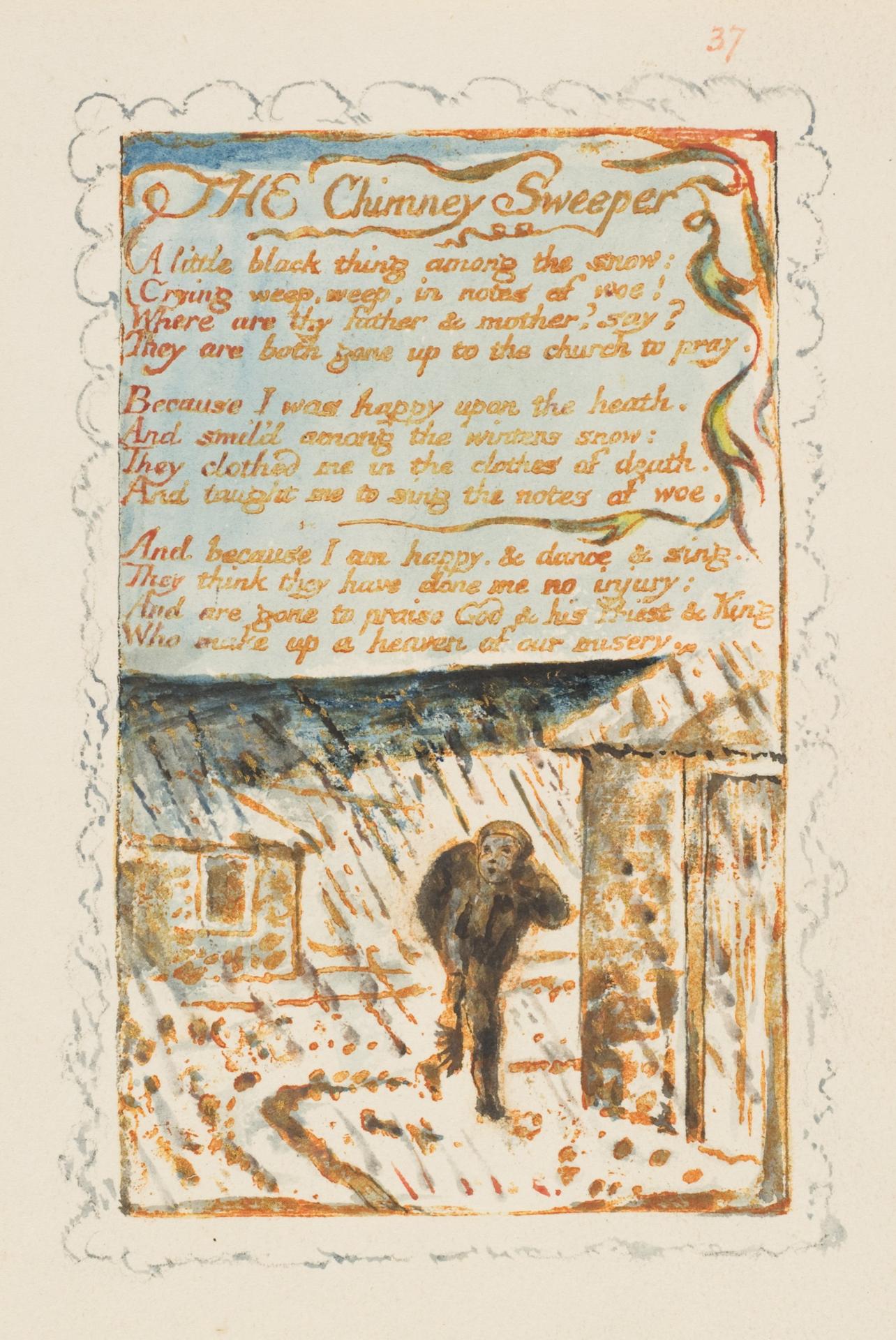
The Chimney Sweeper
Original title: Songs of Experience: The Chimney Sweeper
kurzbeschreibung
A chimney-sweeper boy stands in a snow-covered landscape, a motif from William Blake's 'Songs of Experience'. The relief etching in orange-brown, created around 1794 and printed about 1825, combines watercolor and gold highlights. Text and symbolic scene are united on a single sheet.
Description
At the top, a text panel opens with the poem in orange letters. Below, a small boy in dark clothing stands amid the snow; his face looks troubled, his gaze drifting into the distance. A plain house with an open gate, through which snow blows, forms the backdrop. Blues and grays dominate the palette, creating a cold, lonely mood. A wavy ornament frames the sheet decoratively.
Context
In 1794 Blake issued 'Songs of Experience' as a companion to 'Songs of Innocence' of 1789. The poem addresses the social plight of chimney-sweeper boys in 18th-century London, who often lived in poverty and exploitation. Blake's critique of church and monarchy becomes clear in verses that denounce a religion that has constructed a 'heaven from our misery'. The fact that the print was made around 1825 shows that Blake produced and colored his works himself over decades.
Impact
The barren snowscape and the sad boy condense into an atmosphere of abandonment. The cool coloring and delicate hand-coloring give the sheet a fragile, almost elegiac beauty. The wavy border contrasts with the strict pictorial order and underscores the artistic will to design.
Technique
For the relief etching that Blake developed himself, the drawing is etched into the printing plate so that the lines remain raised. Printing was done in orange-brown; then hand-coloring with watercolors and shell gold followed. This combination of printmaking and manual painting characterizes Blake's illuminated prints.
AI-generated description text
Source: Metropolitan Museum of Art · Public Domain (CC0 1.0)