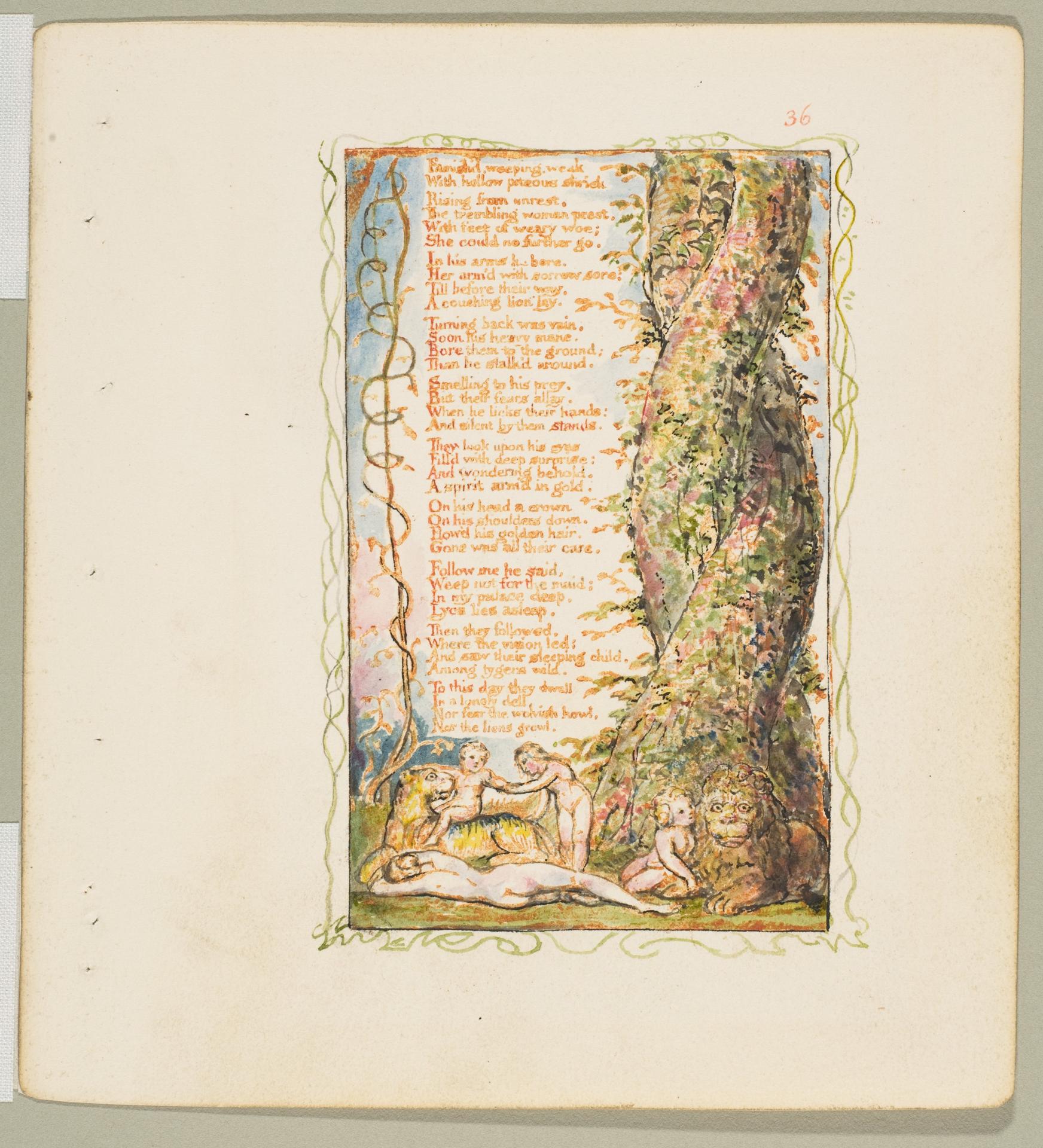
Songs of Experience: The Little Girl Found (second plate)
Original title: Songs of Experience: The Little Girl Found (second plate)
kurzbeschreibung
Unlike the other plates of the Songs of Experience, this relief print by William Blake, struck around 1825 from a plate of 1789, brings a tree scene together with figures and a poem. The hand-colored impression, worked in watercolor and shell gold, belongs among the late pulls from the plate.
Description
A powerful tree, heavy with leaves and blossom, holds the middle of the image. Beneath it on the ground two naked figures lie at rest, while two childlike figures sit nearby. A border of tendrils and leaves encloses the scene, and further plants are hinted at behind. Across the full width above the picture runs an English poem. Warm oranges, browns, and golds govern the coloring, and the light falls evenly, casting no shadows.
Context
Blake first published the Songs of Experience in 1794 as a counterpart to the Songs of Innocence. This impression was taken around 1825, pointing to a later issue. Blake devised relief etching, in which text and image are etched together onto a single copper plate. The poem The Little Girl Found tells of the search for a lost girl and her recovery in a symbolic landscape.
Impact
Warm color and floral ornament give the sheet a calm, almost idyllic mood. The naked figures beneath the tree feel archetypal and lend the work something timeless and symbolic. The even light and delicate gold accents create the impression of a crafted, nearly sacred image.
Technique
In relief printing the non-printing parts of the plate are etched away, leaving the lines standing in relief. Blake printed in orange-brown ink and then colored by hand with watercolor and shell gold. In this way he could print text and image in a single pass and treat each copy individually.
AI-generated description text
Source: Metropolitan Museum of Art · Public Domain (CC0 1.0)