Songs of Experience: The Little Girl Lost
Original title: Songs of Experience: The Little Girl Lost
kurzbeschreibung
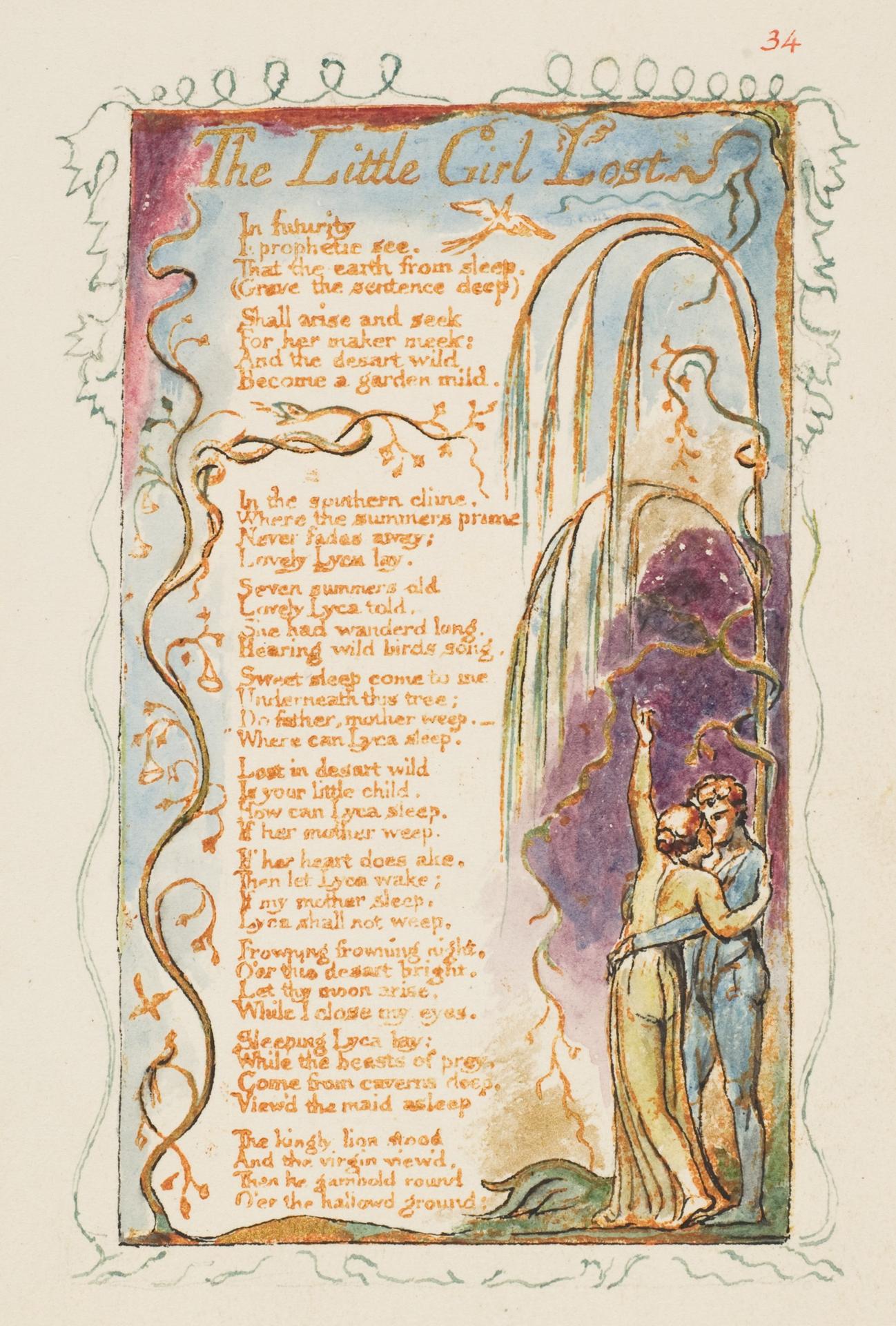
This plate belongs to William Blake's 'Songs of Experience' and presents the poem 'The Little Girl Lost'. Printed around 1825 as a relief etching, it was afterwards hand-coloured with watercolour and shell gold. Text and image are bound together in a balanced, symmetrical arrangement.
Description
The layout is symmetrical: the poem occupies the left side, while an illustration fills the right. Two figures embrace—one in a long dress, the other in shirt and trousers. An arch of vines and leaves frames the scene behind them. Warm oranges and browns dominate, accented with gold and blue. Light falls evenly, with no discernible shadows.
Context
Blake published 'Songs of Experience' as a counterpart to 'Songs of Innocence' of 1789. In it he explored the loss of childhood innocence through social constraints. The poem 'The Little Girl Lost' reflects his critical stance toward authoritarian morality. This version was printed around 1825—the year before Blake's death, when he reissued his works.
Impact
The union of text and image creates a calm, meditative mood. Warm colours and the symmetrical arrangement give the plate a sacred aura. The delicate hand-colouring underscores the scene's mystical symbolism.
Technique
Relief etching was used, in which the non-printing areas are etched away. The orange ink was then hand-coloured with watercolour and shell gold. This method allowed Blake to intertwine typography and image closely.
AI-generated description text
Source: Metropolitan Museum of Art · Public Domain (CC0 1.0)