Songs of Innocence: Nurse's Song
Original title: Songs of Innocence: Nurse's Song
kurzbeschreibung
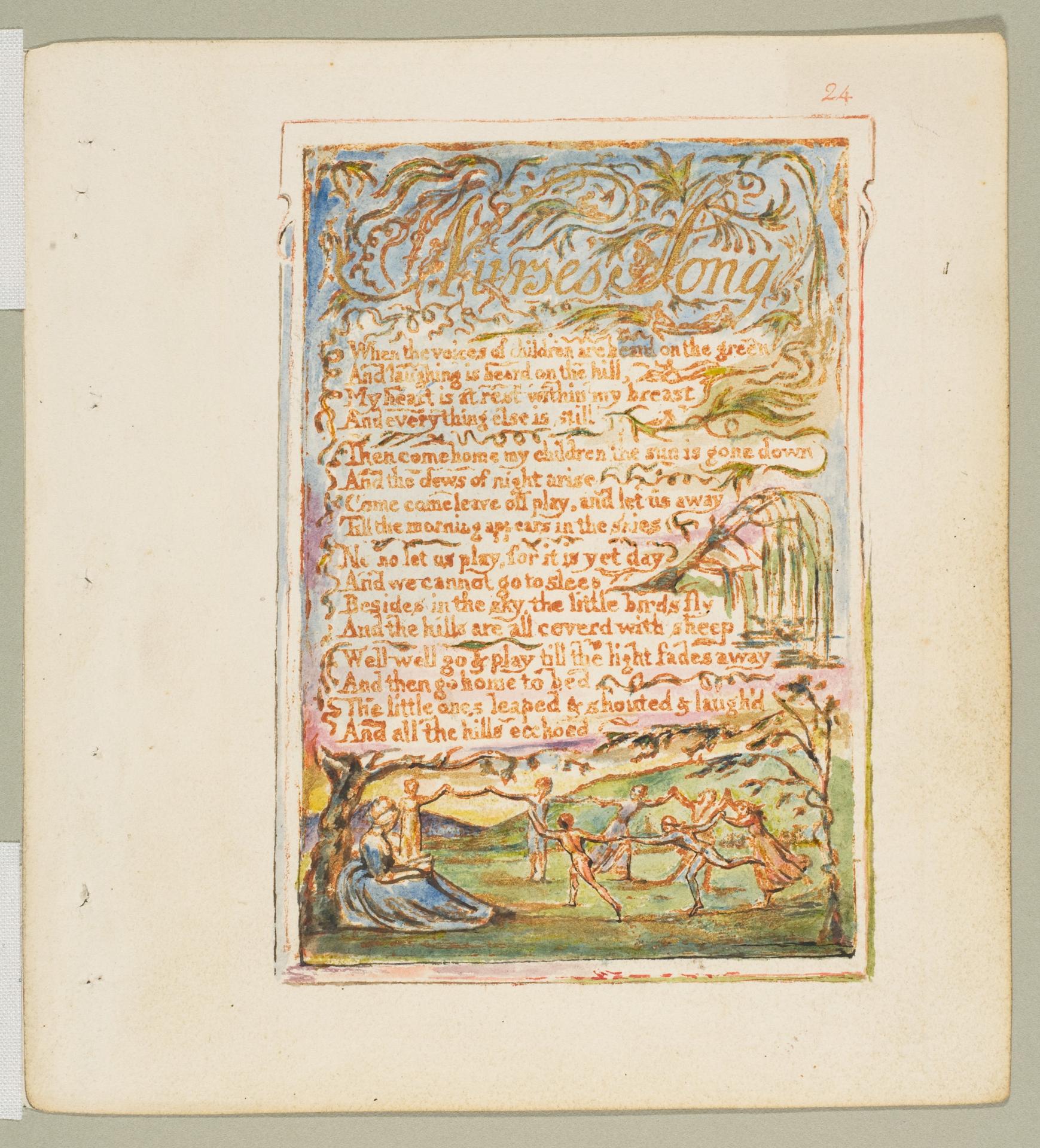
Nurse's Song pairs a poem with a rural dance scene on this sheet, part of William Blake's Songs of Innocence, first published in 1789; the version here was made around 1825. It is a relief etching in orange-brown ink, afterwards colored by hand with watercolor and shell gold.
Description
A seated woman at the left watches dancing figures who move beneath the poem placed at the middle of the sheet. Leaves and tendrils enclose the text in a frame. Gentle hills and trees form the backdrop, held in warm, lively colors. Soft light lies over the scene and strengthens its peaceful, cheerful mood. The figures are drawn with simple lines that are nonetheless richly varied.
Context
With Songs of Innocence Blake set out to fuse poetry and image into a single whole. To that end he developed relief etching, in which text and picture are etched together into a copper plate. The series arose in an age of social upheaval and reflects Blake's idealized idea of childhood innocence. The coloring of around 1825 probably comes from Blake himself or from his wife Catherine.
Impact
The ornamental frame and the idyllic setting combine into a harmonious, almost meditative whole. Warm tones and soft light create an atmosphere of security and an unspoiled world. At the same time the detailed execution draws the eye to the interplay of text and image that was fundamental to Blake's understanding of art.
Technique
In relief printing the non-printing areas of the copper plate were etched away, leaving the lines standing in relief. Printing was done in orange-brown ink; manual coloring with watercolor and shell gold followed. This union of printing ink and hand-applied color marks Blake's illuminated prints.
AI-generated description text
Source: Metropolitan Museum of Art · Public Domain (CC0 1.0)