Songs of Innocence: Night (second plate)
Original title: Songs of Innocence: Night (second plate)
kurzbeschreibung
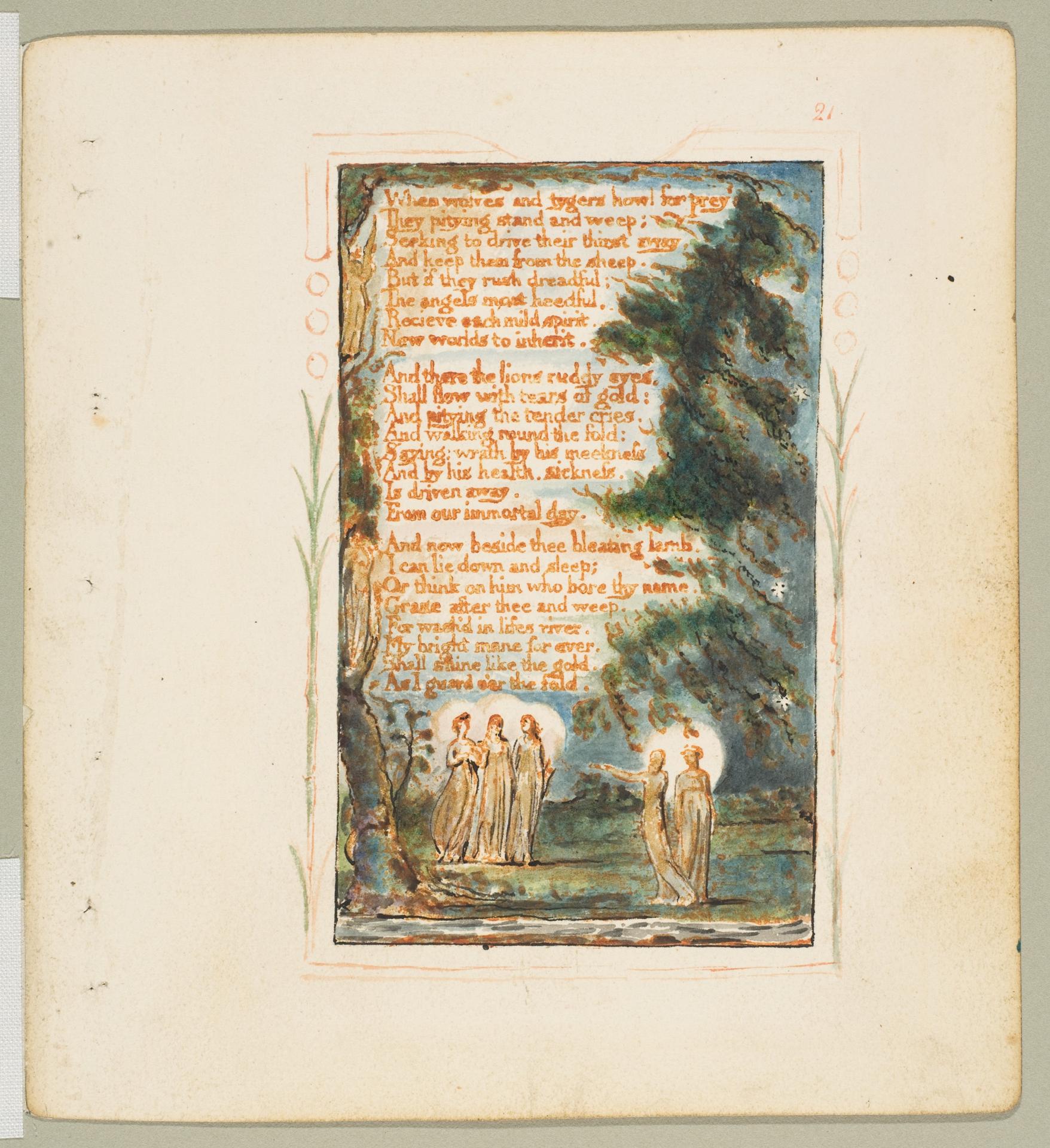
William Blake's "Night (Second Plate)" belongs to his illustrated poetry collection "Songs of Innocence" of 1789; this particular print was made around 1825. It is a relief etching in orange-brown ink, afterwards hand-coloured with watercolour and shell gold. The image presents a nocturnal encounter of figures in traditional dress, set within a wooded landscape beneath a bright moon.
Description
An outdoor night scene is enclosed by an orange frame. Several figures in traditional clothing stand in the foreground, surrounded by nature. Trees and a night landscape emerge further back, while a moon glows in the sky. Calligraphic lines of poetry run from left to right across the sheet and are integrated into the frame. Earth tones dominate, with accents of gold and white.
Context
The "Songs of Innocence" first appeared in 1789 and formed part of Blake's self-printed and coloured illuminated books. The second plate of "Night" arose in this context; later the songs were combined with the "Songs of Experience" (1794). The present impression comes from a later printing around 1825, indicating continuing interest in Blake's work. For his books Blake developed his own relief etching method, which allowed him to print and colour in a controlled operation.
Impact
Delicate hand-colouring and strong orange-brown lines create a quiet, almost meditative mood. The night view feels both familiar and sublime through the earthy tones and gold-white accents. Because text and image are closely interwoven, the sheet invites reading poetry and visual art as a unity.
Technique
In relief etching the non-printing areas are etched away so that the lines remain raised. Printing was done in orange-brown ink; hand-colouring with watercolours and shell gold followed. This combination of printing and manual work gives each copy its own character.
AI-generated description text
Source: Metropolitan Museum of Art · Public Domain (CC0 1.0)