Songs of Innocence: The Divine Image
Original title: Songs of Innocence: The Divine Image
kurzbeschreibung
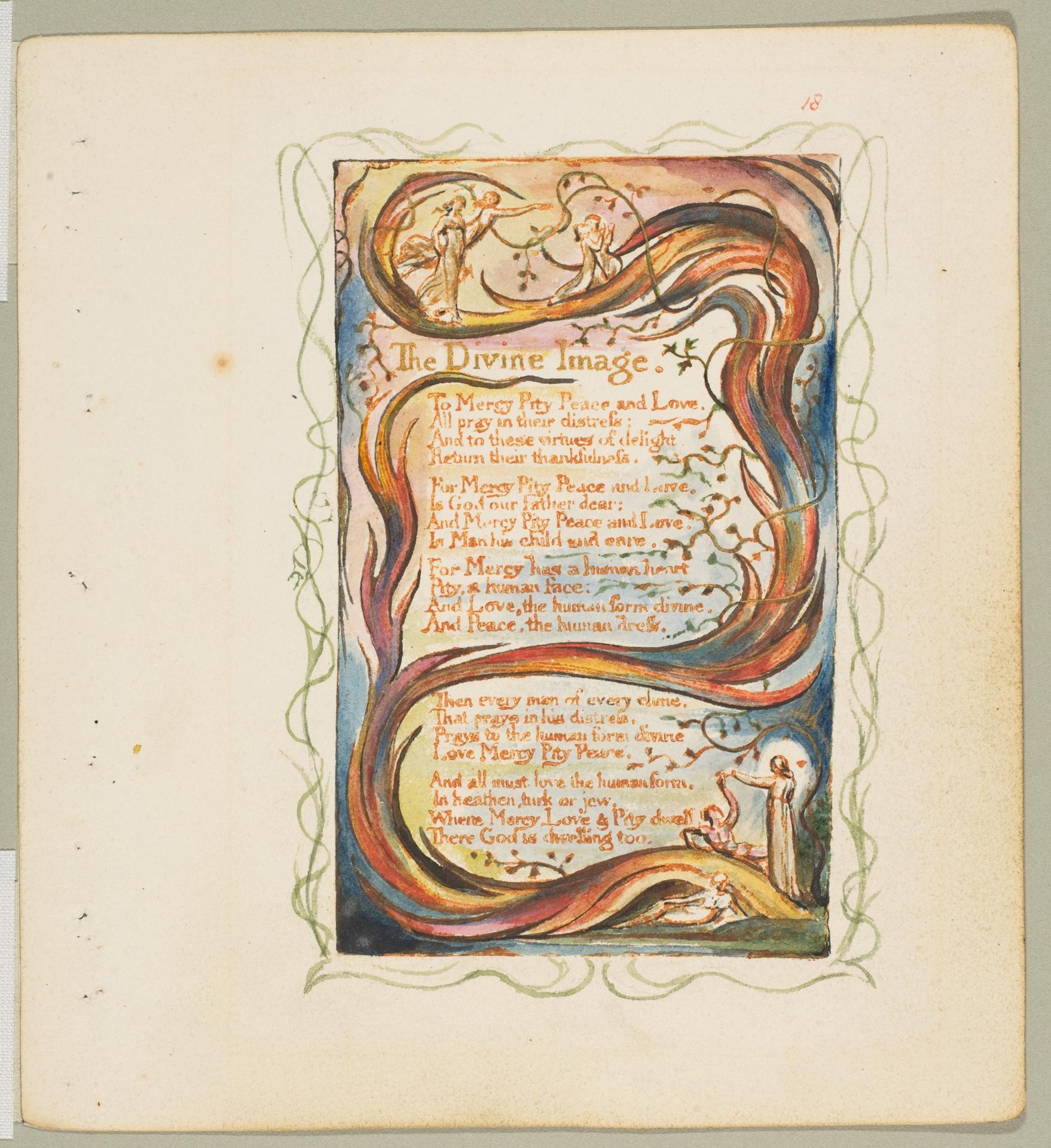
William Blake's Songs of Innocence includes the poem 'The Divine Image', presented here in an illuminated print. The first creation dates from 1789; this copy was printed around 1825 as a relief etching in orange-brown ink and then hand-colored with watercolor and shell gold. Text and image form a unity in which Blake's idea of the divine within the human becomes vivid.
Description
A dense mesh of greenish tendrils frames the sheet as a floral border. A block of text with the heading 'The Divine Image' occupies the middle, its lines in clear handwriting carrying religious content. Above the text, two figures twist in a flowing, dance-like movement, their bodies in earthy tones. Below, a hand emerges from the text block and carries a figure dressed in white and gold on a pedestal, underscoring its sacred meaning. Warm, lively colors are distributed evenly across the sheet; the light remains soft, with no harsh shadows.
Context
In 1789 Blake brought out the Songs of Innocence, part of his plan to publish his own poems using the technique he devised, 'illuminated printing'. Editions remained small, and coloring was often done to order, as with this copy of about 1825 from a later printing. Blake's work belongs to the Romantic movement and the political upheavals after the French Revolution; he set his own ideas against the rationalist theology of his time.
Impact
Delicate coloring and ornamental framing create an intimate, almost meditative mood. The divine appears in human form directly and invitingly, without pathetic exaltation. Those who linger discover ever new details in the interplay of text and image.
Technique
Relief etching, developed by Blake himself, leaves the lines and areas to be printed standing and etches away the spaces between. The plate was inked in orange-brown and transferred to paper; then came coloring with watercolor and shell gold, which gives the sheet a shimmering gloss. Because printing and handwork came together, each copy remained unique.
AI-generated description text
Source: Metropolitan Museum of Art · Public Domain (CC0 1.0)