Songs of Innocence: A Cradle Song
Original title: Songs of Innocence: A Cradle Song
kurzbeschreibung
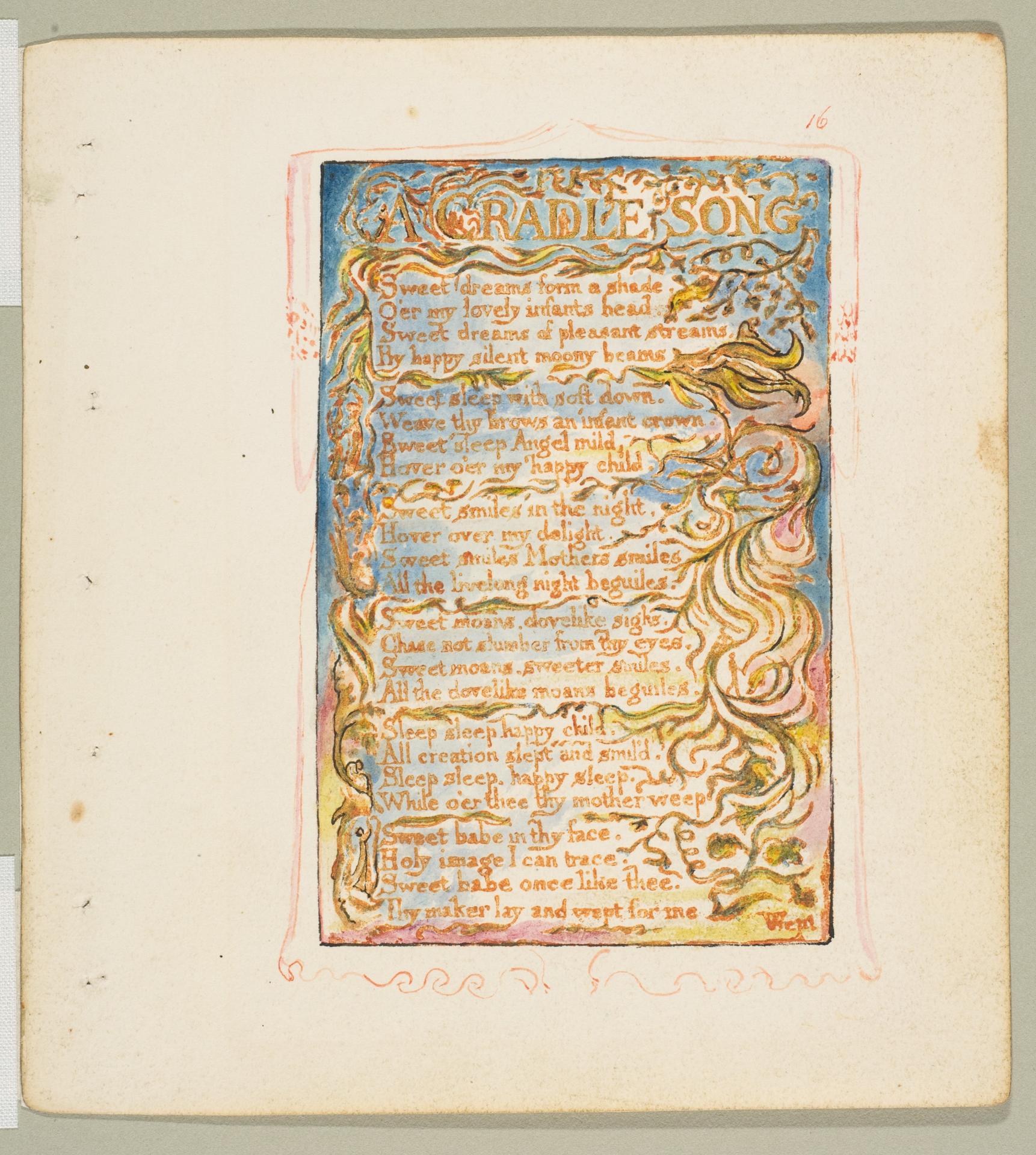
William Blake first published 'Songs of Innocence: A Cradle Song' in 1789; the sheet here comes from a printing made around 1825. A hand-colored relief etching on paper, it belongs to Blake's celebrated song collection and turns on a lullaby sung to a sleeping child.
Description
A floral ornament climbs from the lower edge of the page and curls around the poem, which is set in Blake's own distinctive lettering. Yellow, pink, blue, and green carry the coloring that spreads across the whole sheet. The number 16 appears at the upper right. The verses themselves dwell on the calm and safety of a sleeping child.
Context
This leaf belongs to the second issue of 'Songs of Innocence,' which Blake printed around 1825; the first edition had appeared in 1789, when he was developing his new relief-etching technique, which let him unite text and image on a single plate. Coloring by hand with watercolor and shell gold matched his laborious method, and it made every copy unique.
Impact
Tender lyric and decorative color meet in a quiet, almost devotional mood. The luminous floral frame draws the eye to the verses and reinforces the sheltering, maternal atmosphere of the lullaby.
Technique
For printing, Blake used the relief-etching process he had devised: the non-printing areas were etched away so that lines and letters stood proud. The sheet was printed in orange-brown, then colored by hand with watercolor and shell gold, which gives each impression its own character.
AI-generated description text
Source: Metropolitan Museum of Art · Public Domain (CC0 1.0)