Songs of Innocence: Laughing Song
Original title: Songs of Innocence: Laughing Song
kurzbeschreibung
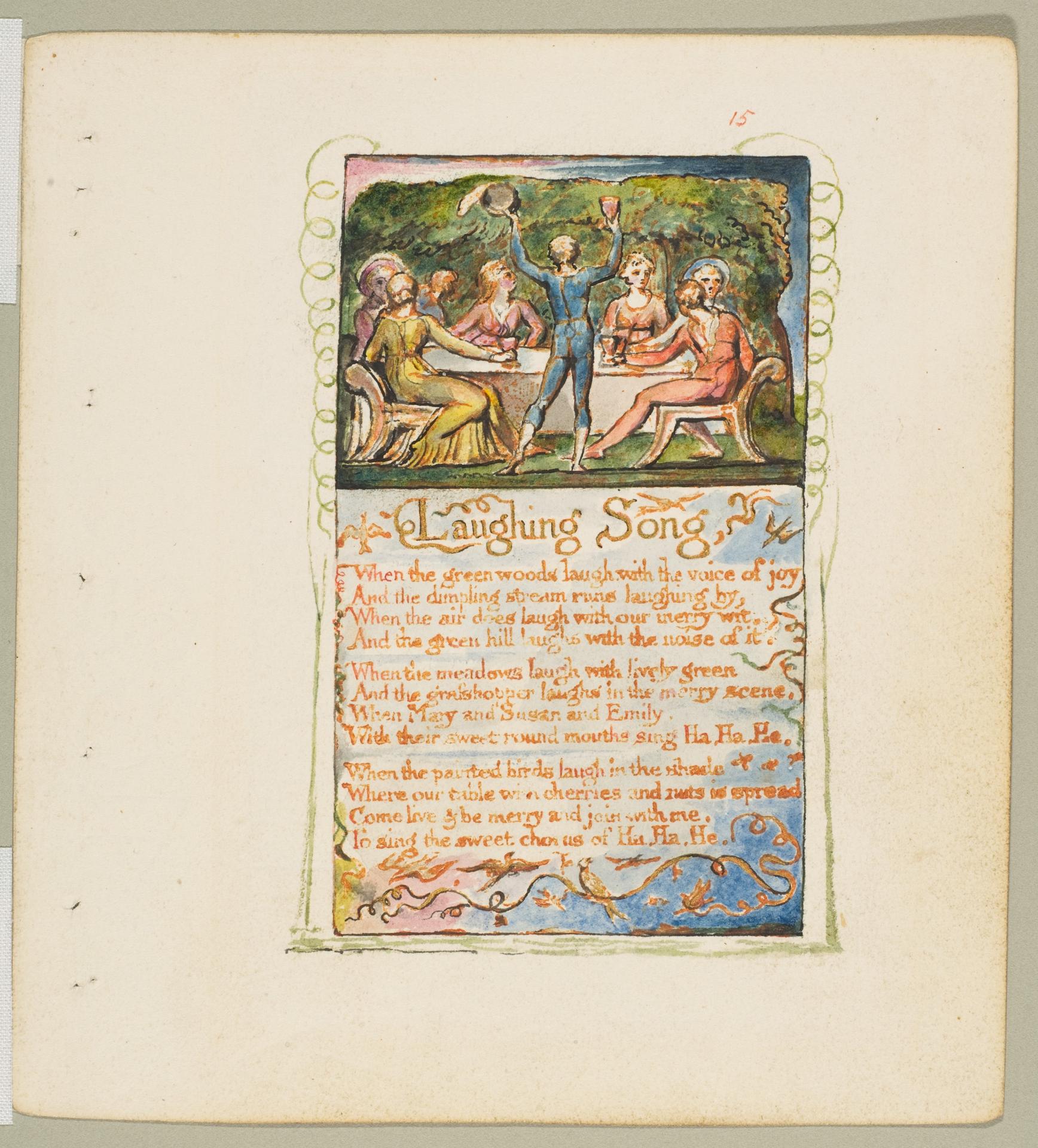
This hand-coloured print by William Blake, based on a design from 1789 and printed around 1825, shows an illustrated scene accompanying a poem. It was made by relief etching and then embellished with watercolour and gold.
Description
Several figures in historical dress have gathered around a table and appear to be in conversation. One of the men in the middle throws both arms up in a gesture that suggests celebration. Trees and bushes fill the rear area, hinting at a natural setting. The poem stands below the image in orange lettering, surrounded by floral motifs and a bird. Orange, brown and blue set the warm tonal range; light falls evenly across the whole, with no discernible shadows.
Context
William Blake first published the 'Songs of Innocence' in 1789 as part of his illuminated books, which he produced himself using a method of his own invention. The fact that the print was issued again around 1825 shows how Blake continued to revise and circulate his work over decades. 'Laughing Song' belongs to the early songs in which childlike joy and closeness to nature are sounded. With relief etching Blake chose an unusual method for his time, one that allowed text and image to be combined on a single plate.
Impact
The warmth of the tones and the balanced arrangement of the figures convey a quiet, harmonious mood that suits the poem. The eye moves back and forth between image and text, encouraged to linger, linking seeing with reading.
Technique
In relief etching the non-printing areas of the plate are removed, so that the lines appear in orange-brown on the paper. Hand-colouring with watercolours and so-called shell gold followed, bringing out the decorative character of the sheet.
AI-generated description text
Source: Metropolitan Museum of Art · Public Domain (CC0 1.0)