Songs of Innocence: Little Boy Lost
Original title: Songs of Innocence: Little Boy Lost
kurzbeschreibung
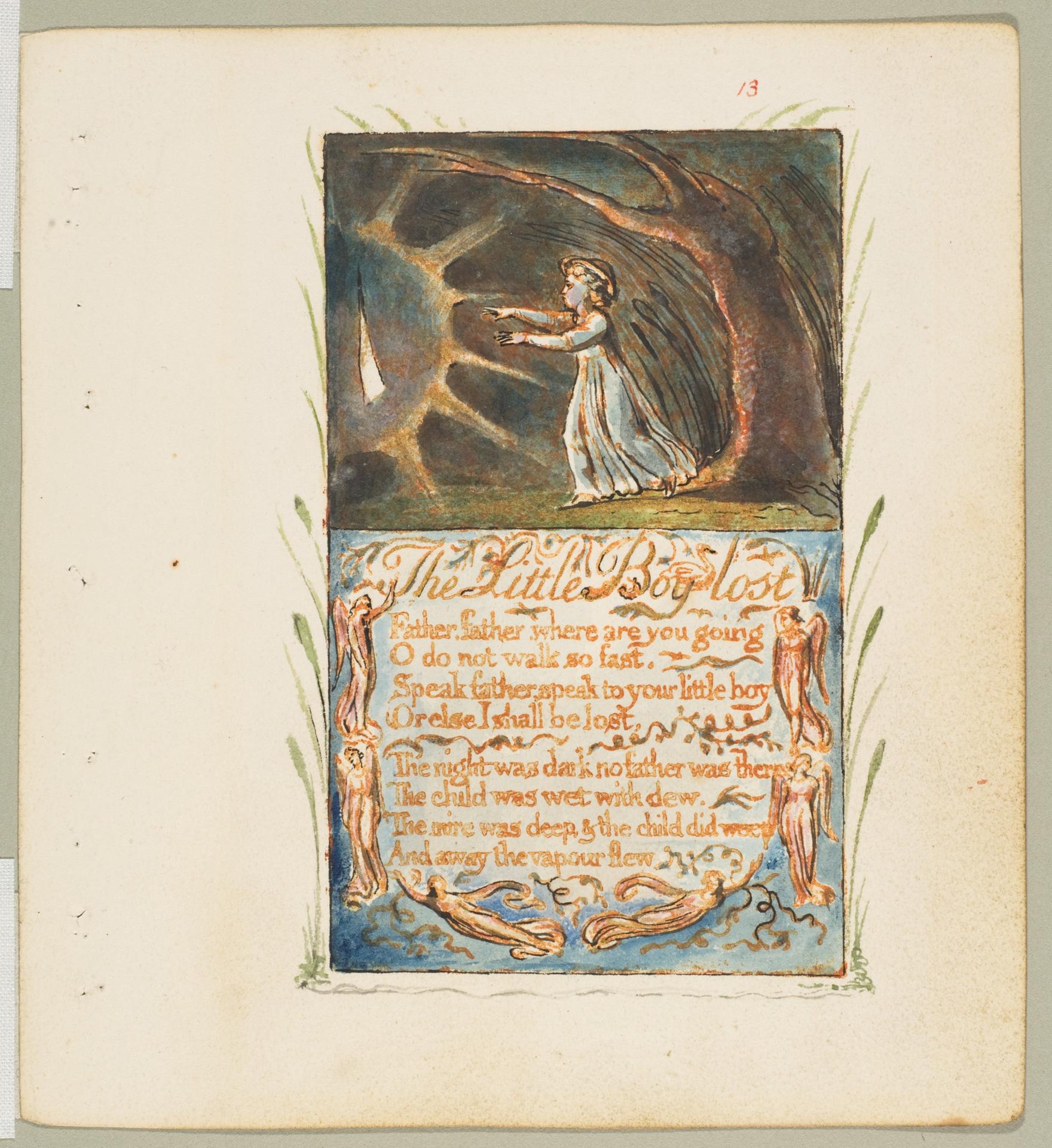
A boy in pale clothing steps toward the left through a dark, non-representational landscape, a motif taken from William Blake's Songs of Innocence. The sheet, made around 1789 and printed around 1825, combines relief etching with watercolor and shell gold applied by hand.
Description
Near the top of the page a small figure in white moves left, facing forward, arms outstretched. Around it lies a murky, abstract setting: a large sickle-shaped form that suggests moon or sun, and a nearly black area that could be forest or cave. Grass and leaves edge the bottom. Beneath this sits a text panel with the title and the English poem in orange, flanked by stylized angel- or spirit-like figures standing in a blue liquid or river. That blue sets up a sharp contrast with the orange lettering.
Context
Songs of Innocence first appeared in 1789, and Blake devised his own method of 'illuminated printing' for it, etching text and image into a copper plate and coloring the results by hand. The present later issue of about 1825 shows that he kept reprinting his works over decades, varying the colors as he went. The poem 'The Little Boy Lost' concerns a child's abandonment and belongs to a sequence about innocence and its endangerment.
Impact
The vivid orange of the printing ink meets a deep blue in the watercolor, producing an intense, almost mystical mood. The dark, abstract landscape and the ghostly figures give the sheet something puzzling and melancholy; the viewer is drawn into the lost boy's emotional world.
Technique
Printing was done by relief etching: the non-printing parts of the copper plate were etched away so that lines and letters stood up in relief. A warm orange-brown ink served as the printing color; watercolor and shell gold were added afterward, lending the work a luminous, handcrafted quality. The paper is slightly yellowed and shows signs of age typical of Blake's later prints.
AI-generated description text
Source: Metropolitan Museum of Art · Public Domain (CC0 1.0)