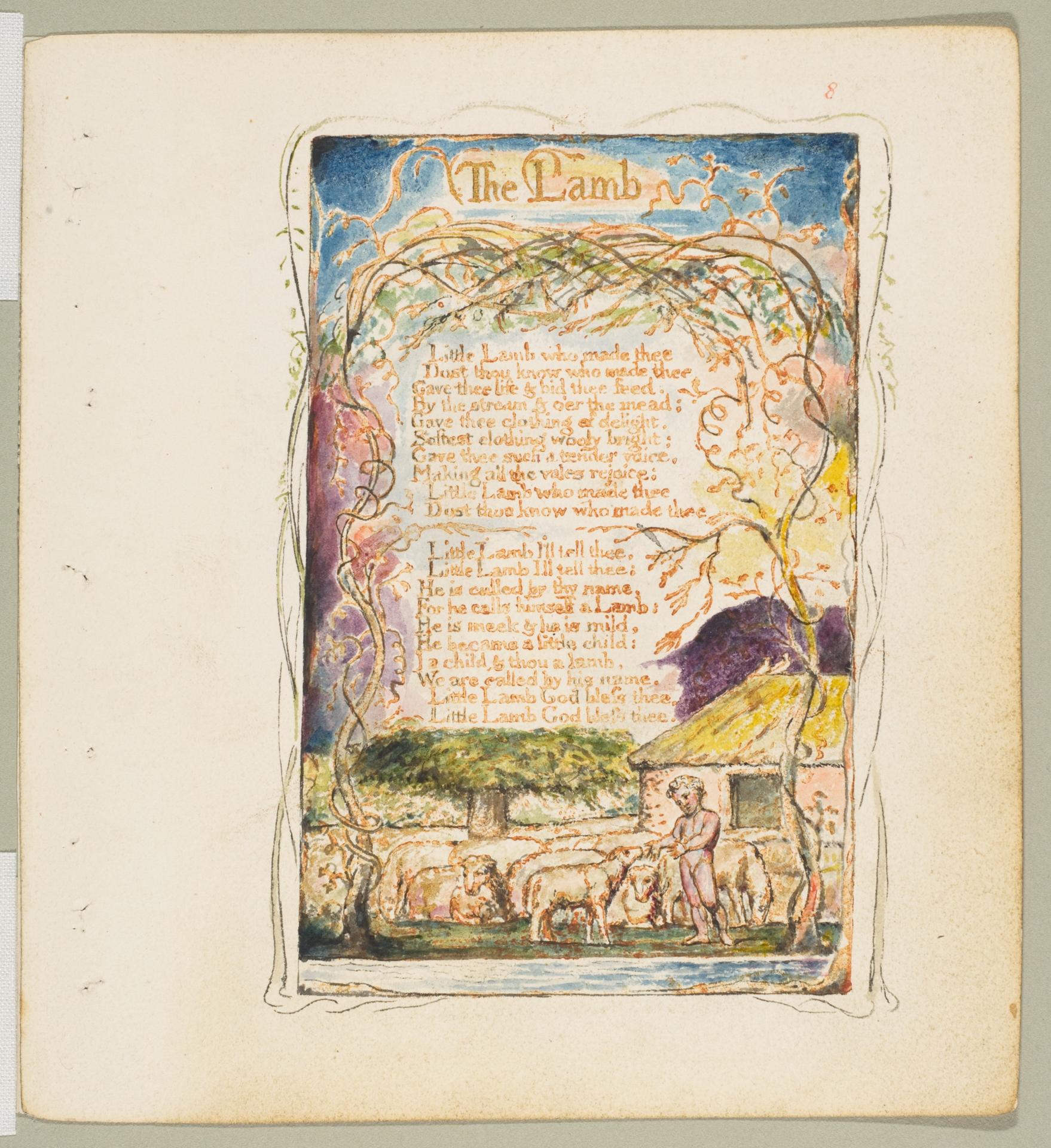
Songs of Innocence: The Lamb
Original title: Songs of Innocence: The Lamb
kurzbeschreibung
A child reaches out to stroke a sheep: this is the central motif of William Blake’s poem “The Lamb” from Songs of Innocence, first published in 1789 and printed here around 1825. The relief etching was hand-coloured with watercolour and shell gold, and shows the child among other sheep and trees.
Description
A naked child stands on a meadow at the centre of the image, one hand resting on a sheep. Several animals lie peacefully behind, while trees with vines frame the scene on the left and right; a thatched house can be made out in the distance. An ornamental border of leaves and tendrils closes the image. Warm oranges, browns, and greens dominate, intensified by the hand-colouring, while the light remains even and shadowless.
Context
William Blake first issued Songs of Innocence in 1789; the plates were made using his own relief-etching technique. This copy, from around 1825, carries later hand-colouring of the kind Blake often supplied for patrons. “The Lamb” stands in contrast to the later “The Tyger” from Songs of Experience, and treats innocence and divine creation from a Christian perspective.
Impact
The warm colours and the calm, symmetrical arrangement create an idyllic, peaceful mood. The combination of delicate hand-colouring and symbolic imagery produces a mystical atmosphere that draws the viewer into the innocent world of the child and the lamb.
Technique
For his relief etchings Blake etched both image and text areas as raised surfaces, a method he developed himself. Printing was done with orange-brown ink; afterwards the sheet was coloured by hand with watercolours and shell gold, so that each copy has its own individual character.
AI-generated description text
Source: Metropolitan Museum of Art · Public Domain (CC0 1.0)