Songs of Innocence: Introduction
Original title: Songs of Innocence: Introduction
kurzbeschreibung
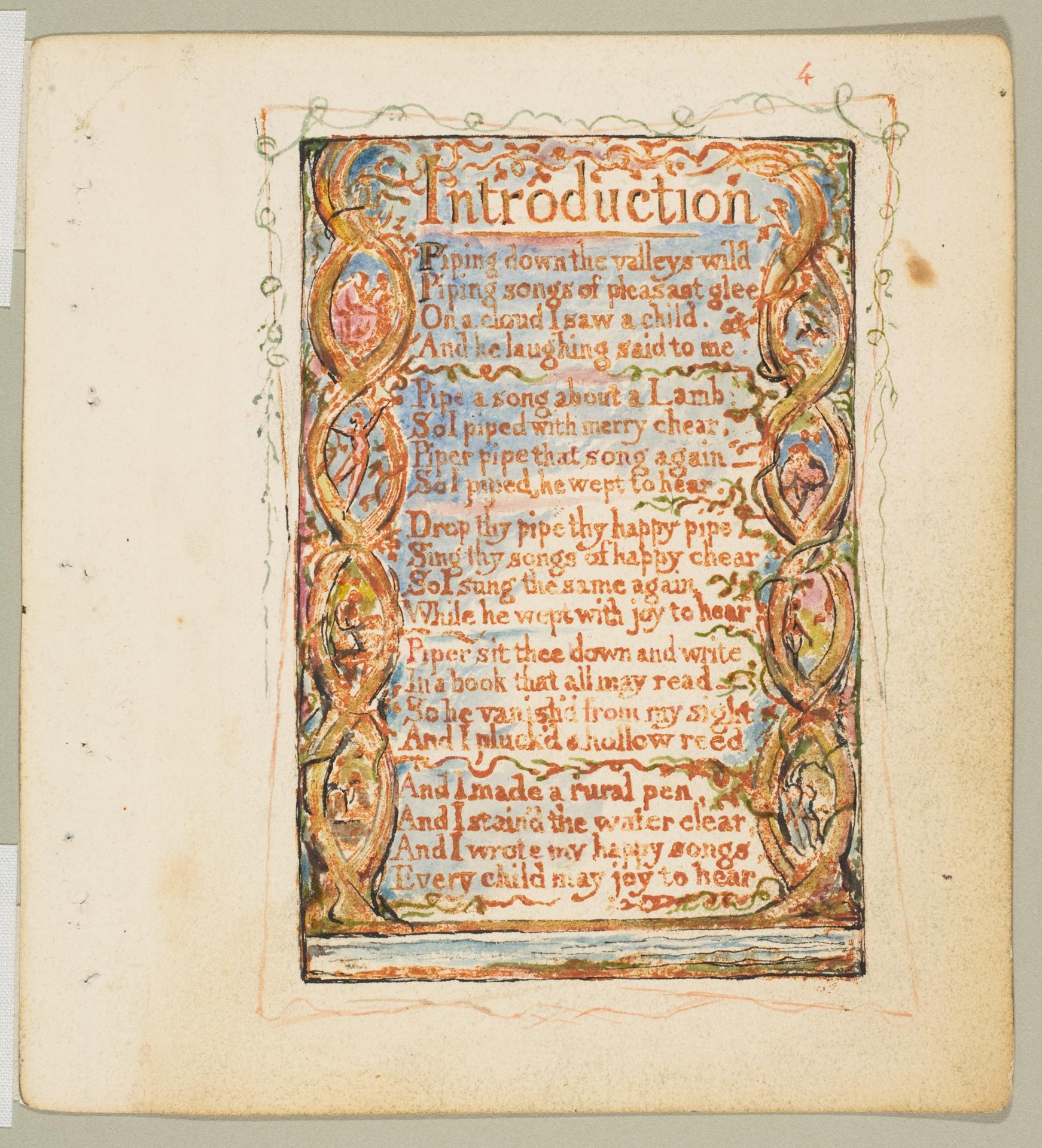
Where the other pages of the Songs of Innocence stand as individual poems, this sheet opens the cycle. Lieder der Unschuld: Einleitung was designed in 1789 and printed around 1825. Executed as a relief etching in orange-brown ink and then hand-colored with watercolor and shell gold, it presents the start of Blake's sequence of poems within an ornamental framing system.
Description
A block of text set at the center is enclosed by a border of blossoms and leaves. Strong blues, greens and oranges shape the symmetrical plant ornaments. Along the upper edge of the frame the title "Introduction" stands out. The verse lines, in an older type that looks handwritten, unfold a lyrical narrative. Light and shadow bring out the relief structure and the delicate touches of coloring.
Context
The Songs of Innocence belong to Blake's prophetic and poetic work, which he published himself as illuminated prints. Created in an age of deep social change, shaped by the French Revolution and Romantic ideals, Blake developed relief etching to join text and image in a single printing pass. The later edition of around 1825 shows that he revised and reprinted his works over decades.
Impact
Text and ornamental imagery enter a harmonious, almost meditative union. Vivid colors and the symmetrical arrangement convey a timeless, craft-like aesthetic. Blake's mystical symbolism invites the viewer to reflect on the unity of poetry and image.
Technique
For relief printing the printing lines are worked in relief while the spaces between them are etched away, a method Blake used as relief etching. Printing was done in orange-brown ink on paper; hand-coloring with watercolor and shell gold followed. In this way Blake could shape each copy individually and refine it artistically.
AI-generated description text
Source: Metropolitan Museum of Art · Public Domain (CC0 1.0)