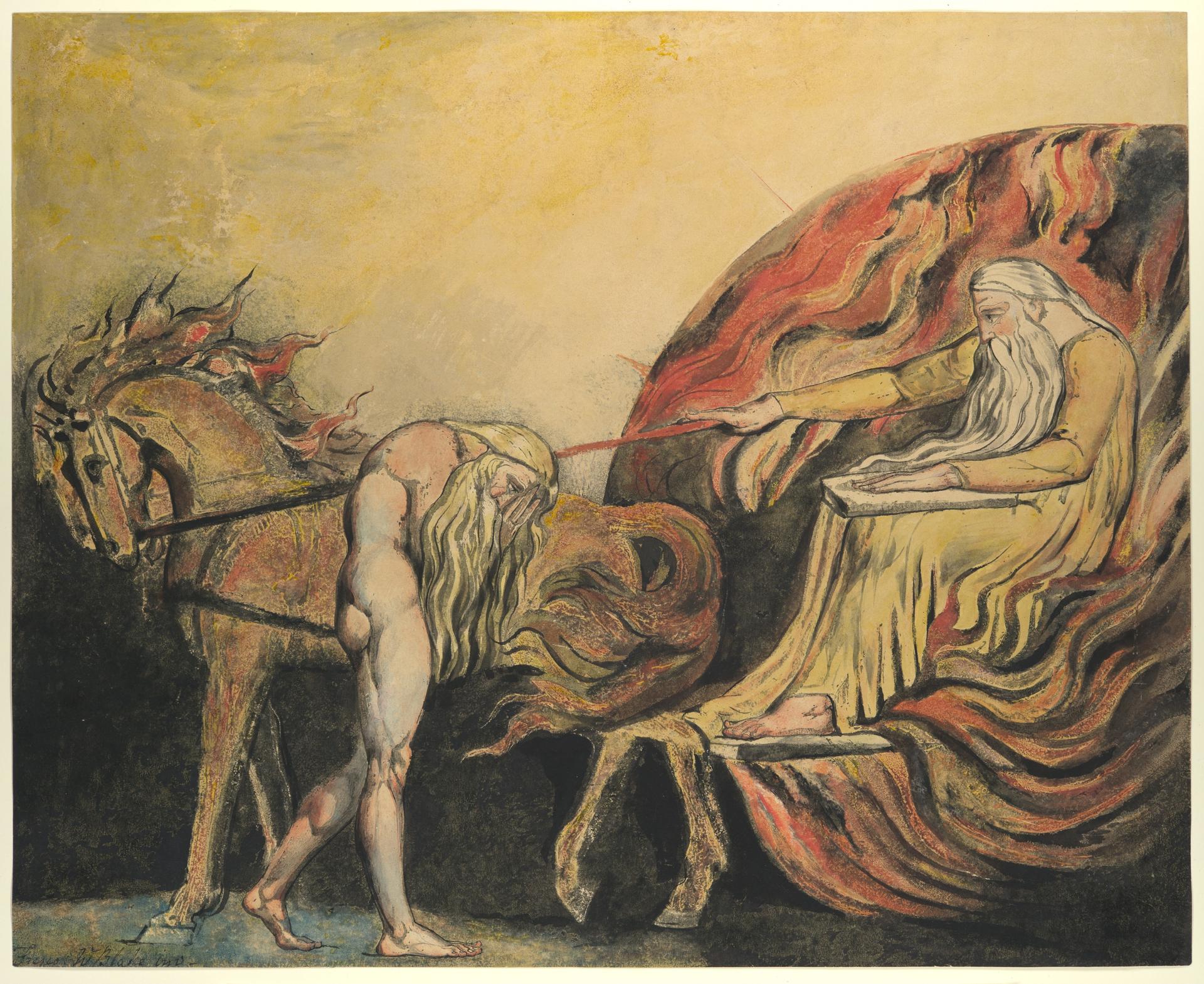
God Judging Adam
Original title: God Judging Adam
kurzbeschreibung
William Blake made this color relief etching around 1795, then reworked it with pen, ink and watercolor. It pictures the biblical moment when God confronts Adam after the Fall. Blake's idiosyncratic printing method fuses word and image into a single visionary whole.
Description
Adam dominates the foreground, barefoot and bent forward, his long hair hanging loose; the posture hints at guilt or at least at a burden he cannot put down. To the right God sits enthroned in white, a scroll in his hand, and the gesture of that hand reads like a verdict. A horse with a red mane appears behind them and may stand for fate or for accountability. Warm reds and browns, together with a muted light, draw the eye to the figures and tighten the drama.
Context
The sheet belongs to the 1790s, when Blake was producing several large prints on biblical subjects. It is one of a series of twelve images with scenes from the Old Testament. For this series Blake developed his own relief-etching technique, in which he laid acid-resistant drawings on the plate. The work forms part of his ambitious effort to publish his own books with revolutionary graphic art.
Impact
An intense, almost oppressive mood takes hold, making the weight of divine judgment palpable. Strong color and expressive figures give the image an immediate and at the same time timeless presence. Blake's scene invites reflection on guilt, responsibility and divine justice.
Technique
Blake used the technique he had developed himself, color relief etching: the drawing was etched in acid, then the plate was inked in color. Afterwards he went over the sheet with pen, ink and watercolor to refine details and color nuances. This interplay of printing and manual reworking makes every impression unique.
AI-generated description text
Source: Metropolitan Museum of Art · Public Domain (CC0 1.0)