The Complaint and the Consolation; or, Night Thoughts
Original title: The Complaint and the Consolation; or, Night Thoughts
kurzbeschreibung
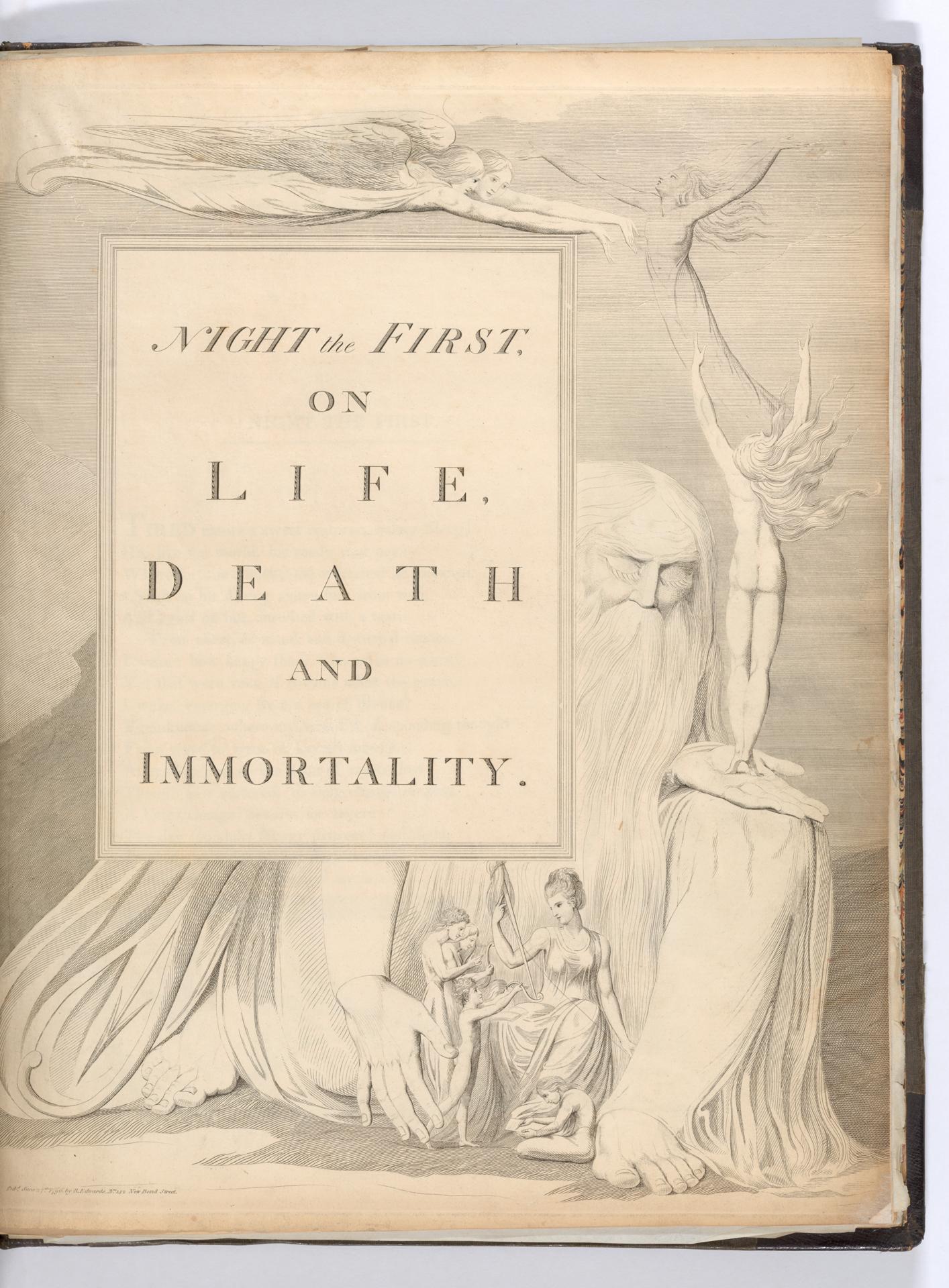
This print belongs to William Blake's series of illustrations for 'The Complaint and the Consolation; or, Night Thoughts', made in 1797. Executed as an etching with engraving, it carries the title 'NIGHT the FIRST, ON LIFE, DEATH AND IMMORTALITY'. An allegorical scene of angels and human figures plays out questions of life, death and immortality.
Description
Two angels hover at the top, wings spread, their bodies caught in flowing, restless poses. Below them an old man with a long grey beard and streaming hair sits on a pedestal, gazing upward. Beside him a woman in a long robe has taken her place; she holds a flower and also looks up. In the lower section another woman appears with a child seated on the ground, eyes raised. The layout feels symmetrical, angels above and figures below, and stays mostly in shades of grey.
Context
The illustrations were made for Edward Young's poetic cycle 'Night Thoughts', published between 1742 and 1745. The 1797 edition came out with Richard Edwards and included 43 illustrations engraved by Blake. Blake was known for his visionary art and his engagement with religious and philosophical questions. Etching and engraving were common processes at the time, and he used them for his book illustrations.
Impact
Grey tones and a diffuse light give the sheet a quiet, contemplative mood. The symmetrical arrangement and the upward gazes of the figures create a spiritual atmosphere that invites the viewer to reflect on life and death.
Technique
Etching and engraving were both used here: the drawing is etched into a metal plate. The depth of the etched areas and the subsequent printing bring out the fine lines and shading. Grey tones are typical of this printing process, which allows details to be reproduced precisely.
AI-generated description text
Source: Metropolitan Museum of Art · Public Domain (CC0 1.0)