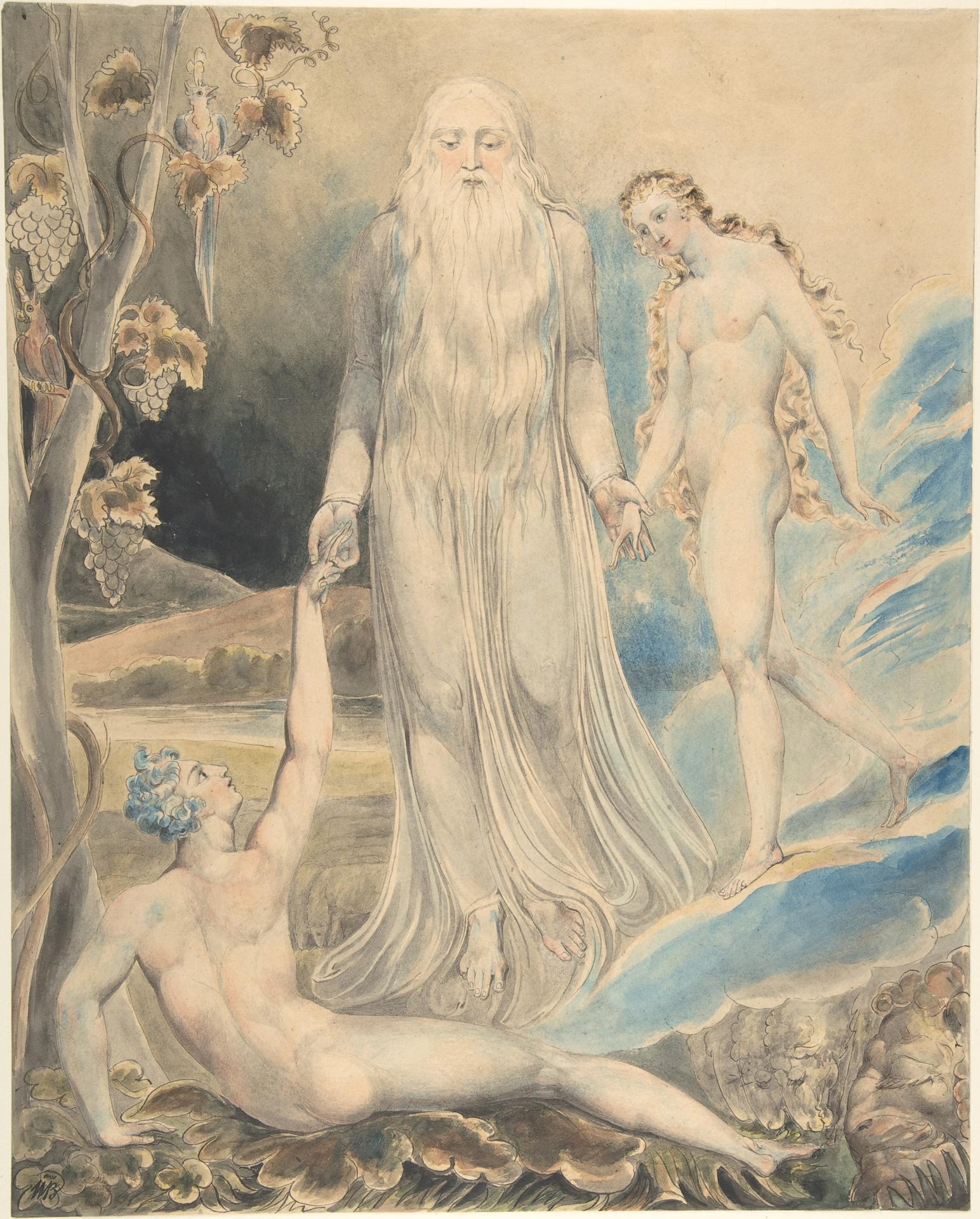
Angel of the Divine Presence Bringing Eve to Adam (The Creation of Eve: "And She Shall be Called Woman") (recto); Sketch for the same (verso)
Original title: Angel of the Divine Presence Bringing Eve to Adam (The Creation of Eve: "And She Shall be Called Woman) (recto); Sketch for the same (verso)
kurzbeschreibung
William Blake captured a biblical subject around 1803 in watercolour, pen and black ink over graphite: an angel leads Eve to Adam. The sheet shows the moment Eve is presented to Adam, set within a landscape of mystical mood.
Description
A grey-haired man with a long white beard and flowing robe holds the hand of a young woman — Eve. She stands on a bank of clouds and turns her gaze toward the old man. At her feet lies Adam, reaching out his hand to her. Stylised trees and fruits in the background suggest nature and fertility. The palette remains mostly pastel; the light is soft and diffuse, bathing the scene in a mystical atmosphere.
Context
Made around 1803, this work falls in a phase of intense artistic and poetic activity for Blake. It belongs to a series of watercolours on biblical themes that Blake produced for patrons such as Thomas Butts. Blake's interpretation of the creation story sets its own accents: he has an angel act as mediator, departing from conventional pictorial traditions — a testimony to his independent theology.
Impact
The delicate pastel tones and diffuse light give the scene something transcendent, almost dreamlike. The precise linework and detailed execution draw the eye to the fine figures and their interaction. From this arises a calm, contemplative mood.
Technique
Watercolour, pen and black ink over graphite on a sheet of 41.6 × 33.2 cm — with these means Blake achieved fine contours and subtle colour transitions. The combination of media is characteristic of his watercolour technique of those years.
AI-generated description text
Source: Metropolitan Museum of Art · Public Domain (CC0 1.0)